
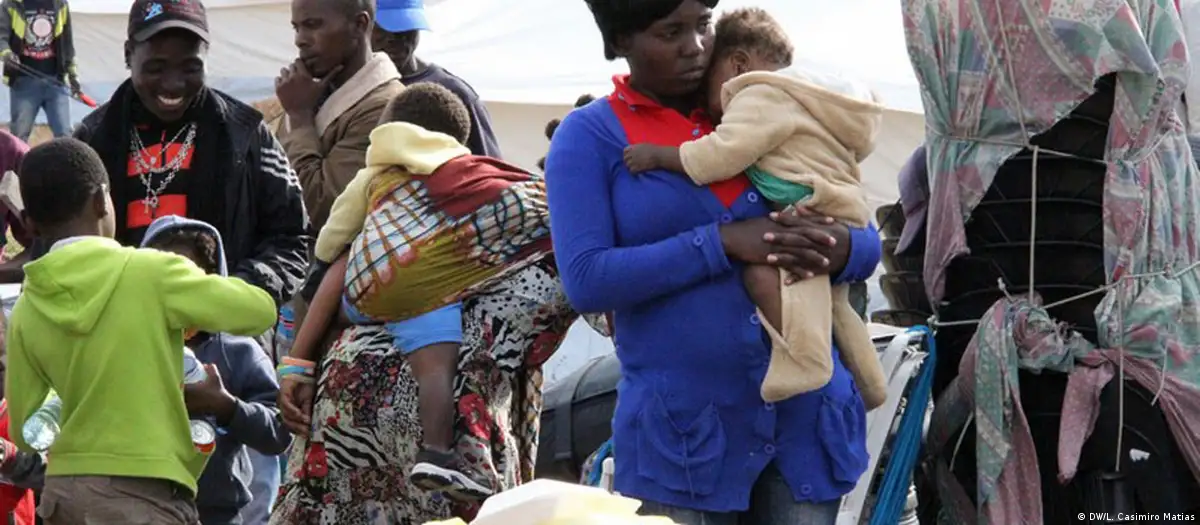
South Africa has ordered its refugee reception offices to accept new asylum applications from anyone who indicates an intention to seek protection, including people who entered the country irregularly or without valid documentation, a development that could have significant implications for thousands of Zimbabweans living across the border.
However South Africa’s Home Affairs Department has warned the move does not mean every undocumented migrant qualifies for asylum, with Acting Director-General. Thulani Mavuso, saying Zimbabweans fleeing economic hardship alone are unlikely to meet the requirements for refugee protection.
The department’s directive follows a landmark Constitutional Court judgment which struck down several provisions of the Refugees Act that had allowed asylum seekers to be screened out of the system because of irregular entry or procedural failures before their claims were considered on their merits.
In Scalabrini Centre of Cape Town and Another v Minister of Home Affairs and Others [2026] ZACC 30, handed down on July 7, 2026 the Constitutional Court confirmed that sections 4(1)(f), 4(1)(h), 4(1)(i) and 21(1B) of the Refugees Act were unconstitutional and invalid.
On this topic
The court found that the provisions operated as procedural barriers capable of excluding asylum seekers from a merits-based assessment of their claims, undermining the principle of non-refoulement, the protection against returning to a country where a person may face persecution or serious harm.
The judgment means irregular entry, lack of documentation or delays in approaching refugee offices can no longer, on their own, be used to prevent a person from accessing the asylum application process.
In a September 28, 2026 directive to all refugee reception offices, Mavuso instructed officials to immediately receive every person who reports in person and indicates an intention to apply for asylum.
This includes people who entered South Africa unlawfully, entered somewhere other than a port of entry, did not declare an intention to seek asylum when entering the country, have no visa or failed to report to a refugee reception office within five days of entering South Africa.
Refugee reception offices have also been prohibited from requiring applicants to first prove “good cause” for their irregular entry or delay before their applications can be accepted.
Those previously turned away, or whose biometrics were captured or appointments issued without an application being lodged, must also be assisted to lodge their applications.
Where an office cannot process everyone on the day, officials must record the person’s details and provide a written, dated appointment rather than simply turning them away.
South Africa currently has five refugee reception offices in Musina, Pretoria, Durban, Gqeberha and Cape Town, placing an immediate administrative burden on a system already dealing with significant backlogs.
Mavuso acknowledged the department expects to be overwhelmed.
“The bigger challenge that I want to raise around, obviously we’re going to be overwhelmed with the numbers,” said the Acting Director-General.
He said the department had already seen large numbers at the Durban refugee reception office and would have to consider longer working hours and deploying more personnel.
“We cannot obviously operate on a quota policy that prevents people from lodging the application,” Mavuso said, noting that South Africa has only five refugee reception offices.
To Zimbabweans, however, the reopening of the asylum system does not amount to a new pathway to regularise economic migration.
Mavuso said Zimbabwe had a high rejection rate for asylum applications because many applicants were found to be economic migrants rather than people fleeing persecution.
“We have a high rate of rejection of asylum applications because, as I said, it’s economic migrants,” Mavuso said to South African media.
“We have seen in the region, particularly in southern Africa, that there’s a lot of migration because of economic reasons. Unfortunately, in terms of the UNHCR, famine has not been determined as one of the causes for accepting asylum. It’s not one of the conditions you can use to determine that because people are hungry, therefore, you must consider (asylum).”
However Mavuso added: “Obviously, there’s issues now in terms of climate change that have been considered. We are going to the UNHCR Executive Committee (ExCom) plenary meeting next week. So some of those issues will be raised. So we’ll also obviously put our position on some of those issues.”
Mavuso also said this did not mean Zimbabweans or other migrants could not qualify for asylum.
South African authorities consider individual circumstances, including evidence of political persecution, imprisonment or other threats that make it unsafe for an applicant to return home.
Mavuso gave the example of Zimbabweans involved in political formations who could demonstrate they had been targeted because of their political views.
“We do have those cases where people are able to indicate, and there’s evidence sometimes even on social media about them participating in issues relating to political formations in terms of wanting change, wanting more democracy to prevail,” he said.
He said some applicants had been imprisoned and could provide evidence that they had been persecuted or arrested because of their political views.
Such evidence can be important in establishing that a person cannot safely be returned to Zimbabwe.
The distinction is critical for Zimbabweans who may interpret the Constitutional Court judgment as an opportunity to obtain an asylum document simply because they are undocumented or struggling economically.
Mavuso said South Africa is required to apply the principle of non-refoulement, meaning a person claiming protection must first be brought into the asylum process before a decision is made on whether they qualify.
“We need to first include them in the process before excluding them,” he said.
However inclusion in the process is not the same as acceptance of a claim.
Applications are subjected to assessment, including interviews and consideration of evidence and country-of-origin information. South Africa profiles conditions in applicants’ countries to assist refugee status determination officers in assessing individual claims.
“Some of us who live in those who are genuinely seeking asylum, some of them will find that they do not even have a travel document,” Mavuso said, explaining that authorities may have to conduct extensive interviews to establish the facts surrounding an applicant’s claim.
He said claims must ultimately be supported by credible evidence.
“The word that the person gives you ought to be at some point backed by tangible evidence that is credible for us to be able to grant that status,” he said.
South Africa’s Constitutional Court did not declare that anyone who enters South Africa irregularly is entitled to refugee status.
Rather, the court found that immigration-related procedural failures cannot be used to shut a person out of the asylum process before their claim has been assessed on its merits.
The court specifically held the previous provisions were inconsistent with non-refoulement because a person may substantively qualify for refugee protection even before being formally recognised as a refugee.
Mavuso said the Home Affairs Department must therefore accept an application and assess the substance of the claim rather than requiring an applicant to first justify irregular entry.
“There’s no longer a need for that good cause letter,” he said.
“We just have to accept the reasons in the application for asylum. And then obviously that will be adjudicated in that manner.”
The change has also removed the requirement for an asylum seeker to first obtain an asylum transit visa as a condition of applying.
However, the department is simultaneously working on reforms intended to strengthen immigration control.
Mavuso said South Africa was developing legislation around a proposed “first safe country” principle, under which people who have passed through other safe countries before reaching South Africa could face additional scrutiny.
He said the department was already at an advanced stage in drafting legislation and had researched how the principle could be implemented.
To Zimbabweans considering applying for asylum, Secretary of the African Diaspora Forum (ADF) and chairperson of the Zimbabwe Community in South Africa, Ngqabutho Nicholas Mabhena, urged caution.
In an interview with CITE, Mabhena said he had visited the Desmond Tutu Refugee Reception Centre in Pretoria on Tuesday with other migrant community leaders to observe how applications were processed following the Home Affairs directive.
He said officials were receiving applicants but stressed Zimbabweans should not rush to refugee offices simply because the process had reopened.
“It is important to get professional advice before you rush to apply for an asylum document,” Mabhena said.
He warned an application could initially result in an asylum document but later be cancelled if authorities determined that the claim was unfounded.
“If you just rush, you might be given an asylum document. After review, say in three or six months, your asylum document might be cancelled on the basis that your claim is unfounded,” Mabhena said.
Mabhena said migrant community organisations were planning engagements with migrant leaders to explain what prospective applicants should know before approaching refugee offices.
“We do not want ourselves to see people coming here to flood,” he said.
“Only those that are being qualified should visit these premises.”
The Constitutional Court ruling has therefore created an important shift for people who may previously have been denied access to the asylum system because of how or when they entered South Africa.







Leave a Reply