
By Zenzele Ndebele
When humanity meets hostility
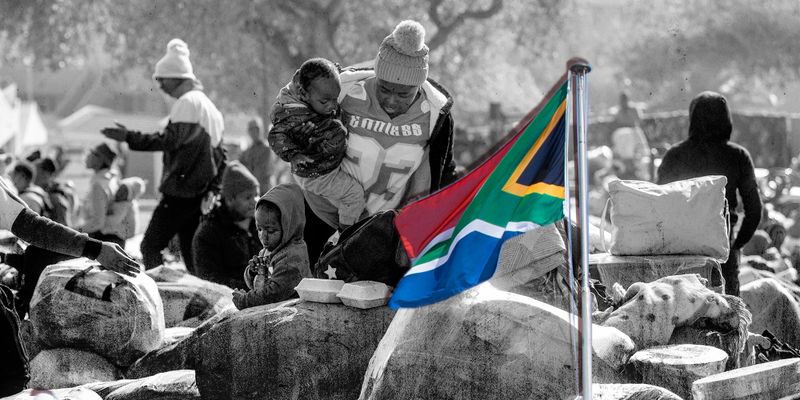
A video that circulated widely on social networks shows a young woman, presumably a Malawian, a baby strapped to her back, shuffling through a crowd of fellow immigrants as they are processed at an immigration repatriation centre, in an exchange with two men speaking in Zulu. The men, who are clearly flirting, are not shown. One of the men says, “Siyahamba angithi tshomi wami?” (Are we going, my friend?), to which the young woman replies with an infectious, almost defeated smile, “I don’t know how to speak Zulu”.
With more familiarity, one of the men confidently responds with chuckles, “Ah unamanga hehehe kadu skhuluma nje” (You are joking, you were just speaking in Zulu). The other man interjects, “Kade siskhuluma nawi zolo wooo wenu sile wena” (we were speaking it/Zulu with you yesterday … you are very naughty). As she begins to warm up, the woman playfully promises the two unlikely suitors that she will return next year, presumably to meet them.
On this topic
If there were no audio, one might be forgiven for thinking they were listening to a typical courtship between South African men and a foreign woman.
But the images of the crowded centre and the woman’s rather dejected countenance tell the sad story. These scenes are playing out across South Africa. But most of them have shown hostile interactions between immigrants and angry local mobs hurling expletives and even dispensing violence.
Yet I found this video more unnerving.
Two members of the violent vigilante groups casually flirting with one of the victims of their violent movement does not illustrate that we are all human after all. It demonstrates how deeply many of the perpetrators of Afrophobic violence in South Africa are oblivious to the level of inhumanity, hate and hurt that their actions represent. For them, vigilantism is a means to an end; it will rid South Africa of African migrants from poor countries, free many jobs for South Africans and clean the streets of drugs and violent crime.
Vigilantism is not immigration policy
But vigilantism will not work. Besides being unlawful and dangerous, the calls by the anti-migrant movements like March and March, for undocumented foreigners to leave South Africa by 30 June, have damaged South Africa’s regional and international standing beyond measure. While recent social media exchanges between soccer fans from other African countries and South Africans can be explained away as humour and banter, they indicate the growing indignation towards South Africa across the continent.
More worryingly, the State seems to either have lost control or become a somewhat grumpy babysitter of marauding gangs molesting foreigners and suspected foreigners on South African streets, asking for identity documents and sometimes meting out instant justice.
Perhaps there is a fear of a possible violent confrontation if police try to disrupt some of these activities. Its agency seems limited to what, at best, are poorly coordinated responses to some of the senseless activities and statements by the leaders of the vigilantes, such as Phakelumthakathi Ndabandaba, Ngizwe Mchunu and Jacinta Zuma-Ngobese. South Africa’s establishment media has fared worse. Not content with spectating, it has successfully created captivating media spectacles from some of the events, with the three protagonists given acres of space to spout virulent, if incoherent rhetoric, which has fired up gullible members of the public.
President Ramaphosa has repeatedly proclaimed that immigration enforcement is the work of the State, not private groups. He has also pronounced, perhaps ad nauseam, that no ordinary individual can demand identity papers or proof of nationality from another. The acting Minister of Police, Firoz Cachalia, has also reiterated the same messages, although without much conviction. The government has also repeatedly warned that violence, intimidation and xenophobia will not be tolerated. Adding his own voice, the ANC’s Secretary-General, Fikile Mbalula, went so far as describing those behind the wave of vigilantism as unpatriotic and working against the interests of South Africa.
But anti-African migrant violence and rhetoric have worsened despite the repeated warnings and assurances. Out of fear, several African governments have been repatriating citizens, with Ghana notably acting when the first wave of violence hit migrant communities. Ghana and other African states’ reaction indicates their lack of confidence in South Africa’s ability and willingness to contain the situation.
Worst timing for besieged SA
This is also a bad time for South Africa to look unstable and inhospitable. It has dispatched envoys and diplomats to neighbouring countries to contain a brewing regional fallout, which it doesn’t need, as it faces battles on many fronts.
Chief among these battles is Pretoria’s diplomatic tiff with the second Trump administration. Since around February last year, South Africa has been under pressure from Washington after Trump’s repeated false claims of a “white genocide” in South Africa. Not that anyone believed Trump’s claims. In fact, it was clear from the time he assumed his second presidency that Trump was spoiling for a fight with South Africa because Ramaphosa’s administration had adopted positions that contradicted Washington’s interests in its foreign policy. Among these was Pretoria’s case against Israel at the International Court of Justice, over Israel’s prosecution of its war in Gaza.
Reuters’ fact checker, for instance, found no evidence for the genocide claim. Many others, including scholars, journalists, international human rights lawyers and activists also found the claims contemptuous at best. Reuters and many other groups also showed that Trump used images of massacres in the eastern Congo as supposed proof of killings in South Africa, indicating that the country was under a coordinated campaign to discredit and condemn it. Undeterred, Washington escalated. It cut nearly all aid to South Africa, and also expelled the South Africa’s ambassador. It also doubled down on the claims of genocide and offered refugee status to white Afrikaners. Though in fewer numbers than anticipated, many white Afrikaners visibly accepted the offer.
A country under this kind of pressure does not need vigilante politics to add further damage to its image.
Separating the facts from the fear
South Africa does have a migration issue, but the facts are more complex than the slogans. According to Statistics South Africa, Census 2022 counted more than 2.4 million international migrants, just under four percent of the population. A later Stats SA survey put the number at about 3.1 million, still only around 5.1 percent of the population.
Stats SA says migration into South Africa is mainly regional, with Zimbabwe and Mozambique as the main countries of origin since 1996. The point is not that migration is trivial; it is that South Africa is dealing with normal, long-running regional mobility inside Southern Africa, not an invasion, as suggested by the likes of Phakelumthakathi, Ngizwe and Jacinta.
Such statistics do not, of course, quell the public mood. According to the Human Sciences Research Council, in 2025, only 15 percent of South Africans said they would welcome all foreigners, while 42 percent said they would welcome none. Afrobarometer found that 69 percent thought immigrants had a negative economic effect and 85 percent wanted refugee entry reduced or stopped altogether. These attitudes help explain why groups like March and March have garnered a groundswell of support, although they do not prove that such groups are right.
Similarly, research-based evidence from the World Bank and other organisations, including news agencies such as Reuters, does not support many of the wild claims about jobs and crime. Not only are migrants not driving national crime, but many offences linked to foreign nationals are immigration offences. Furthermore, World Bank studies indicate that migrant workers generate local jobs, in part by spending money, starting businesses, and creating demand. South Africa’s own migration profile states that migrants are part of the labour market and that Gauteng and the Western Cape attract large numbers of employed migrants.
But anti-migrant narratives find fertile ground
It is easy, in the face of this evidence, to scream ‘mob psychology’!
However, the reality is that South Africa itself is under strain. Unemployment, which has been rising gradually over the past decade, has become severe, especially among younger demographics. Weak service delivery, poor infrastructure, corruption and general state failure for many citizens have compounded these problems. Many communities, whether big cities or villages, experience chronic water shortages. Many reports indicate some of these shortages are a result of a network of corruption involving local government officials and companies with tenders to deliver water bowsers to stricken communities. Roads in some municipalities are so potholed that users joke they are driving in Zimbabwe.
Migrants have, unsurprisingly, been blamed for some of the problems behind service delivery. Hospitals have been a major target for anti-migrant groups even before the current wave. As South Africa struggles to meet its citizens’ health needs, many groups have campaigned vigorously to prevent all foreigners from accessing public health facilities. In 2022, Phophi Ramathuba (then Health MEC in Limpopo Province; she is now the Premier) caused controversy when a video appeared in which she scolded an ill Zimbabwean woman who was lying in a hospital bed for “killing” South Africa’s health system. The current Minister of Health, Aaron Motsoaledi, has also occasionally expressed disquiet on foreign nationals receiving public health medical care in South Africa. Both Ramathuba and Motsoaledi are trained medical doctors and leading politicians. Their rhetoric mirrors and amplifies many utterances in South Africa which frame migrants as the cause of crime, disorder and pressure on strained services. Many communities are therefore led to believe in the removal of migrants as a quick fix for frustrating state failures.
Global hostility on migration
What is happening in South Africa is not unique. It is part of a wider global turn in which migration is increasingly blamed for a host of state failures, including poor economic performance, crumbling service delivery and crime. The politics around migration has also been popularised by the Trump administration’s aggressive immigration crackdown, which sometimes does not discriminate between legal and illegal foreigners. Some in the current anti-migration debate in South Africa have also called for all African foreign nationals to leave, regardless of status.
Across Europe, there has been a rise of openly right-wing anti-migrant parties in countries like the Netherlands, Sweden and the UK. The UK’s Prime Minister resigned last week after his party lost many local government seats to Reform UK, a right-wing entity which was previously seen as a joke. The successes of these parties have led to a serious crackdown on migrants.
Zimbabwe must own up
It is easy to pile the blame on South Africa and call out the ugly xenophobic marches that have played out in the media and on social media, but Zimbabweans need to speak honestly about why so many are leaving. A recent Afrobarometer found that 58 percent of Zimbabweans had considered emigrating, and that those with post-secondary education were especially likely to do so if given the chance. The main reason was work opportunities. South Africa was the top destination, followed by Europe and North America. Afrobarometer also reiterated that young and highly educated Zimbabweans were especially likely to consider leaving.
Stats SA says Zimbabwe has been one of the main source countries for migrants into South Africa for decades. IOM data show Zimbabwean migrants in South Africa working in retail, engineering and construction, and domestic work. In Botswana, IOM says Zimbabweans account for 50.5 percent of the migrant population. Needless to say, many of these Zimbabwean migrants have been pushed by the unprecedented levels of state failure in Zimbabwe over the past two decades.
In 2008, Zimbabwe’s crisis became so bad that South Africa created the Zimbabwe Exemption Permit (popularly known as ZEP). This special visa arrangement allowed Zimbabwean nationals to live, work, and study in South Africa legally. The ZEP was designed to ease economic pressure on Zimbabwe, while the country worked out the political problems behind its crisis. Nearly two decades later, the crisis has deepened. Zimbabwe’s economy has been completely informalised. Industries that were once the pride of southern Africa have all but collapsed, resulting in one of the world’s highest unemployment rates.
Zimbabwe is not an isolated case. Botswana and Namibia, citizens of many countries in southern Africa, east Africa and West Africa flock to South Africa in search of economic opportunities they cannot find back home. The underlying cause is deep-seated state failure in these countries, such that decades after independence, the capacity to provide a decent life for citizens has diminished.





Leave a Reply