
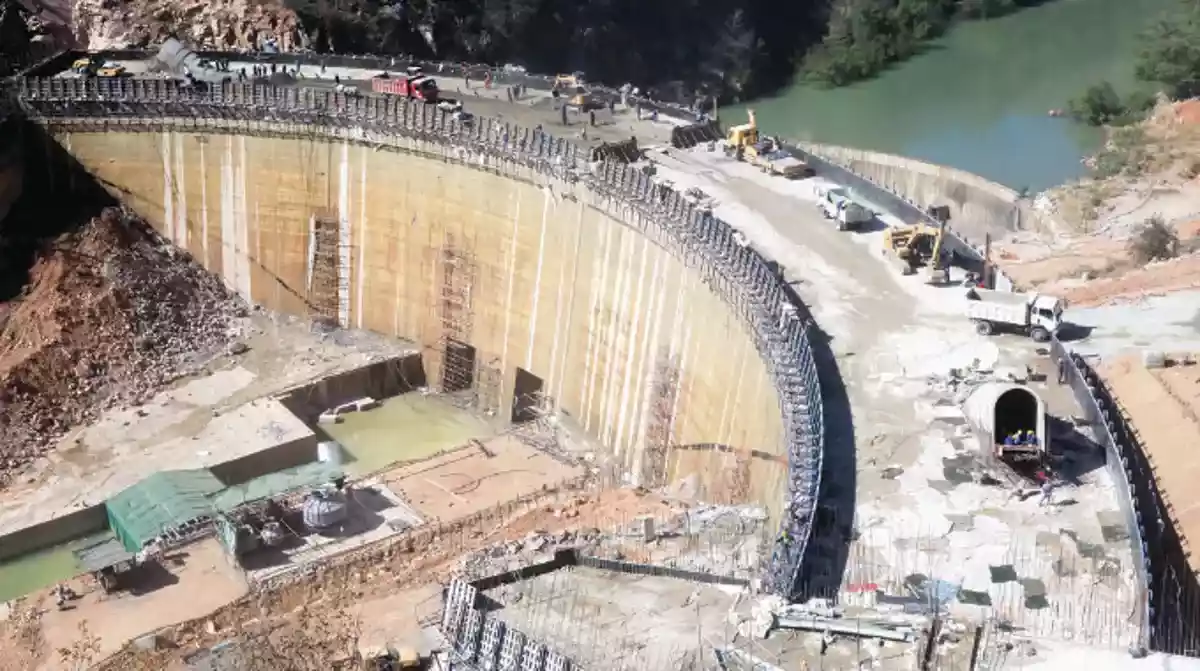
Lubimbi villagers in Binga’s Ward 20 say they have been left without clear information about their impending relocation and compensation as construction of the Gwayi-Shangani Dam nears completion.
The villagers say they do not know how many households will be relocated, when the move will take place, what compensation they will receive or whether basic services will be available at the proposed resettlement area.
Their concerns come as the Gwayi-Shangani Planning Area Master Plan, prepared by the Department of Spatial Planning and Development in Matabeleland North in May 2026, identifies Ward 20 as one of the areas likely to be affected by the dam.
The Master Plan says rising water levels in the reservoir, planned recreational parks, irrigation schemes and new settlements will result in the displacement of households.
On this topic
According to the document, about 420 households are likely to be directly affected, mainly because of rising flood levels. Another section puts the number of households highly likely to be affected at about 402, following physical surveys conducted by the Zimbabwe National Water Authority (ZINWA) and the Zimbabwe Parks and Wildlife Management Authority (ZimParks).
The figures cover the wider Gwayi-Shangani Planning Area and do not specify how many households in Ward 20 will be relocated.
“Further relocation of households from around the dam area is envisaged to pave way for other developments and conservation activities,” the Master Plan says.
It adds that the dam will alter settlement patterns in the planning area, with new settlements expected to accommodate relocated people.
Under its findings on “Displacement and Resettlement”, the Master Plan says flooding from the dam, the establishment of recreational park boundaries, irrigation schemes and a new town will all contribute to the displacement of households.
“Most of the households will be resettled at Nakanono resettlement area,” the document says.
The plan does not state when Nakanono will be ready, how much land will be allocated to each family or what housing, agricultural land and other amenities will be provided.
It also says about 7.5km of the Gwayi-Lubimbi road, together with the Shangani bridge crossing to Lubimbi, will be submerged once the dam is impounded.
“About 7.5 kilometres of the Gwayi-Lubimbi road, together with the Shangani bridge crossing to Lubimbi, are expected to go underwater once the dam is impounded.”
Lubimbi Primary School is also identified as infrastructure that will be submerged by the dam.
The Master Plan further identifies Ward 20 as having potential for agricultural development, including two proposed 200-hectare irrigation blocks.
The issues were discussed during a community meeting hosted by the Zimbabwe Resilience Network in partnership with Basilwizi Trust, with financial support from ActionAid Zimbabwe, to unpack the Master Plan with villagers.
Lwazilwenkosi Tshuma said villagers were concerned that the number of affected households recorded in the Master Plan was inaccurate.
“The challenge that we are facing as the community of Chinbone and Lubimbi 2 is that the Master plan captured the wrong information of households. We spoke of 500 and something but it captured 400 and something and they bunched us together with other two districts so we don’t know specifically our own household, so we need to know how many households are affected in our area and where they are moving to,” she said.
Tshuma said villagers had not been shown what was being done at Nakanono to prepare for their arrival.
“It is written Nakanono but so far there is no one who came to take us there clear the land for a school, road or clinic or to tell us how our children will survive there, we dont know anything but it is written in the master plan that the dam is almost complete.”
She said the uncertainty had left villagers unsure whether they should start preparing to leave.
“Should we claim that area or we keep quiet and wait for them since they know there is something happening at the dam.”
Tshuma said the community wanted a larger resettlement area because villagers depended heavily on agriculture, fishing and livestock.
“Our plea is that in terms of households, we are not few, many people are affected by the dam so they should understand us and they place where they are relocating us to should be huge so that we are able to farm, have gardens because where we are staying we are growing vegetables for selling, doing fishing business, thus how we are surviving.”
She added that grazing land would also be needed for livestock.
“All those issues affect us when we are reading this writen master plan,” said Tshuma.
Another villager, Ane Ncube, said the community had previously engaged their Member of Parliament, Mxolisi, and asked him to take their concerns to Parliament, but they had not received feedback.
“Up to now he hasn’t come back to use. We went to Nakanono, we got to where there is a borehole, we viewed the place, we were satisfied that the place is good. The Bulawayo team returned to Bulawayo and we came back home, since then nothing happed,” she said.
“We don’t know if the MP is still on his way to give us feedback,” said Ncube.
Chrispen Munkuli said there were inconsistencies in the information being provided to the community.
“There is inconsistence of information, what we know is there is 510 households and if the master plan is saying 420 for all the three districts then the information needs to be corrected. This document was published in May 2026 but the information we have was gathered before May 2026,” he said.
Munkuli said villagers had not been informed about compensation.
“This document doesn’t have all the information, it appears they are trying to hide some information from us. We are not aware how much our relocation will cost and the dam wall is about to be completed soon.”
“We want our own relocation budget as Lubimbi, it should not include other districts,” he said.
He said the relocation process should move at the same pace as dam construction.
“We want the relocation and the progression of the dam wall to move concurrently,” he said.
Limon Simon, another villager who said he had previously worked on dam construction projects including Tugwi-Mukosi and Bubi-Lupane dams, said the situation in Lubimbi was different from his previous experiences.
“What I am seeing here is totally different, up to now people don’t know where they are going but in other areas they were compensated even before the dam wall was completed,” he said.
“This dam is almost complete, its only 2metres which is out standing. What is preventing from closing the outlets is that they are constructing tanks and pipeline to Bulawayo,” he said.
Simon said villagers affected by the Tugwi-Mukosi project had been compensated and relocated, including the relocation of graves.
“They were compensated, this side they are not telling us what plans they have for us. If only the government compensated us, we could have left long back. The reason why we are here is because the government hasn’t compensated us,” he said.
Ward 20 councillor Jealous Mpande called on the Department of Lands to show villagers where they would be relocated.
“Also what we wrote in the position paper should be captured as it is because we are on the ground. The dam affects all Lubimbi people, they should come and give us feedback on the process of relocation,” Clr Mpande said.
Another villager, Shadreck Ncube, said the Master Plan stated that traditional leaders had been consulted and urged villagers to use existing leadership structures to push their concerns.
Bigboy Ncube called for a fresh enumeration of affected households.
“If possible, we should do recounting,” he said.
Ncube said villagers should by now have detailed information on the different categories of people affected by the project.
“The master plan has five groups of people who are going to submerge in water. Some are directly affected and these will lose land and infrastructure. There are those who are indirectly affected due to the lake and park. Some will be affected by loosing social amenities such as clinics, roads. By now we should be having those figures on those directly and indirectly affected but up to now they are quiet about it,” said Ncube.
Chief Kavula said the uncertainty surrounding the relocation had caused him distress as the traditional leader responsible for the affected communities.
“I am appealing to the government to remember me. May all the stakeholder come to ward 20 and assist me explain to the villagers where they are going, they are crying every day,” he said.
“They don’t know where they are going but they are happy that the dam will come with some positives and gains but I have to reiterate that they dont know where they are going. Please assist me on that one,” said Chief Kavula.
He said villagers continued building homes despite the uncertainty because they had not been given clear instructions on when and where they would move.
“I am appealing to the government to assist us on that because even though I have a distance but my surbodinates are affected And we wish the response can be soon as our ancestors might end up turning their backs on us as we continue to cry,” said Chief Kavula.
“The villagers wrote a position paper saying they want to go to Nakanono before I was a Chief, now I have been installed and people still dont know what is happening at Nakanono.”
Chief Kavula said the community had previously lived in the area now proposed for resettlement before being moved to make way for a cold storage facility.
“Their parents graves are still that side so they are being taken back but the cold storage wasnt for the blacks, it was for the whites, so I dont know what is going on that side, please assist me on that one before villagers submerge in water, the government isnt like that, he assists people so please assist me,” said Chief Kavula.






Leave a Reply