
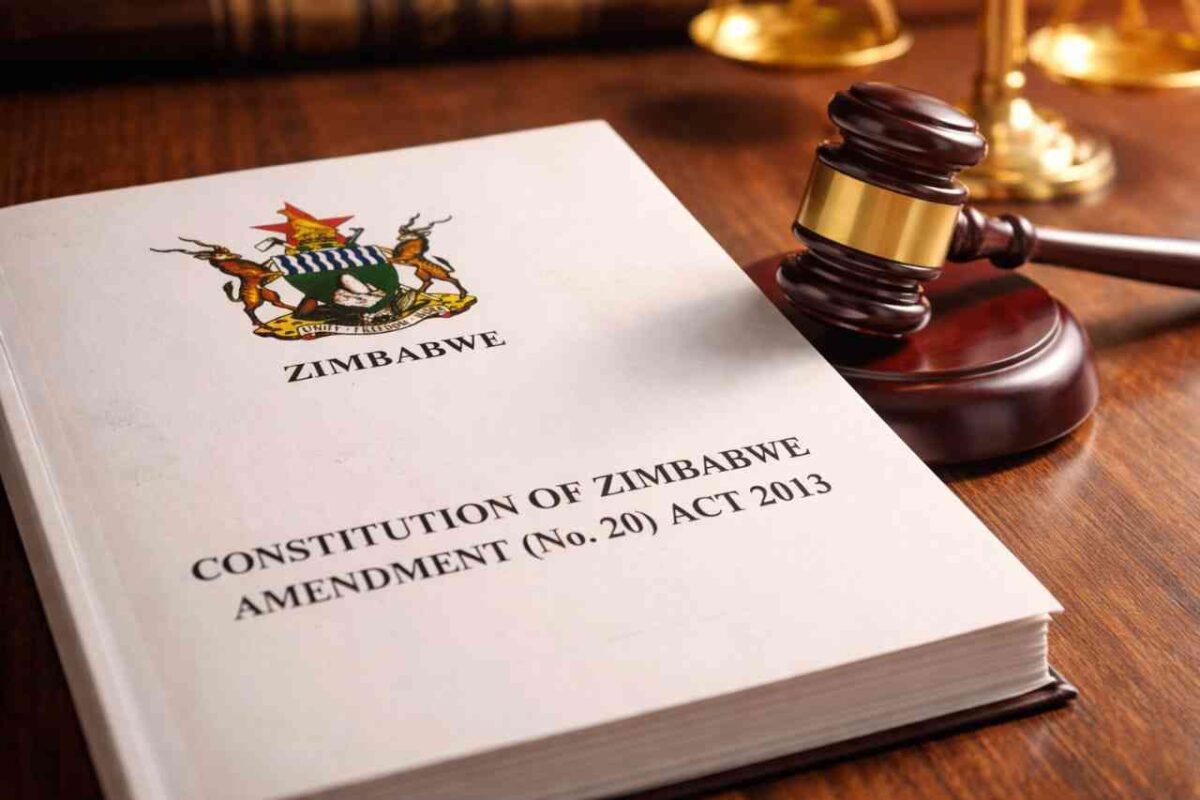
Human rights lawyer Douglas Coltart has argued the Constitutional Amendment Bill No. 3 (CAB3), contains a ‘smoking gun’ admission, which requires a referendum and that the government’s attempt to bypass the people’s vote is a cynical power grab.
Coltart, who was assaulted and had his phone stolen during public hearings on the bill in Harare, has laid out a four-point legal argument demonstrating why the proposed extension of presidential and parliamentary terms from five to seven years is fundamentally unconstitutional.
In an explainer video that Coltart made recently, the first point he argues is the five-to-seven-year extension is a “term limit provision” contrary to what Zanu PF supporters are claiming .
Coltart argued changing Section 95(2) of the Constitution from a five-year term to a seven-year term clearly falls within the definition of a “term limit provision” under Section 328(1).
On this topic
“A term limit provision means any provision of this constitution which limits the length of time that a person may hold or public office. The length of time,” Coltart said, directly countering claims by propagandists that the amendment only addresses the number of terms, not the length of time.
“Substituting seven years instead of five years, does that extend the time that the president may hold office? The question to this if you speak English, if you have passed grade one is yes. Seven years is longer than five years.”
The second point, Coltart made was that the incumbent, President Emmerson Mnangagwa, cannot benefit from the extension.
Under Section 328(7) of the Constitution, any amendment that extends the length of time a person may hold public office “does not apply in relation to any person who held or occupied that office or any equivalent office at any time before the amendment”.
The lawyer noted the Constitutional Court has already settled this matter in the Marx Mapungu versus Minister of Justice, Legal and Parliamentary Affairs and Six Others (7 of 2021) [2021] ZWCC 7 (22 September 2021)
“The Constitutional Court explicitly stated that Section 95(2) is a term limit provision and it is subject to the restrictions of Section 328, meaning the incumbent cannot benefit,” he said.
“The drafters of our constitution had exactly this scenario in mind when they drafted Section 328 (7). They knew politicians like to cling on to power and so they specifically drafted this provision so that they couldn’t.
“The drafters went further because they knew politicians who like to cling on to power may try to amend the very rule and precisely why the drafters of the constitution inserted Section 328(9).”
Section 328(9) says the whole of Section 328 may be amended only by following the procedures set out in subsections four, five ,and six three, as if this section were contained in Chapter Four of Zimbabwe Constitution, which contains the Declaration of Rights (Sections 44 to 87), serving as the foundational bill of rights for all citizens.
The third point Coltart made was highlighting the use of the ‘notwithstanding’ clause in CAB3, which he said was an admission that a referendum is necessary.
He pointed to the bill’s own language where Clause 4 includes the phrase “notwithstanding Section 328(7)”, which Coltart said Zanu PF was using to imply they are going ahead with CAB3 despite what the section says.
Coltart said that was a deliberate attempt to override the constitutional bar on incumbents benefiting from term extensions.
“The Bill is saying ‘we are going to just ignore that because we think we’re above the constitution, we think we’re more important than it and most importantly we think that we get to have a say and not the people’ because there is no other reason whatsoever other than that,” said the lawyer.
“Why would you need to say anything? Why not just leave it silent? Why not just make your amendments and get on with it? They know they can’t do that because Section 328 does apply. They know the Constitutional Court has already said that it applies.”
In its formal submissions, the Law Society of Zimbabwe echoed this concern, stating that the “notwithstanding” provision “purports to negate the ordinary operation of section 328(7)” and that passing the clauses without a referendum “will be inconsistent with the constitution”.
The fourth point Coltart made was that a referendum is mandatory because the amendment touches Section 328.
He argued Section 328(9) triggers an automatic requirement for a referendum under subsections 4, 5, and 6, before the President can sign the bill into law.
“They know in simple English that a term limit provision is absolutely clear in the constitution, it is defined as a provision which limits the length of time. They know it applies which is why they’re seeking to oust it. The bill itself admits that it needs to go for a referendum,” Coltart said.
“(Zanu PF is) just saying we don’t want to because we don’t care about you, we don’t care about your voice. We want to deprive you of a voice because we think that we are more important than you and that we need to stand up against.”
The Law Society has also concluded that passing the clauses without a public vote would breach Zimbabwe’s obligations under the International Covenant on Civil and Political Rights and the African Charter on Democracy, Elections and Governance.
Coltart reminded Zimbabweans that President Mnangagwa himself once championed term limits.
He quoted the President who in an CNN interview said: “With the new constitution which came into effect on the 22nd of May 2013, we have now limited the terms of presidency, just two terms, five years. … Even if the people would love me to the heel, I will still go because I believe constitutionalism is important.”
“Ten years is not a short period in my view,” Mnangagwa had said.
CAB3 passed its third reading in the National Assembly last Thursday, 18 June 2026, with 216 votes in favour and 42 against.
However, legal challenges are expected once the parliamentary process is complete.
“If we allow Parliament to do this now, to take for itself a right it does not have to extend its own term, we will be opening the door to perpetual extensions,” Coltart warned.
“There’s nothing stopping them getting to 2030 and saying, ‘Why don’t we just extend again?’”
He urged citizens to contact their members of parliament: “When you were voted into office, we gave you a five-year term. We did not allow you to go a day over that term. That is your term. You need to be done with it.”








Leave a Reply