
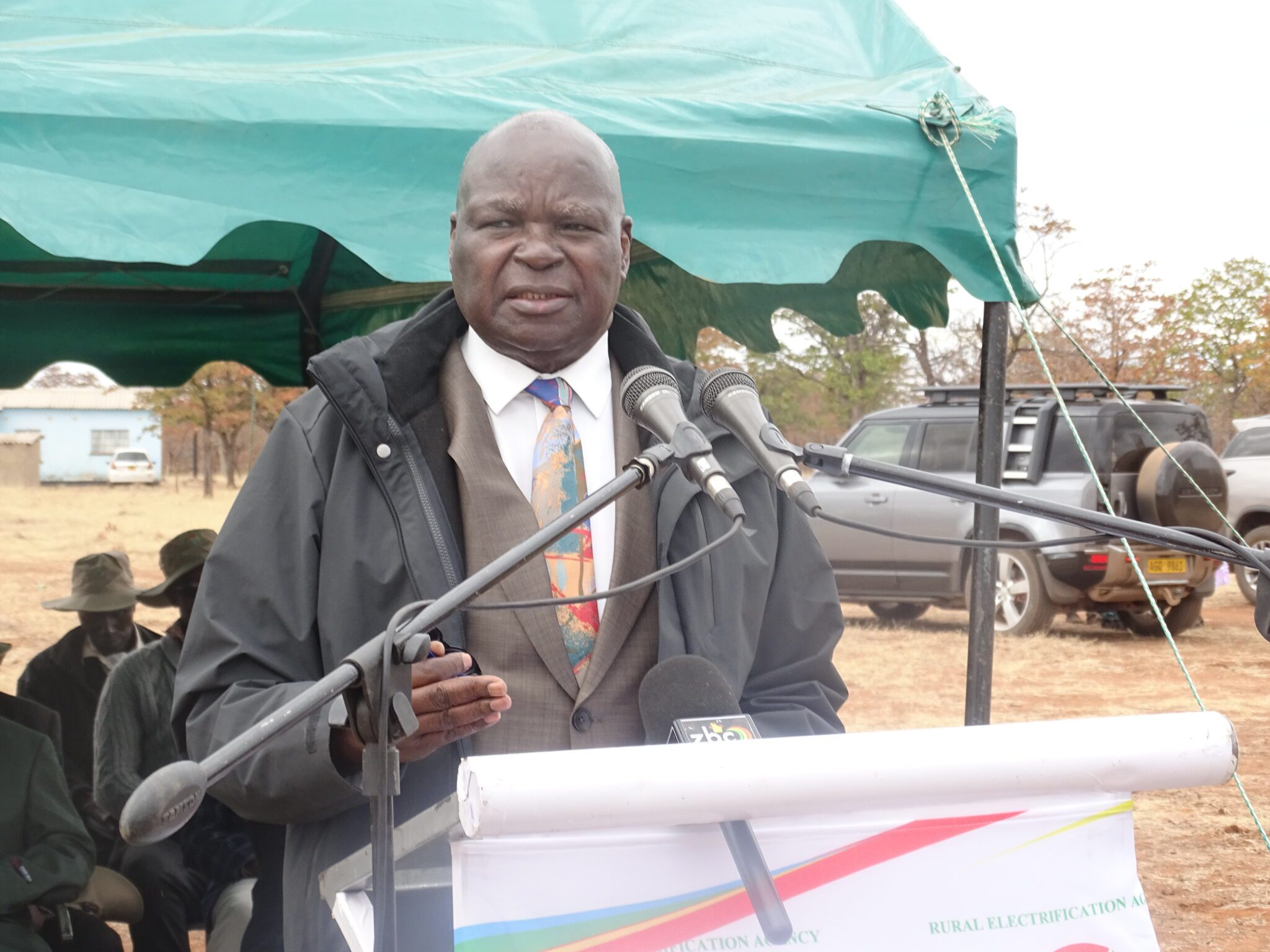
The commissioning of the Majindane Electrification Project in Umguza district marks a significant milestone in government’s drive to improve rural livelihoods through expanded access to electricity, Energy and Power Development Minister July Moyo has said.
Speaking at the switch-on ceremony at Majindane Primary School in Matabeleland North Province, Minister Moyo described electricity as a critical catalyst for industrialisation, economic growth, improved education, quality healthcare and rural development.
“Electricity or energy in general is a key driver to industrialisation, modernity, economic development and improved living conditions for our people. We cannot talk about quality education, quality healthcare, or thriving rural businesses without access to electricity,” he said.
The Minister reflected on the historical inequalities that left rural communities without access to electricity while urban centres, commercial farming areas and mines enjoyed modern energy services.
On this topic
He noted that the absence of electricity had negatively affected schools, clinics and agricultural productivity in rural areas, disadvantaging generations of learners and limiting opportunities for economic growth.
Minister Moyo said the establishment of the Rural Electrification Fund (REF) in 2002 accelerated efforts to ensure equitable access to electricity across the country.
He revealed that Zimbabwe’s rural electrification rate stood at only one percent in the early 1990s, prompting Government to introduce a surcharge on electricity consumers to fund rural electrification projects.
“Today, the Rural Electrification Agency is implementing a targeted programme to ensure that all primary schools are electrified. Here in Umguza, 44 primary schools have already been connected to the grid, with only 11 remaining. We promise that all the outstanding schools will be electrified before the end of this year,” he said.
The minister commended the Rural Electrification Agency (REA), ZESA and other stakeholders for their commitment to expanding access to electricity in rural areas.
He highlighted that as of June 15 this year, the agency had electrified 11 414 projects and households countrywide, including 3 256 primary schools, 1 647 secondary schools, 1 086 rural health centres, 497 government extension offices, 311 chiefs’ homesteads and 1 397 business centres.
The Minister said Zimbabwe’s achievements in rural electrification were attracting international attention despite challenges posed by sanctions and limited external support.
He announced that Matabeleland North Province will host the International Solar Alliance Conference in August, bringing together energy ministers and delegates from across Africa to witness Zimbabwe’s progress in renewable energy development.
At Majindane, the Rural Electrification Agency constructed eight kilometres of power lines to connect the school, local businesses and a community borehole to the national grid.
Minister Moyo urged the community to maximise the benefits of electricity by establishing irrigation schemes, school business units and income-generating projects.
“This electrification must become a catalyst for development. With electricity and water, communities can increase agricultural production, support school feeding programmes and create business opportunities for young people,” he said.
The Minister also encouraged livestock farmers in Matabeleland North to embrace biogas technology as an alternative energy source, noting that the region’s large cattle population presents significant opportunities for clean energy production.
He further revealed that the Rural Electrification Agency is expanding off-grid renewable energy solutions through the construction of solar mini-grids in remote communities.
Addressing education and healthcare development, Minister Moyo stressed the importance of electrifying teachers’ houses and health facilities to improve working conditions and retain skilled personnel in rural areas.
“A teacher who has electricity, clean water and decent accommodation is more likely to stay in rural communities and contribute to better learning outcomes for our children,” he said.
He also praised local veterinary officers for their commitment to supporting livestock farmers and called on communities to ensure government workers are adequately supported.
Minister Moyo urged residents to safeguard electricity infrastructure from vandalism and theft, saying community ownership would guarantee the long-term success of the project.
While welcoming the development, he warned against social ills such as drug and substance abuse that sometimes accompany increased economic activity.
“We place this electrification programme in your hands. Protect it, use it responsibly and ensure it improves the lives of present and future generations,” he said.






Leave a Reply