

By Dr Shame Mugova
Zimbabwe’s economy is growing again. Inflation has fallen, the exchange rate has become more stable, and economic activity is recovering. The economy expanded by 8.3% in 2025, while the International Monetary Fund projects growth of 5% in 2026.
These improvements deserve recognition. But they raise a more fundamental question: is Zimbabwe rebuilding its productive economy, or merely recovering economic activity within a substantially weakened economic structure?
Consider Harare’s traditional industrial areas of Workington, Southerton, Graniteside and Willowvale, or Bulawayo’s Belmont and Donnington. These were once important centres of manufacturing, engineering and industrial employment. Many factories closed during Zimbabwe’s prolonged economic difficulties. Others survived but reduced production, while some former industrial premises have been repurposed for warehousing, wholesale trade and other commercial activities.
On this topic
Commercial activity may have returned to some of these properties, but has manufacturing returned?
A former factory converted into a warehouse can generate employment and income. Yet it does not necessarily replace the machinery, technical skills, industrial jobs and supply chains previously associated with manufacturing.
This distinction receives insufficient attention in Zimbabwe’s economic debate. Inflation and GDP growth dominate the discussion, while less attention is paid to the productive capabilities the country has lost and what is being built in their place.
Recovery is not the same as transformation
The Confederation of Zimbabwe Industries reports that manufacturing output increased by 13% in 2025, while capacity utilisation improved from 52.3% to 55.9%. Approximately 35% of surveyed manufacturers invested in expanding productive capacity.
These are encouraging developments. However, they also indicate that approximately 44% of installed capacity among surveyed manufacturers remained unused.
More importantly, capacity utilisation measures the performance of existing businesses. It does not account for factories that permanently closed years earlier.
A surviving manufacturer can increase production while the industrial district surrounding it remains substantially diminished.
Zimbabwe entered the 1990s with considerable manufacturing capabilities in textiles, food processing, engineering, chemicals, metal products and other industries. Not all were efficient or internationally competitive, but they supported formal employment, technical expertise and extensive supplier networks.
Economic transformation should not mean reopening every factory of the past. Some industries were technologically outdated or dependent on protection.
The relevant question is whether lost capabilities are being replaced by modern, competitive industries that generate sustainable employment, increase productivity and produce higher value goods.
When farms stopped feeding factories
Perhaps the clearest illustration of Zimbabwe’s structural transformation is the weakening of connections between agriculture, manufacturing and retail.
Cotton provides an important example.
A functioning cotton industry does not end at the farm. Cotton moves through ginning, spinning, weaving, fabric manufacturing, garment production and clothing retail. Each stage creates employment, investment opportunities and demand for related services.
Zimbabwe once possessed substantial capabilities across this production chain.
Over time, textile and clothing manufacturing contracted sharply, while imported new and secondhand clothing became increasingly important in domestic markets.
Today, vendors selling imported clothing provide livelihoods for many families. Their activities are economically meaningful, but they cannot fully replace the employment and industrial linkages associated with domestic textile production.
The experience of Truworths illustrates this wider transformation.
Once an extensive clothing retail business with domestic manufacturing connections, Truworths entered corporate rescue and was delisted from the Zimbabwe Stock Exchange in July 2025.
Its difficulties involved several factors, including consumer purchasing power, operating costs and competition. Nevertheless, its decline demonstrates how weaknesses in domestic production can become intertwined with the difficulties facing formal retail businesses.
Agriculture presents similar questions.
Zimbabwe produces maize, wheat, soya beans and other commodities that support food processing. Yet domestic supplies remain vulnerable to agricultural shocks.
According to ZIMSTAT’s Food Balance Sheet, maize import dependence increased from 7% in 2022 to 73% during the drought affected year of 2024. Soya bean import dependence reached 62%, while wheat stood at 38%.
These figures do not represent permanent import requirements. Agricultural output has since recovered in several crops. Rather, they expose the vulnerability of domestic production and supply chains.
Why should a country with significant agricultural potential remain so vulnerable to disruptions in food production? How much investment is going into irrigation, storage, agricultural processing and reliable domestic supply systems?
A recent example further illustrates the challenge.
In September 2026, the Competition and Tariff Commission initiated a safeguard investigation following concerns raised by National Foods about rising pasta imports. Imported pasta accounted for approximately 87% of Zimbabwe’s domestic market in 2025, while import volumes increased from about 49.5 million kilograms in 2024 to 58.1 million kilograms in 2025.
National Foods had commenced domestic pasta manufacturing in February 2024. Its concerns raise an important question about the conditions under which emerging domestic manufacturers can compete with established imported products.
The investigation has not established that imports caused the company’s difficulties. Nevertheless, the case demonstrates the challenge of developing local manufacturing in a market already dominated by foreign suppliers.
Imports are not inherently undesirable. International trade can lower prices, increase competition and improve consumer choice. Protecting inefficient industries indefinitely would impose costs on households and businesses.
The concern arises when imports replace productive capabilities that could be competitively developed domestically, without new industries emerging to create alternative employment and export opportunities.
The objective should be competitiveness, not protection for its own sake.
From supermarkets to roadside vendors
The transformation is also visible in Zimbabwe’s retail economy.
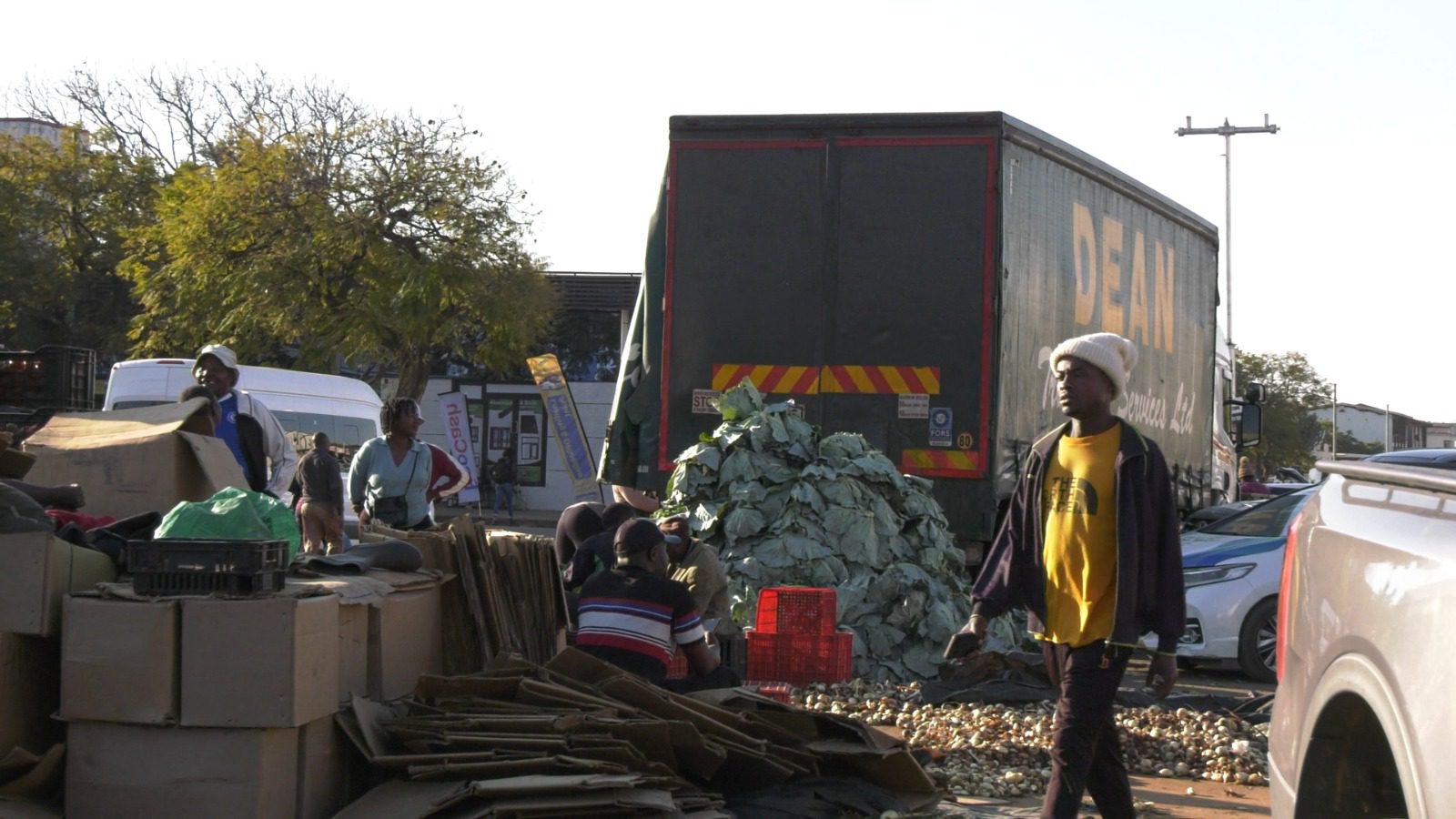
Established supermarket chains have faced increasing pressure, while tuckshops, informal wholesalers and roadside vendors have become important distribution channels.
In November 2025, OK Zimbabwe reported closing 11 stores, with three more undergoing closure. The company also highlighted difficulties involving suppliers and stock availability.
It would be misleading to blame informal traders alone. Formal retailers face operating costs, financing constraints and changing consumer behaviour. Informal outlets may offer competitive prices, greater convenience and quantities suited to household budgets.
Nevertheless, the changing retail landscape raises questions about the quality of employment and household purchasing power.
A household with stable monthly earnings can plan expenditure, purchase essential products in larger quantities and build savings.
A household dependent on irregular income may purchase only what it can afford that day.
Both participate in economic activity, but their financial security differs substantially.
Similarly, a person who loses factory employment and starts selling imported goods remains economically active. Yet the transition may involve lower productivity, unpredictable earnings and weaker employment benefits.
Informal enterprise is not inherently unproductive. Many successful businesses begin informally. The concern is when informal trading becomes the principal alternative to formal jobs that the economy is struggling to create.
A busy marketplace should therefore not automatically be interpreted as evidence of rising prosperity. It may reflect entrepreneurial dynamism, economic necessity, or both.
The investment problem beneath the recovery
There is another indicator that deserves much greater attention than it receives in discussions of Zimbabwe’s recovery: gross fixed capital formation.
This measures investment in fixed assets such as machinery, equipment, buildings and infrastructure.
Historical World Bank data show that Zimbabwe’s gross fixed capital formation reached approximately 24.6% of GDP in 1995. By 2024, it was approximately 7.9%.
Although changes in national accounting and GDP measurement require caution when making historical comparisons, the figures point to a substantial decline in investment intensity.
This matters because economies do not grow sustainably through consumption and trading alone. They must accumulate productive capital.
Factories require machinery. Farmers need irrigation equipment. Railways require locomotives and maintained tracks. Manufacturing businesses need modern production systems, reliable electricity and efficient logistics.
Investment also needs to replace depreciating assets before productive capacity can expand.
A country may experience a construction boom while still investing inadequately in machinery and industrial production. Residential buildings are valuable assets, but they do not automatically replace lost manufacturing capabilities.
The distinction is between an economy that is spending and an economy that is building the productive capacity required to generate future income.
The question is therefore not simply how much investment is taking place, but where that investment is going and whether it is improving productivity.
Who is financing economic reconstruction?
Rebuilding productive capacity also requires finance.
Factories need machinery, technology, reliable infrastructure and working capital. Expanding industrial production frequently requires financing that can be repaid over several years.
Yet Zimbabwe’s financial system remains relatively shallow.
The IMF’s 2025 assessment estimated private sector credit at approximately 4.3% of GDP and identified limited banking intermediation.
Banks can be profitable, adequately capitalised and financially stable without supplying sufficient long term investment finance.
The capital market provides another potential financing channel, but Zimbabwe’s listed corporate sector has experienced substantial delistings and relatively few new operating company listings.
The Victoria Falls Stock Exchange has facilitated important capital raisings through its United States dollar denominated market. However, transferring an existing company from the Zimbabwe Stock Exchange to the VFEX does not, by itself, generate new productive investment.
What matters is the amount of fresh capital businesses actually raise and invest.
If banks provide limited long term credit and relatively few enterprises raise equity through public markets, how will Zimbabwe finance the next generation of manufacturing businesses?
The issue extends beyond money circulating in the economy. It concerns whether savings and financial resources are reaching productive enterprises capable of creating employment and future output.
The railway test
Infrastructure provides another revealing measure of economic reconstruction.
Zimbabwe’s railway system once transported substantial quantities of minerals, agricultural commodities and industrial products.
In 1998, annual railway freight exceeded 12.4 million tonnes. Zimbabwe’s National Development Strategy 2 reports that freight had fallen below 3 million tonnes in recent years, representing a dramatic deterioration in the role of railway transport.
Some freight has shifted to road transport, and the decline cannot be attributed entirely to industrial contraction. Nevertheless, it reflects a major weakening of railway transport’s contribution to the national economy.
The consequences extend beyond the railways themselves.
Manufacturers and mining companies face transport costs, while heavier dependence on road freight increases pressure on highways.
The prolonged deterioration and ongoing rehabilitation of the Bulawayo to Victoria Falls road demonstrate the wider importance of reliable infrastructure for tourism, mining and commerce.
Industrial competitiveness depends not only on what happens inside factories, but also on electricity reliability, water availability, transport efficiency and the cost of moving goods to markets.
A country cannot sustainably industrialise while these supporting systems remain inadequate.
Growth that depends on rainfall
The anticipated 2026/27 agricultural season provides an important test of Zimbabwe’s economic resilience.
The economy grew by only 1.7% in 2024 when severe drought affected agricultural production. Better rainfall contributed to the substantial recovery in 2025.
Now, with forecasts warning of possible El Niño related drought conditions, the IMF expects growth to moderate from 5% in 2026 to 3.5% in 2027.
This is not a forecast of economic contraction. However, it highlights the continuing vulnerability of national economic performance to agricultural conditions.
Agriculture will always remain sensitive to rainfall. Even advanced economies experience production losses during severe droughts.
The difference lies in their ability to absorb shocks.
An economy with extensive irrigation, diversified manufacturing, reliable electricity, productive services and developed financial institutions is better equipped to sustain economic activity when agricultural output falls.
Zimbabwe’s vulnerability is amplified because rainfall affects more than crops. Poor agricultural seasons reduce rural incomes, increase food import requirements and can disrupt hydroelectric power generation.
The consequences spread through manufacturing, commerce and household consumption.
The question is therefore not simply whether agricultural production will recover after the next favourable rainy season.
It is whether Zimbabwe is building an economy capable of sustaining growth when rainfall is poor.
Where is the economy growing?
There are genuine areas of expansion.
Mining has benefited from investment and favourable commodity prices. New steel and mineral processing projects offer opportunities for industrial development. Agriculture, construction, telecommunications and selected manufacturers continue to generate output and investment.
These developments should not be dismissed.
But their contribution to national transformation depends on the productive relationships they establish with the wider economy.
Does mining growth create sufficient demand for domestic engineering firms, machinery manufacturers and skilled labour?
Does agricultural expansion support food processing, packaging and industrial employment?
Does construction stimulate domestic production of building materials?
Are mineral export earnings and diaspora remittances being converted into productive investment, or are substantial amounts flowing into consumption, imported goods and property?
Consumption and housing investment are valuable economic activities. The issue is whether enough resources are also being directed towards investments that strengthen future productive capacity.
An economy can experience visible construction, busy trading centres and rising export earnings without generating an equally broad improvement in industrial employment and household incomes.
Growth becomes more transformative when expanding sectors create opportunities for others.
Beyond GDP and inflation
Zimbabwe should continue monitoring inflation, exchange rates and GDP growth. They remain essential measures of macroeconomic performance.
But they should be complemented by indicators that reveal whether the economy’s productive foundations are strengthening.
How many factories are operating? How much investment is going into industrial machinery and infrastructure? Are manufacturing employment and productivity increasing?
How much agricultural production is processed domestically? Are exports becoming more diversified? How much long term finance is reaching productive businesses?
Are railway freight volumes recovering? Are traditional industrial towns attracting sustainable new investment? Are ordinary households experiencing improvements in real earnings, purchasing power and employment security?
These questions should be central to evaluating economic progress.
Zimbabwe’s recent macroeconomic improvements provide an opportunity to address longstanding structural weaknesses. Greater stability can support investment, but stability should be treated as the foundation for transformation rather than its completion.
The objective is not to recreate the industrial economy of the 1990s. It is to develop modern productive capabilities, strengthen connections between sectors and create an economy capable of generating sustainable prosperity.
Zimbabwe can record falling inflation while factories remain underutilised. It can report GDP growth while formal employment opportunities remain limited. It can earn substantial export revenue while depending heavily on imported goods and vulnerable infrastructure.
These outcomes are not contradictory. They describe different dimensions of the economy.
The real test of Zimbabwe’s recovery is not how quickly GDP grows after a favourable harvest or commodity boom. It is whether the country is accumulating productive capital, increasing labour productivity, creating sustainable employment and improving real household incomes. Above all, it is whether Zimbabwe is building an economy capable of sustaining prosperity when favourable conditions disappear.
Dr Shame Mugova is a Lecturer in Finance at Birmingham City University. He writes on finance, economic policy, governance and development, with a particular interest in Zimbabwe and Southern Africa. He writes in his personal capacity.






Leave a Reply