
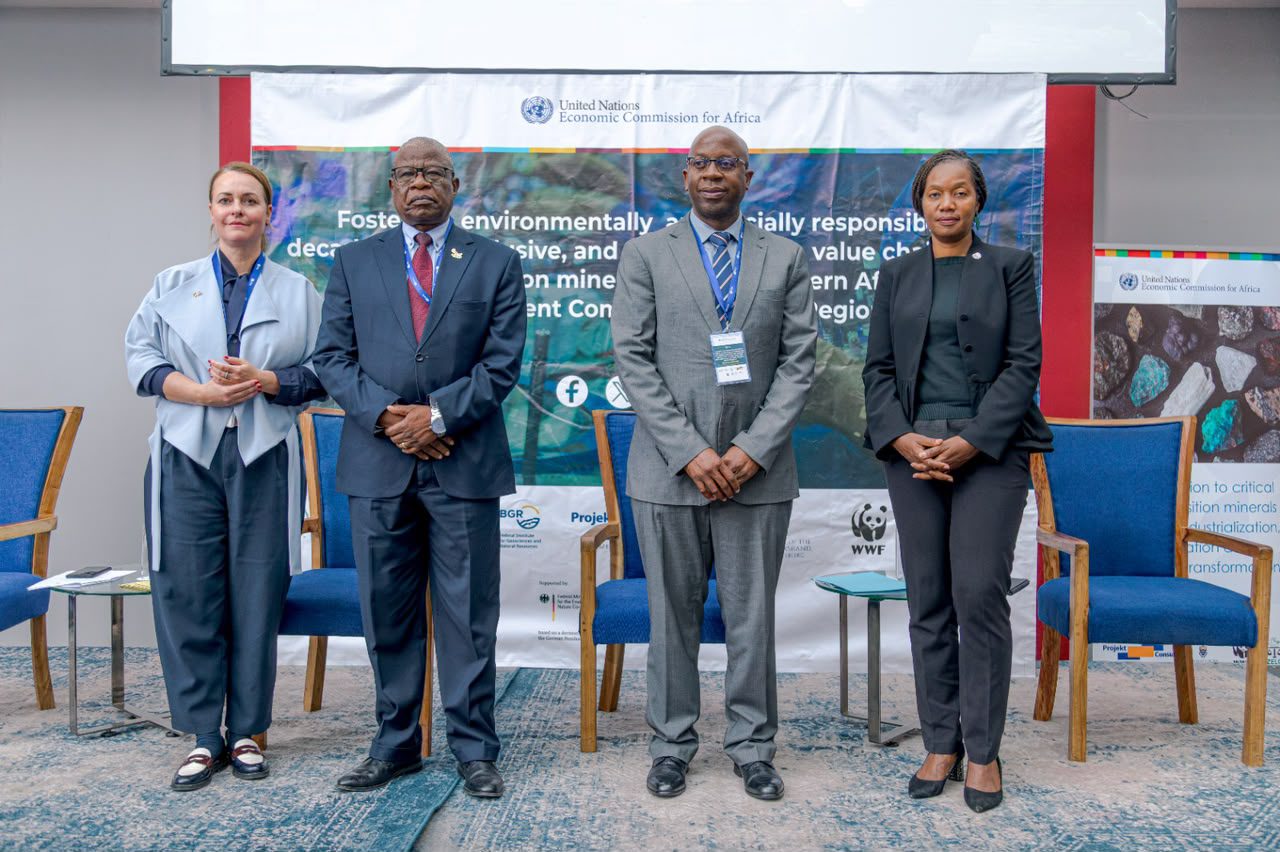
Southern African countries must move beyond raw mineral exports and embrace value addition, responsible mining and inclusive development to benefit from the global clean energy transition, officials said Tuesday at the launch of a major regional project in Lusaka.
The five-year initiative, “Fostering Environmentally and Socially Responsible, Decarbonised, Inclusive and Transformative Value Chains for Energy Transition Minerals in the SADC Region,” is funded by the German government through the International Climate Initiative (IKI) and implemented by the United Nations Economic Commission for Africa (ECA) in partnership with a consortium of regional organisations.
Speaking at the launch ceremony that was also broadcast online, Director of UNECA’s Sub-Regional Office for Southern Africa, Eunice Kamwendo, said the project addresses a longstanding gap in ensuring the extractive sector delivers broad-based benefits across the region.
“Currently, Africa exports most of its minerals in raw or semi-processed form, capturing only a small share of the value, despite hosting a significant proportion of the world’s reserves of key minerals such as cobalt, copper, lithium, manganese, nickel, and platinum group metals,” she said.
On this topic

Kamwendo noted the mining sector already contributes between seven and over 25 percent of GDP in countries including South Africa, Zambia, and the Democratic Republic of the Congo (DRC), but linkages to local economies and job creation remain limited.
“In addition, mineral exports account for the bulk of foreign exchange earnings in several Member States, underscoring the strategic importance of the mining sector to the region’s economies,” she said.
“Countries such as Zimbabwe are key players in lithium production, while Mozambique and Namibia continue to expand their roles in supplying graphite, uranium and other critical minerals and South Africa is a key manganese and platinum group metals producer.”
According to global projections, demand for critical energy transition minerals such as lithium and cobalt could increase by more than four to six times by 2040, driven by the shift to clean energy.
“This presents a significant opportunity for the region to not only supply raw materials, but to actively participate in higher-value, low-carbon industrial development and decarbonisation,” Kamwendo said.
“Therefore, this initiative presents a timely opportunity for the SADC region to position itself strategically within the global energy transition. To fully realize this potential, the policy and institutional frameworks must actively support the participation of local enterprises particularly micro, small and medium-sized enterprises in key segments of energy transition mineral value chains.
“Through deliberate local content policies facilitating access to procurement and supply chains and investing in skills development and technology to enhance competitiveness within regional and continental markets, including under the African Continental Free Trade Area, the CETMs boom can support transformation and equity.
The project spans 2026 to 2031 and includes Zambia, the DRC, Mozambique, Namibia, South Africa and Zimbabwe as beneficiary countries.

Zambia’s Permanent Secretary for the Ministry of Mines and Minerals Development, Dr Hapenga Kabeta, officially launched the initiative and stressed that sustainable development cannot be achieved without meaningful inclusion of all segments of society.
“Sustainable development cannot be achieved unless women, youth, local communities and persons with disabilities are meaningfully included in the economic opportunities created by the sector,” Kabeta said.
He noted that while the SADC region is uniquely endowed with strategic minerals, significant challenges remain, including limited beneficiation and value addition, gaps in environmental and social governance compliance, and inadequate participation of local communities.
“For Zambia, this opportunity is particularly significant. As one of the world’s major producers of copper and an emerging player in the development of critical minerals, we recognize that the future competitiveness of our mining sector will increasingly depend on responsible production, environmental stewardship, value addition and integration into sustainable regional and global value chains,” Kabeta said.

Counsellor and Head of Environmental Affairs and Climate Action at the German Embassy in South Africa, Verena Stöckigt, said Germany is committed to supporting a just energy transition that safeguards both people and the planet.
“The SADC region is a key source of many of these minerals. It is important that the minerals boom is exploited equitably and contributes to regional priorities. At the same time, it’s fundamental to make environmental and biodiversity safeguards and promote value-addition,” Stöckigt said.
“Germany sees the transition to a low-carbon economy as a collective task. By working together with Zambia and the broader SADC region, we can make sure that the minerals essential for the global energy transition are produced in a manner that safeguards our planet and uplifts our peoples.”
The project aims to develop regional policy frameworks for material extraction, strengthen monitoring and regulatory oversight bodies, empower civil society and local communities to enforce environmental standards, and promote actionable pilots for climate, water, and biodiversity measures.
Senior officials from Mozambique, Namibia and the DRC also attended the launch, developmental partners alongside representatives from the private sector, academia and civil society.




Leave a Reply