
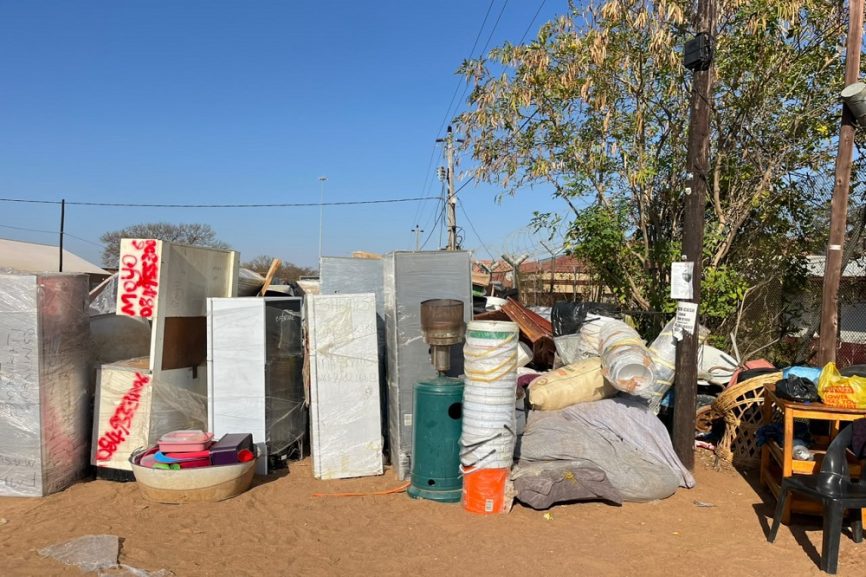
Trucks loaded with goods belonging to Zimbabwean nationals remain stationed outside the Mankweng Police Station near Polokwane in South Africa’s Limpopo province, with drivers reportedly waiting for a 50 percent upfront payment from the Zimbabwean government before transporting the belongings across the border.
The goods belong to Zimbabweans who were repatriated from South Africa last month, as well as others who remain stranded at the police station after they were displaced from various parts of Limpopo, including Lebowakgomo and Seshego.
According to South African media reports, truck drivers contracted to transport the goods are demanding an upfront deposit to cover fuel, toll fees and other costs associated with the journey to Zimbabwe.
The situation has left some Zimbabweans waiting at the police station while others, who were repatriated in July, remain separated from their belongings.
On this topic
One of those still waiting outside Mankweng Police Station, Herbert Masimba, appealed to the Zimbabwean government to intervene and ensure that the goods were transported home.
“What we want the Zimbabwean government to do for us is to look for truckers who are willing to take these goods from here to Zimbabwe,” Masimba said in comments carried by South African media.
“Once they drop off these goods, the government should pay them and give them a binding contract stating that they will be paid once they have completed the work.
“That is what we need the trucks for now. Our government has promised that buses will still be coming. We are compiling a list of people who want to be repatriated back home.”
The stranded goods have revived concerns raised by Zimbabwean community leaders about the humanitarian consequences of deportations and anti-immigrant operations in South Africa, particularly where migrants are forced to return home without the possessions they accumulated over years of living and working across the border.
Zimbabwe Community in South Africa chairperson, Ngqabutho Nicholas Mabhena, said he had alerted the Zimbabwean Consulate in Johannesburg after seeing reports about the Zimbabweans and their belongings at Mankweng.
“I saw this and alerted the Zimbabwe Consulate in Johannesburg. Yesterday (Wednesday) I talked to them. I alerted them to what I had seen. I am sure they are attending to that,” Mabhena told CITE.
He said the organisation had previously raised similar cases with the consulate, including concerns involving hundreds of Zimbabweans stranded in Bloemfontein.
“Last time we received complaints or inquiries from Zimbabweans in Bloemfontein, about 300 people. I phoned the consulate and they sent buses to pick them up,” he said.
Mabhena said he had also recently visited the consulate, where he was briefed on efforts to assist Zimbabweans returning home.
“Some weeks back, I went in person to visit the consulate and I was briefed that since the process started, 50 000 people were repatriated,” he said.
“When I saw this incident yesterday, I again contacted the consulate. That is why I believe they are working on it.”
However, he said repatriation should not result in people left destitute or separated from possessions they had spent years acquiring.
Mabhena said the Zimbabwe Community in South Africa believed where immediate repatriation was not possible, displaced Zimbabweans should be allowed to return temporarily to their communities in South Africa.
“Our view as the Zimbabwe Community in South Africa is that people should be returned to their communities in South Africa if they cannot be repatriated,” he said.
“This should be part of social cohesion, where people should live together in peace as opposed to driving innocent people out.”
The situation at Mankweng echoes concerns raised by the Zimbabwe Community in South Africa last month after its leaders visited the United Congregational Church of Southern Africa (UCCSA) in Njube, Bulawayo, which has been serving as a temporary reception and transit centre for Zimbabweans returning from South Africa.
During that visit, the delegation encountered returnees who had spent years working in South Africa but arrived in Zimbabwe with little more than the clothes they were wearing.
Many had left behind furniture, clothing, household goods and other possessions after they were caught up in deportations and anti-immigrant operations.
Mabhena said the experiences of the returnees reinforced the organisation’s call for the South African government to temporarily halt deportations and consider granting undocumented Zimbabweans an amnesty or other humanitarian relief to enable them to make arrangements for their belongings.
“We are worried as the Zimbabwe Community in South Africa that people had to leave their property in South Africa,” he said at the time.
He argued that allowing deportees sufficient time to recover and transport their possessions would reduce the economic and emotional impact of forced returns.
“This is why we have been calling on the South African government to at least stop deportations. We raised this when we appeared before the Portfolio Committee on International Relations and Cooperation, asking that people be granted an amnesty so they can get assistance from their employers to transport their belongings back to Zimbabwe,” Mabhena said.
He said many Zimbabweans had spent years working in South Africa but were now returning home with neither savings nor the possessions accumulated during their time there.








Leave a Reply