

The majority of Zimbabweans who participated in nationwide consultations on a proposed constitutional amendment bill supported its key provisions, including removing direct presidential elections, a parliamentary committee has found.
Presenting the Joint Committee’s report to Parliament on Thursday, chairperson Eddison Zvobgo said the findings drew on public hearings and written submissions collected across all ten provinces, in fulfilment of constitutional requirements for public participation in law-making.
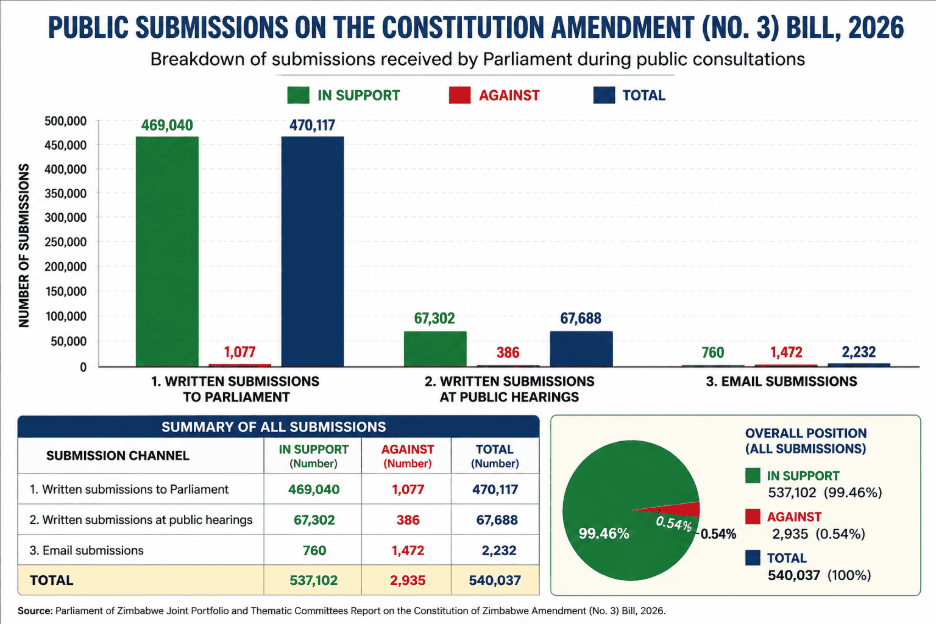
Parliament received 540 037 written submissions on the Constitution of Zimbabwe Amendment (No. 3) Bill. Of these, 537 102, or nearly 99.5%, were in support of the proposed changes, while 2,935 opposed them.
Among the most significant proposals to receive majority backing was a plan to have Parliament elect the president rather than voters doing so directly. Supporters told the committee the arrangement would reduce election costs, ease political tensions and strengthen accountability between the executive and legislature. Critics, however, argued it would undermine popular democracy.
On this topic
Other proposals supported by the majority of submissions included transferring voter registration from the Zimbabwe Electoral Commission (ZEC) to the Registrar-General, extending presidential and parliamentary terms from five to seven years, and establishing a separate Zimbabwe Delimitation Commission.
Despite the weight of public opinion, the committee declined to endorse every clause in the Bill.
It recommended retaining the Zimbabwe Gender Commission, rejecting majority support for its merger with the Zimbabwe Human Rights Commission. The committee cited concerns raised by women’s organisations and the country’s obligations under international agreements.
The committee also recommended keeping the constitutional bar on traditional leaders participating in partisan politics, even though a majority of submissions favoured removing it, saying the proposal conflicted with provisions requiring chiefs to remain politically neutral.
Zvobgo said the committee was broadly supportive of the Bill and called on both Houses of Parliament to give its recommendations full consideration.
“The Joint Committee sought to ensure that there was consistency between the Bill’s provisions and the Constitution as well as aligning with the expectations and aspirations of the people and regional and international best practices,” he said.
The Bill remains one of the most contested pieces of legislation in Zimbabwe in recent years, with civil society groups and opposition figures questioning whether the consultation process was genuinely representative.
Support CITE’s fearless, independent journalism. Your donation helps us amplify community voices, fight misinformation, and hold power to account. Help keep the truth alive. Donate today






Leave a Reply