
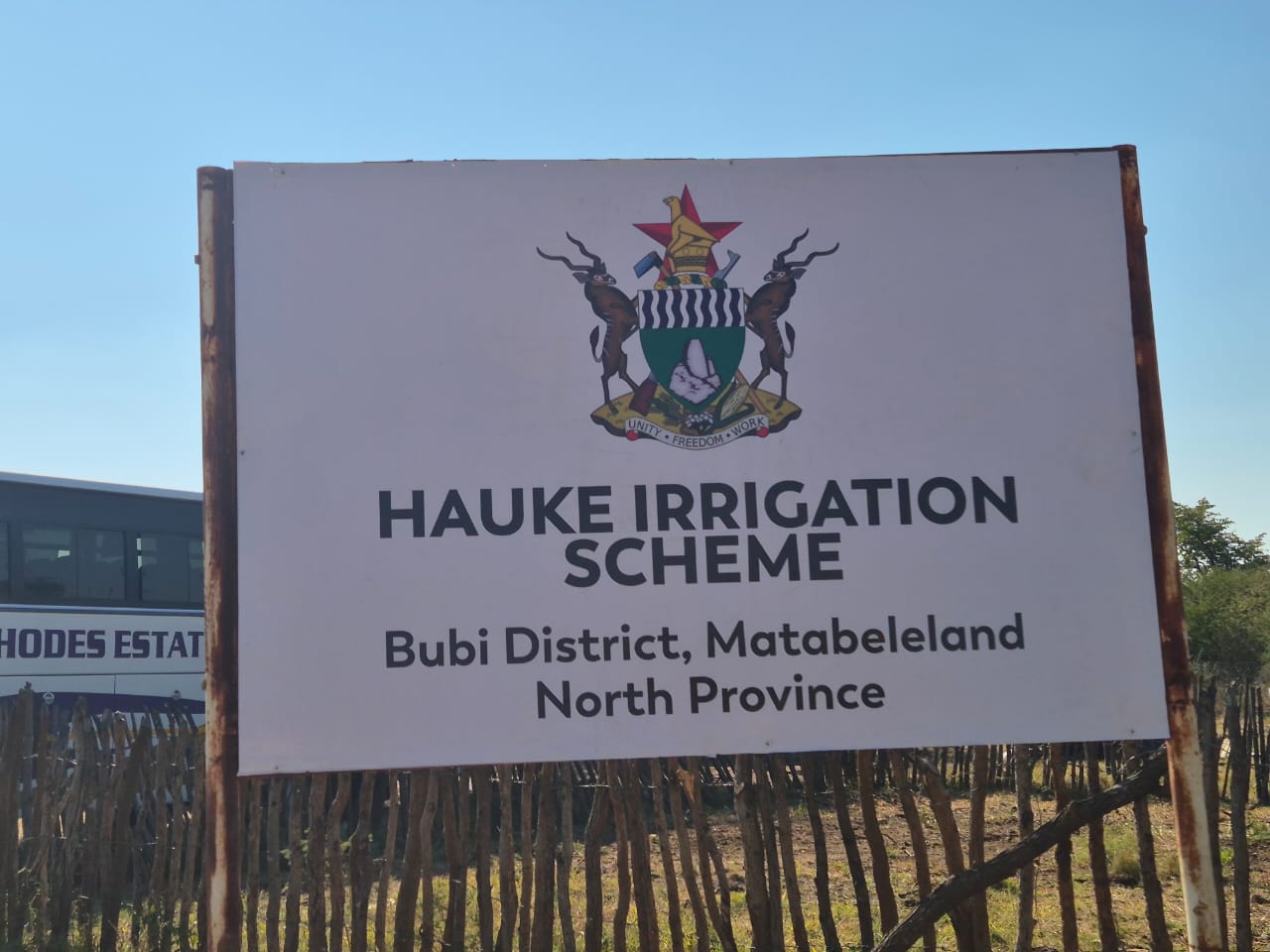
Farmers at Hauke Irrigation Scheme in Bubi district, Matabeleland North, are adopting an innovative soil moisture monitoring system known as the Chameleon to improve irrigation efficiency and reduce water wastage.
The technology uses colour-coded sensors inserted into the soil at different depths to help farmers determine underground moisture levels and decide when and how much to irrigate.
Chairperson of the irrigation scheme, Thandanani Khabo, said the system has transformed how farmers manage water.
“The first stick is inserted 30 centimetres into the ground, while a second goes 20 centimetres down. Sensors are placed at 10 and 20 centimetres respectively, because our plants’ roots don’t go beyond 20 centimetres,” Khabo said.
On this topic
He explained that colour indicators give farmers a real-time picture of soil moisture during irrigation.
“We use flood irrigation here. When the yellow colour appears, it means water has reached the 10-centimetre level. If red appears, you have watered beyond 20 centimetres,” he said.
A handheld sensor complements the in-ground system by alerting farmers when soil is dry and irrigation is needed.
“When we water, the sensor flashes blue. When the green light stops flashing, the soil is dry and you can irrigate. When it stays continuously blue, the soil is still moist, so hold off,” Khabo said.
Before adopting the technology, farmers relied on the appearance of the topsoil, a method that frequently led to over-irrigation.
“We used to water crops whenever we saw the topsoil dry, not realising the soil beneath could still be wet. We were overwatering,” he said.
The sensors can also detect waterlogging. “When you overwater, the red tip stays up. You then use a syringe to draw out the excess water,” Khabo added.
Beyond moisture monitoring, the system can be used alongside litmus paper to assess soil fertiliser levels, indicating whether nutrients are deficient or excessive.
Martin Moyo, a Farming Systems and Analysis Scientist at the International Crops Research Institute for the Semi-Arid Tropics (ICRISAT), described the Chameleon as a practical tool for smallholder farmers.
“It shows how wet or dry the soil is and guides farmers on when and how to irrigate,” Moyo said. “Red means no moisture, green means the soil is moist and ready for irrigation, and blue means the soil is at field capacity.”
However, Agricultural Business Advisor Mtshado Ngwenya, who works in the training section of Insiza District, said extension workers needed more support to keep pace with modern irrigation technologies.
“There is still a gap that our partners can help fill. Our training programmes are lagging behind in capacitating extension personnel. We still need training on the tools, and access to ICTs remains a challenge,” Ngwenya said.
The adoption of Chameleon technology is expected to improve water conservation, increase crop productivity and strengthen climate-smart agriculture practices across Zimbabwe’s irrigation schemes.
Support CITE’s fearless, independent journalism. Your donation helps us amplify community voices, fight misinformation, and hold power to account. Help keep the truth alive. Donate today







Leave a Reply