
By Elizabeth Duve Dziva
Zimbabwe is home to a remarkable ceramic heritage that stretches back centuries, reflecting the creativity, knowledge and cultural experiences of communities that lived in this part of Africa.
Long before modern factories produced household utensils, our ancestors were already transforming ordinary clay into objects that served practical, artistic and cultural purposes. Yet pottery was never just about making containers. It was also a way of expressing identity, communicating ideas and preserving aspects of community life.
People often use the terms ceramics, pottery and clay pots interchangeably. However, they do not mean exactly the same thing. Ceramics is the broadest term, pottery refers to a particular category of ceramic objects, while clay pots are specific objects made from clay.
On this topic
The historical importance of pottery is particularly evident in the different ceramic traditions identified by archaeologists across Zimbabwe. These include the Bambata, Gokomere, Ziwa, Zhizo, Leopard’s Kopje, Gumanye, Harare, Musengezi, Khami and Mahonje traditions. Each is recognised by distinctive characteristics, including vessel shapes, methods of decoration, surface finishes and manufacturing techniques. By studying these differences and the archaeological contexts in which pottery is discovered, researchers can trace changes in settlement patterns, technology, trade and cultural interaction over time. In this sense, pottery has become one of the most valuable records of Zimbabwe’s past.
Beyond their practical uses, the shapes and designs of traditional pots also carried cultural significance. Different vessel forms have been associated with aspects of human life, including fertility, womanhood, family, spirituality and social identity. Their patterns served several purposes: decorative, by adding aesthetic value; technical, by improving handling and suitability for domestic use; and symbolic, by communicating beliefs, relationships and cultural ideas.
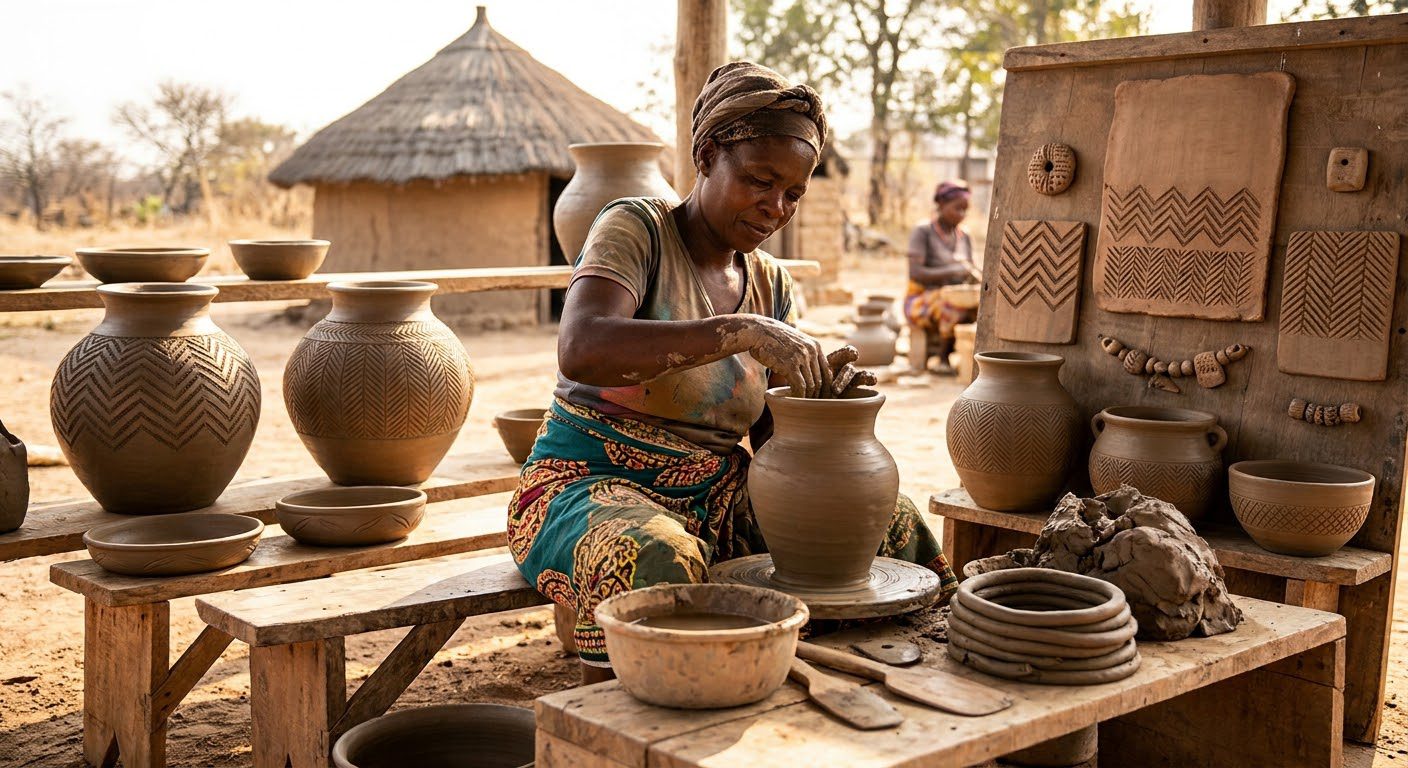
Common geometric designs include the chevron, herringbone, also known as fishbone, and wishbone patterns. Interestingly, similar motifs appear on Zimbabwe’s celebrated dry-stone structures, particularly at Great Zimbabwe and Khami.
The chevron, with its repeated V-shaped lines, has been interpreted in some cultural traditions as representing continuity, fertility and the unending flow of life. Its repeated form can also evoke movement, including the rhythm of water and waves. The herringbone or fishbone pattern, with a central line and smaller branches extending from it, has been associated with social organisation, leadership structures and the relationship between people and their environment. The wishbone, with its branching form, can be interpreted as representing unity, togetherness and the importance of relationships within society. These interpretations are fascinating, although their precise meanings in every historical context cannot always be established with certainty.
Traditional Zimbabwean pottery was also remarkably specialised. Different vessels were made for particular household activities. A chirongo was used for fetching and storing water, while a hadyana was used for cooking relish. A gate was a large vessel associated with storing foodstuffs and, in some communities, brewing or storing traditional beer. A dende is associated in some local classifications with sweet beer.
The mbiya was used for serving food, particularly relish, while the denhe served as a storage vessel for mealie-meal. The tsaiya, also known in some areas as shambakodzi, was used for cooking sadza. Other vessels served purposes such as fermenting, storing and serving traditional beverages. These names and uses sometimes vary between regions and language communities, demonstrating the diversity of Zimbabwean pottery knowledge.
Fortunately, efforts to preserve this heritage continue. First Lady Dr Auxillia Mnangagwa has promoted women’s empowerment through traditional crafts, including clay-pot moulding, while cultural education initiatives have helped bring traditional utensils and food preparation into public view. The National Handicraft Centre also provides a platform for marketing Zimbabwean crafts, including pottery.
Beyond institutional efforts, individuals and community initiatives are helping to keep the craft alive. Gift Zirende, a young potter from Chitungwiza, is one example of a member of the younger generation embracing pottery. Social media platforms, including the Facebook page Pot Tradition, have also helped bring attention to traditional pottery and the people who make it.
The Zimbabwean government has supported pottery preservation through institutions such as the National Handicraft Centre (NHC), established in 1989, which promotes traditional pottery by linking artisans to local and international markets. The National Museums and Monuments of Zimbabwe (NMMZ) preserves archaeological pottery collections and documents the country’s ceramic heritage.
The National Arts Council of Zimbabwe (NACZ) supports the development and promotion of the arts and crafts sector, while the Ministry of Sport, Recreation, Arts and Culture provides the broader policy framework for cultural preservation. These institutions help protect traditional skills, promote indigenous craftsmanship and keep Zimbabwe’s pottery heritage visible.
A frequently asked question is why such a tradition is worth keeping. Pottery connects us to the knowledge, creativity and everyday experiences of earlier generations. It provides archaeological evidence, supports livelihoods, strengthens cultural identity and reminds us that our ancestors were skilled innovators.
The challenge is to ensure that traditional pottery does not become something we only admire in museums. Government institutions, museums, schools, researchers and communities must continue supporting potters, documenting traditional knowledge and creating markets for locally made products.
Perhaps we should begin looking at an ordinary clay pot differently. It is not simply an old-fashioned container or a substitute for modern kitchenware. It is a product of knowledge, artistry and generations of cultural experience. In its shape, patterns and purpose lies a story of Zimbabwean life, carefully formed in clay and preserved through time.
Elizabeth Duve Dziva is an archaeologist, cultural heritage practitioner, and History and English educator. The views and opinions expressed in this article are solely those of the author and do not necessarily represent those of any organisation. For further information, please contact: duveelizabeth@gmail.com.








Leave a Reply