

Emakhandeni-Luveve MP Discent Bajila has raised concerns over the Government’s intervention in Bulawayo’s waste management procurement process, warning that directives to engage Geo Pomona before the completion of statutory procedures could undermine investor confidence in Zimbabwe.
Bajila raised the concerns in the National Assembly on Tuesday through a Point of National Interest, arguing that public institutions should follow established procurement procedures even when the Government is seeking urgent solutions to pressing challenges.
His comments come amid an ongoing dispute over the proposed involvement of Geo Pomona Waste Management in addressing the waste crisis at Richmond Landfill, commonly known as Ngozi Mine.
Local Government and Public Works Minister Daniel Garwe directed the Bulawayo City Council on September 10 to engage Geo Pomona and conclude an agreement within a week as part of efforts to address pollution and waste management challenges at the landfill.
On this topic
The directive was issued while the council was pursuing its own procurement process for a private waste management partner.
According to a council report, three compliant bids had been received in October 2025 and submitted to the Procurement Regulatory Authority of Zimbabwe (PRAZ) and the Zimbabwe Investment and Development Agency (ZIDA) for consideration and guidance.
The council had also submitted a prefeasibility study to ZIDA on June 23, 2026, for consideration by the Public-Private Partnership Committee, which was scheduled to deliberate on the proposal on September 8.
However, while the council was awaiting feedback from ZIDA, Garwe directed the city to engage Geo Pomona.
Bajila said the intervention risked sending a negative message to potential investors about the integrity of Zimbabwe’s public procurement system.
“I rise on a point of National Interest noting recent developments which, if unchecked, may undermine our laid down procurement systems and reduce investor confidence in our development endeavors as a country,” he said.
“Madam Speaker, the Public Finance Management Act read together with the Public Procurement And Disposal Of Public Assets Act, the ZIDA Act and the Urban Councils Act, provide clear procedures of how urban local authorities should dispose of their assets and/or procure goods and services on the market.”
Bajila acknowledged concerns over the pace of procurement processes, particularly those administered by PRAZ, but said due processes were important for maintaining investor confidence.
“At times, the speed at which the Procurement Regulatory Authority of Zimbabwe (PRAZ) shortlists and approves bidders lacks the urgency we desire. However, it is that existence of due processes which builds investor confidence,” he said.
He said the Government’s directive was particularly concerning because it had been issued while the procurement process was still underway.
“Recently, we noted the central government through the Minister of Local Government and Public Works, giving an ultimatum on which company should be awarded a waste to energy tender. Madam Speaker, this ultimatum happens while PRAZ is still adjudicating on the tender,” Bajila said.
“The mesage being communicated to investors by the ultimatum is that bidding for public tenders is just fulfilment of a fixture whose outcome is predetermined by central government. This undermines investor confidence.”
Bajila also questioned the implications of the intervention for statutory institutions involved in assessing public projects, including ZIDA and the Environmental Management Agency (EMA).
“Internally, Madam Speaker, the message being communicated to ZIDA, PRAZ and EMA whose opinions are, ordinarily central to the adjudication of such a tender, is that the central government can intervene and get tenders finalised before the opinions of Statutory Bodies are in place,” he said.
“The opinions of ZIDA on value for money and EMA on Environmental Impact must be central to the determination of such tenders. Thus, the ultimatum, Mr Speaker, stands at the face of the Whole of Government Approach.”
Bajila called on Parliament to exercise its oversight role to ensure that public procurement systems were not undermined.
“To that end, I call upon this House to be sufficiently alert and judiciously conduct its oversight on activities that may undermine the integrity of our Procurement Systems,” he said.
“Local and international investors must know Zimbabwe as an investment destination where everything is above board. And this House must play it’s part in that regard.”
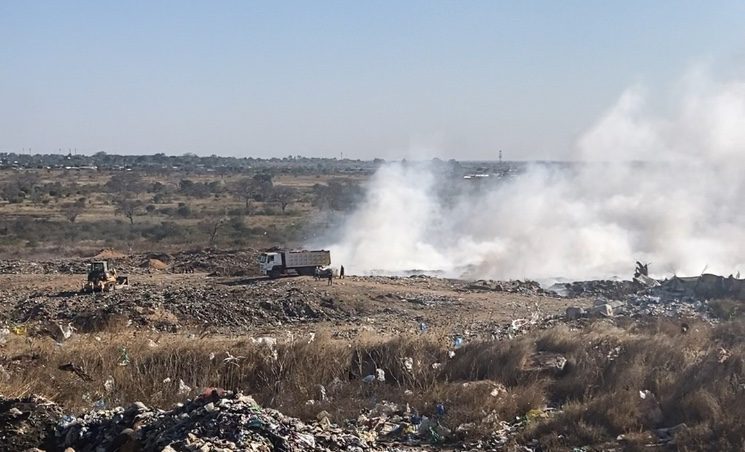
The dispute comes as the Bulawayo City Council faces mounting pressure to address environmental and public health problems at Ngozi Mine, where recurring fires and smoke have affected surrounding communities, including Cowdray Park.
Garwe has argued that Government intervention is necessary because of the urgency of the waste crisis and has described Geo Pomona’s waste management model as one that can be replicated in Bulawayo.
The council initially resisted the seven-day deadline, with Mayor David Coltart saying councillors had instructed management to obtain a draft Memorandum of Understanding from Geo Pomona for consideration before any decision was made.
The council later resolved to engage Geo Pomona, granting management authority to negotiate with the company and report back to councillors.
The decision was made while the council was still awaiting the outcome of its procurement process and engagements with ZIDA.
Residents’ associations and civil society organisations have also called for transparency over the proposed agreement, arguing that the city’s waste crisis should not result in procurement and public scrutiny requirements being bypassed.






Leave a Reply