
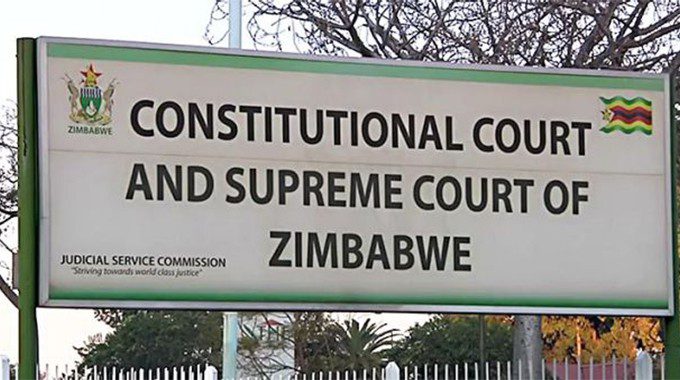
Zimbabwe’s Constitutional Court has set September 23, 2026, for the hearing of a landmark challenge by the opposition Movement for Democratic Change (MDC) against the Constitution of Zimbabwe Amendment Act No. 3 of 2026 (CAA3), with the party arguing the law unlawfully stripped citizens of their right to directly elect the President.
This means the Constitutional Court will now have to determine whether the changes introduced by CAA3 affect the constitutionally protected right to vote in a manner that triggers the referendum requirement, and, if so, what legal consequences flow from the failure to hold one.
The case, which will be heard before a full bench at 9:30am, centres on whether Parliament and President Emmerson Mnangagwa could amend the constitutional method of electing the President without first subjecting the changes to a national referendum.
The MDC, led by Douglas Mwonzora, filed its challenge on August 28, 2026 with detailed heads of argument filed on September 1, 2026.
On this topic
MDC national spokesperson Lloyd Damba announced the hearing date, describing the case as a defining moment in Zimbabwe’s constitutional history.
“We wish to inform all Zimbabweans that the Constitutional Court has set 23 September 2026 at 9:30AM as the date for the hearing of our challenge against the Constitution of Zimbabwe Amendment (No. 3) Act before a full bench,” Damba said.
“This is a defining moment in our constitutional history.”
The core argument of the MDC’s challenge is Section 3 of CAA3, which amends Section 92 of the Constitution and changes the manner in which the President is elected.
The party argues the amendment effectively limits the presidential vote to Members of Parliament, thereby removing ordinary citizens’ direct participation in presidential elections.
The MDC contends this amounts to an alteration of the right to vote protected under the Constitution’s Bill of Rights.
Section 67(3)(a) of the Constitution provides citizens aged 18 and above with the right to vote in elections and referendums. The MDC argues that, before CAA3, that right included voting directly for the President.
“The net effect of Section 3 has been to amend the right to vote as envisaged in Section 67(3)(a) of the Constitution of Zimbabwe,” the party says in its heads of argument.
The opposition argues that because the right to vote is protected under the Bill of Rights, an amendment affecting that right must undergo the constitutional procedure requiring approval through a national referendum.
No referendum was held before CAA3 was enacted, according to the MDC.
The party consequently wants the Constitutional Court to declare the amendment unconstitutional and invalid, arguing Parliament and President Mnangagwa could not lawfully alter a protected constitutional right through the process used to enact CAA3.
The MDC further alleges that the amendment deliberately avoided expressly referring to Section 67 in order to circumvent the referendum requirement.
Damba said the party’s position was that CAA3 was “null and void” because the constitutional process had not been followed.
“CAA3 removed the right of the general populace of Zimbabwe to directly elect the President. This is a fundamental alteration to our democracy and to provisions protected in the Bill of Rights,” he said.
The challenge also takes issue with provisions extending the terms of the President, Parliament and local government from five years to seven years.
The MDC argues that extending the terms of elected institutions, together with changing the manner in which the President is elected, directly affects citizens’ sovereign power and therefore requires public approval.
“Because it affects the right to vote, which is in the Bill of Rights, the bill must have been subjected to referendum first,” Mwonzora said.
The respondents in the case are Mnangagwa as the first respondent, Parliament of Zimbabwe as the second, Justice, Legal and Parliamentary Affairs Minister Ziyambi Ziyambi as the third and Attorney-General Virginia Mabiza as the fourth.
The MDC argues if the court finds that the amendment was enacted unlawfully, provisions and actions based on the contested amendment could also be affected.
“This case is not about the MDC alone. It is about whether Zimbabwe will remain a constitutional democracy, or slide into executive dictatorship. This is about Zimbabwe,” Damba said.
Meanwhile, the MDC has vowed to pursue the case to its conclusion.
“We will use every legal, political, and civic tool at our disposal to reverse this assault on the people’s sovereignty,” Damba said.








Leave a Reply