
A new £500 000 United Kingdom-funded programme aimed at ending violence against women and girls (VAWG) in Zimbabwe has been launched, with stakeholders calling for stronger partnerships between government, business and civil society to confront the scourge described as both a national and economic crisis.
The initiative, unveiled on Wednesday at the Small City Hall in Bulawayo on the sidelines of the Zimbabwe International Trade Fair 2026, seeks to bring together women’s organisations and corporate partners to collaborate on practical, community-driven solutions to prevent and respond to gender-based violence.
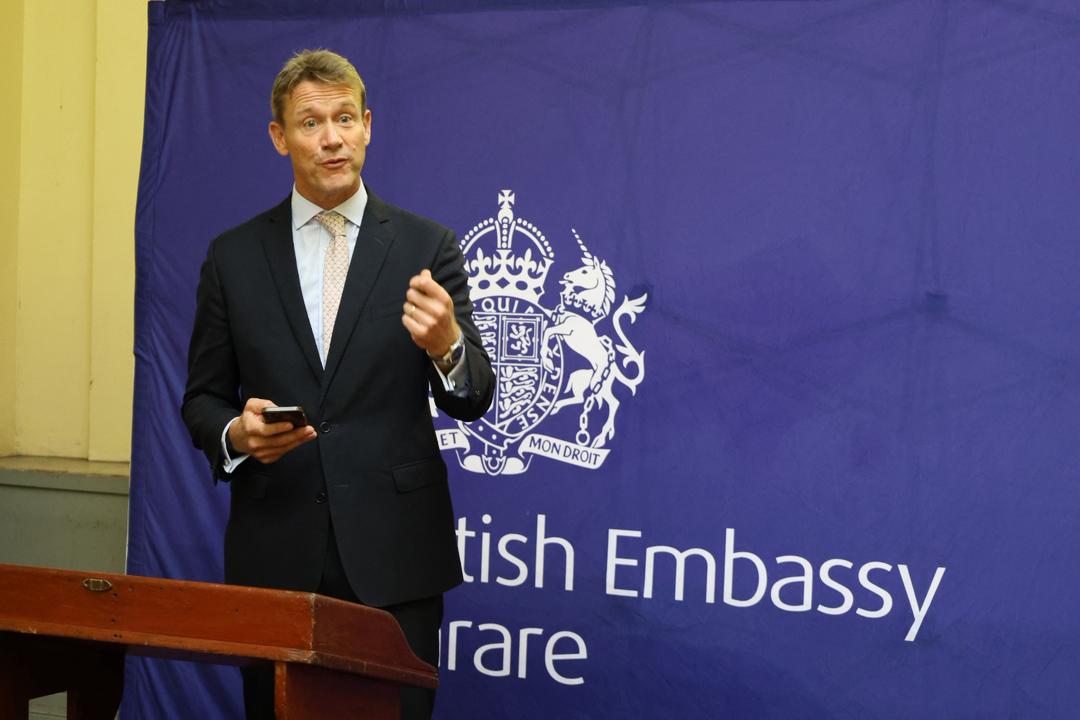
Speaking at the launch, British Ambassador to Zimbabwe, Pete Vowles, said the funding programme represents a deliberate shift towards locally led, sustainable interventions anchored on partnerships.
“We’ve deliberately brought together civil society, business, government, because violence against women is not just a women and girls issue…it’s a national issue and an economic issue as well,” said Vowles.
On this topic
Vowles stressed economic growth cannot be inclusive without addressing systemic inequalities and violence against women and girls.
He also underscored that while Zimbabwe faces significant challenges, with one in three women reportedly experiencing physical or sexual violence, the issue is global in nature.
“As a British ambassador, violence against women and girls is not a Zimbabwe issue. It is a global issue…In my own country, in the United Kingdom, one in four women experience domestic abuse in their lifetime,” he said.
Vowles added that the UK government has classified violence against women as a national emergency and committed to reducing its prevalence over the next decade.
The newly launched programme will be backed by approximately US$750,000 in funding, but Vowles stated that its success will not hinge solely on financial input.
“But it’s not about the money… it’s about using the money to support and to catalyse domestic resources,” he said.
The initiative aims to leverage corporate social responsibility budgets towards tackling harmful social norms that perpetuate violence, rather than focusing only on traditional philanthropic activities.
“Can we encourage them to use their resources to tackle some of the deep social norms that allow violence against women and girls to continue?” Vowles asked.
He acknowledged that past donor models often lacked local ownership and sustainability, adding the UK is seeking to “reimagine” its role.
“Our role probably works best when we are convening, when we are brokering, and when we’re supporting local initiatives,” he said.
Social Development Adviser at the British Embassy in Harare, Caitlin Spencer, said the programme is designed to address chronic underfunding of services for survivors while strengthening long-term sustainability.
“We know services for survivors are really critically underfunded and so the purpose of our funding is really thinking through how we support sustainability in the sector,” she said.
Spencer explained the funding will focus on mobilising domestic resources, including contributions from government, corporates, the diaspora and high-net-worth individuals.
“The expectation is our funding will help leverage new corporate financing… whether that’s in-kind financing, pro bono services, or whatever form makes sense,” she said.
Spencer added the programme will prioritise brokering partnerships between women’s organisations and corporates, while also strengthening the financial resilience of frontline organisations.
The funding is expected to support two to four grants, to be awarded competitively to partnerships between women’s organisations and corporate entities.
“We’re planning a market engagement event next month in Harare, where further details will be shared,” Spencer said.
United Nations Population Fund (UNFPA)
Zimbabwe Country Representative, Miranda Tabifor, said data shows the economic cost of gender-based violence in Zimbabwe is staggering, reinforcing the urgency of coordinated action.
“Money counts. Without money, we cannot provide a comprehensive response to gender-based violence,” she said.
Tabifor revealed preliminary findings from a study commissioned by the government, which indicate that gender-based violence is draining an estimated 3.87% of Zimbabwe’s GDP.
She broke down the costs, citing US$1.12 billion in tangible expenses related to psychosocial and support services and US$1.38 billion in human capital losses.
“Every time a woman is forced to stay home from work, or a girl drops out of school due to violence, the government loses its future productivity,” Tabifor said.
She added that over 12% of the cost stems from intergenerational impacts, where cycles of violence persist across generations.
“This 1.3 billion is everyone’s problem… that is why there is a power of partnership that we are talking about today,” she said.
Permanent Secretary in the Ministry of Women Affairs, Community, Small and Medium Enterprises Development, Dr Mavis Sibanda, welcomed the initiative, describing it as aligned with government priorities.
“GBV undermines economic progress and the growth of our national economy… it limits the full participation of women and girls in economic life,” she said.
Dr Sibanda said hosting the discussion alongside ZITF was strategic, given the role of the private sector in driving economic growth.
“The corporate sector is a driver of economic growth and a major employer. It has a critical role to play in strengthening GBV prevention and response,” she said.
She urged businesses to integrate gender-sensitive policies, including anti-sexual harassment frameworks, and to actively support survivor-centred initiatives.
“Let us make sure this dialogue does not end as mere talk,” Dr Sibanda said.
From the private sector, Managing Director at Telco Holdings, Dumisani Nomagugu Nkala, highlighted how societal factors, including gender-based violence, continue to limit women’s participation in key sectors such as technology.
She noted that women’s representation in STEM fields remains capped at around 40%, with many unable to progress into leadership roles.
“All of this goes back to societal and social factors,” Nkala said.
She highlighted the importance of safe spaces for women leaving abusive relationships, male advocacy and empowering girls from a young age.
“Without exit from those violent situations, they will never be able to rear girls who can see strength,” she said.
Nkala also stressed that ending violence against women requires collective responsibility.
“Without male advocacy, we’re never going to actually defeat this monster,” she said.
“Male advocacy goes even to making sure that our boys we’re raising right now are capable of dealing with stronger women, right? So I think that that’s a second important thing.
“I challenge each and every one of us raising a girl child in our homes, especially in Africa, as girl children, we’re raised to be responsible young adults even before we’re adults and we’re not allowed to play. Let’s let girls play because play is such an important part of dynamic leadership skills, in innovation, and being able to create. We don’t allow girls to play. They will immediately from the get-go, be disadvantaged in comparison to their male peers.”
Support CITE’s fearless, independent journalism. Your donation helps us amplify community voices, fight misinformation, and hold power to account. Help keep the truth alive. Donate today







Leave a Reply