
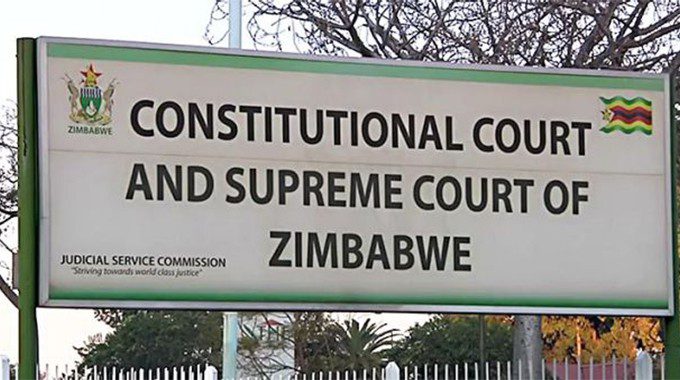
The Movement for Democratic Change (MDC) led by Douglas Mwonzora has approached the Constitutional Court seeking an order declaring the recently enacted Constitution Amendment No. 3 of 2026 unconstitutional, arguing President Emmerson Mnangagwa violated Zimbabwe’s Constitution by signing the legislation into law without first submitting it to a national referendum.
President Mnangagwa assented to the Constitutional Amendment Bill on Tuesday, 7 July 2026, and it was gazetted as Act No. 6 of 2026.
Among other changes, the amendment extends the terms of the President and Parliament from five to seven years, postpones the next harmonised elections from 2028 to 2030 and replaces the direct election of the President by voters with election by Members of Parliament sitting jointly.
According to the application filed in the Constitutional Court, the applicant is the MDC, a political party and legal persona, represented by its president, Douglas Mwonzora.
On this topic
The application states Mwonzora was authorised to institute the proceedings by a resolution of the party’s National Standing Committee dated 8 July 2026.
The respondents are President Mnangagwa, cited in his official capacity as the person who assented to the amendment; Parliament of Zimbabwe as the second respondent; the Minister of Justice, Legal and Parliamentary Affairs, Ziyambi Ziyambi, who introduced the Bill in Parliament, as the third respondent and Attorney-General Virginia Mabiza as the fourth respondent.
In its application, the MDC argues the amendment unlawfully removes Zimbabweans’ constitutional right to directly elect the President.
According to the court papers, Section 3 of the Amendment Act alters Section 92 of the Constitution by transferring the power to elect the President from the electorate to Parliament.
“In terms of Section 67(3)(a), every Zimbabwean citizen who is of or over the age of eighteen has the right to vote in all elections and referendums to which the Constitution or any other law applies. This means that the qualification to vote… in relation to the election of the President has effectively been changed,” the application states.
The party argues the right to elect the President has effectively been removed from ordinary citizens and vested exclusively in Members of Parliament.
The MDC further argues that because the amendment affects rights contained in the Constitution’s Bill of Rights, Section 328(6) required it to be approved through a national referendum before it could be presented to the President for assent.
“Once the Constitutional Bill has the effect of amending the Bill of Rights, then in terms of Section 328(6), the same Constitutional Bill has to be subjected to a referendum before being presented to the First Respondent for presidential assent,” reads the application.
The application states CAA3 alters the Executive, Legislature and Judiciary while also affecting the Bill of Rights, making a referendum constitutionally mandatory.
The MDC also argues that President Mnangagwa was placed in a conflict of interest because he assented to legislation from which he stands to benefit.
“The untenable situation that the First Respondent finds himself in is that as the direct beneficiary of the Amendment he finds himself with the task of approving the same amendment. This is the conflict of interest that Section 328(6) sought to cure,” the court papers state.
The application further cites Section 90(1) of the Constitution, which requires the President to uphold, defend and obey the Constitution, arguing that his failure to call a referendum amounted to a breach of his constitutional obligations under Sections 90(1), 110(2)(f) and 328(6).
The MDC is asking the Constitutional Court to declare that the President failed to fulfil those constitutional obligations, declare Section 3 of Constitution Amendment No. 3 unconstitutional, and set it aside.
Alternatively, the party seeks an order declaring the entire amendment null and void and directing that it be subjected to a national referendum.
It also seeks an order compelling President Mnangagwa to submit the Constitutional Amendment Bill to a referendum within three months, together with costs against the respondents.
CAB3 was passed by the National Assembly on 30 June 2026 by 226 votes to 41 after it had been approved by the Senate on 24 June 2026 by 75 votes to four.









Leave a Reply