
Hundreds of family members, traditional leaders, businesspeople, community leaders and beneficiaries gathered on Sunday to celebrate Bulawayo philanthropist Herbert Mutize’s 72nd birthday to honour his lifetime of service, entrepreneurship and community development.
Mutize began his entrepreneurial journey by making and selling baskets before establishing himself as one of southern Africa’s renowned sculptors. Over the decades, his impact has extended beyond business into informal trade, farming, education, environmental conservation and youth empowerment.
His birthday celebration was held at Cathrene Farm, along Harare road, where guests used the gathering to network and strengthen community development initiatives.
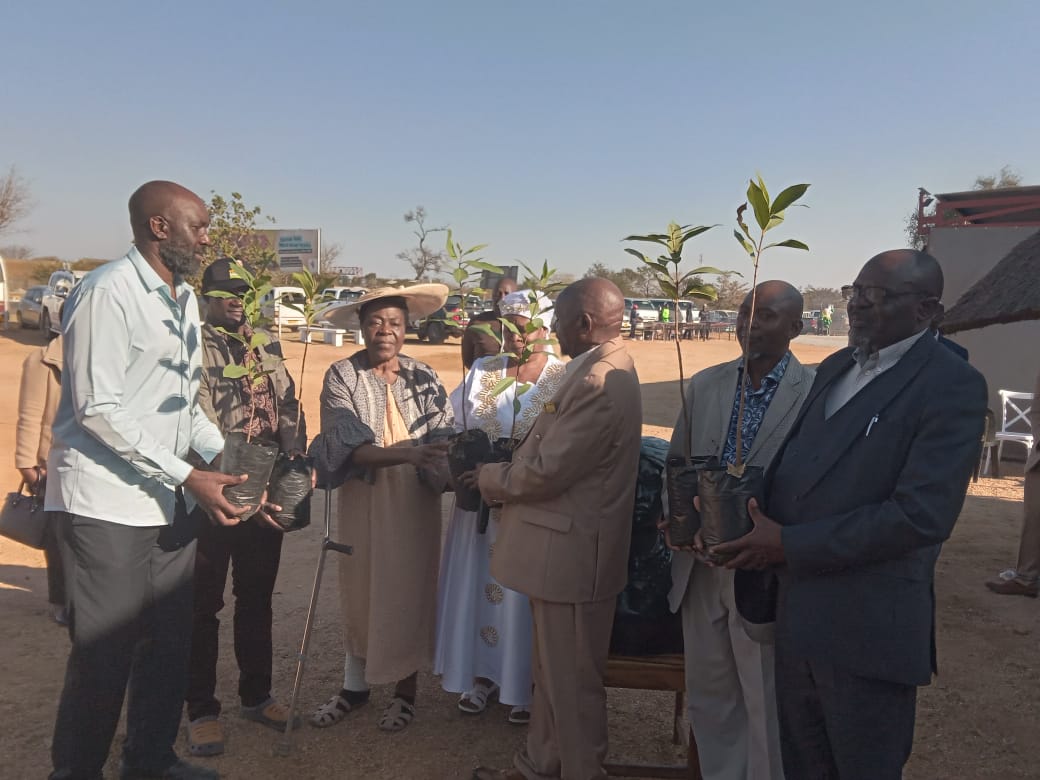
A highlight of the celebrations was a tree-planting ceremony symbolising Mutize’s commitment to environmental sustainability.
On this topic
Guests planted waterberry fruit trees at Cathrene Farm, while Mutize announced the allocation of four hectares of land to local environmental organisation Isandla Esihle.
The land comprises two hectares earmarked for peach production and another two hectares for grape farming to support the organisation’s environmental and livelihood projects.
Isandla Esihle founder and Zimbabwe’s National Tree Ambassador, Never Bonde, said Mutize had consistently demonstrated his commitment to environmental conservation and community development.
“Every function we attend, we plant trees because we believe environmental conservation must become part of our culture,” he said.
Bonde revealed the organisation had approached Bulawayo City Council seeking land to establish a rehabilitation centre for young people battling drug and substance abuse and was allocated land in Cowdray Park.
“We gave Mr Mutize a quotation for the project and immediately he committed himself to drilling a borehole for the rehabilitation centre,” Bonde said.
Beyond environmental work, Bonde said Mutize had partnered with the organisation to identify vulnerable children at Vulindlela Primary in Cowdray Park whose school fees he continues to pay.
The celebrations attracted traditional leaders from Mangwe District in Plumtree, including Chief Bango and Chief Sangulube, who travelled to Bulawayo to honour Mutize.
Chief Bango said their relationship with Mutize began through Chief Hobodo, who introduced them to Mutize’s church.
“We were five chiefs who attended the church, including Chief Tshitshi and Chief Madlambuzi,” said Chief Bango.
“The way we were welcomed encouraged us because there is nothing greater than when genuinely welcomed. We had gone there seeking prayers for our own challenges, but the relationship grew into something much bigger.”
He said Mutize later visited their communities in Mangwe, strengthening ties that extended beyond the church.
“We call him isitsha sikaNkulunkulu (God’s vessel) because he has allowed God to use him in serving the church, government and the nation. We felt his celebrations would not have been complete without us being here,” Chief Bango said.
Bulawayo Minister of State for Provincial Affairs and Devolution Judith Ncube, who was the guest of honour, praised Mutize’s resilience and contribution to economic empowerment.
“His vision is wide and he deserves support,” she said.
Ncube, who was gifted a sculpture by Mutize, praised him for promoting the arts and crafts sector in the city.
She also commended him for refusing to surrender after disaster struck his business.
“When his flea market burnt down, he did not give up. Resilience pays and patience pays,” she said.
In February 2023, the Mutize Flea Market in Bulawayo was destroyed by a devastating fire that left more than 500 informal traders counting losses estimated at approximately ZWL$80 million.
The market housed traders selling clothing, groceries, detergents, gas cylinders, stoves and other household goods, whose destruction left hundreds of families without livelihoods.
Despite the setback, Mutize rebuilt the facility, restoring hope to traders whose businesses depended on the market.
Ncube said she would “recommend that leadership starts compiling biographies of people like Mr Mutize so that we document their contributions while they are still alive.”
“Such people deserve to be respected now and future generations should know they played an important role in building our communities.”
She also challenged society to stop looking down upon informal traders, saying many successful entrepreneurs had started as vendors.
Mutize’s children paid emotional tributes to their father, describing him as a humble man who built both his family and community on faith, integrity and hard work.
One of his daughters, Omega Mutize said her father’s greatest lesson had always been that every success comes from God.
“Those words became real after the flea market burnt down. More than 500 vendors depended on that place and we did not know where to start. We had no plan. But with assistance from Mr (Eugene) Jackson, (Managing Director) of Pump and Steel Supplies through God’s grace, we rebuilt it and today the structure has become the talk of the town,” she said.
Third-born, Samuel Mutize said his father does not discriminate against anyone.
“At one point I had lost direction in my life, but he guided me back onto the right path and encouraged me to pray. When I did, my life began to change,” he said.
Youngest son, Alfred said his father had instilled values that continue to shape the family.
“He taught us hard work, honesty, generosity and the importance of church. He is a wonderful guy,” he said.
Family members also highlighted Mutize’s influence beyond Zimbabwe, with one nephew now based in Cape Town operating a successful sculpting business after he was mentored by him.
Long-time friend Eddie Marere said Mutize’s success story should inspire young entrepreneurs.
“He is tenacious. Even after losing the flea market, he remained hopeful because he knew the livelihoods of hundreds depended on rebuilding it,” Marere said.
“He started by buying a house in Magwegwe, then another in Highmount, expanded into property development and farming. The food we are eating here today comes from his farms. Young people should understand that success does not come easily. It requires hard work and having a supportive wife and family.”
Giving Mutize’s biography, family associate, one Mr Chinhamo said the businessman was born in Mutoko on June 12, 1952 and displayed entrepreneurial instincts from childhood by making and selling baskets.
Despite growing up during the colonial era when business opportunities for black Zimbabweans were severely restricted, Mutize ventured into sculpture in the mid-1970s, eventually becoming one of southern Africa’s renowned sculptors.
He later settled in Bulawayo with his wife, raising 12 children, 53 grandchildren and 10 great-grandchildren.








Leave a Reply