
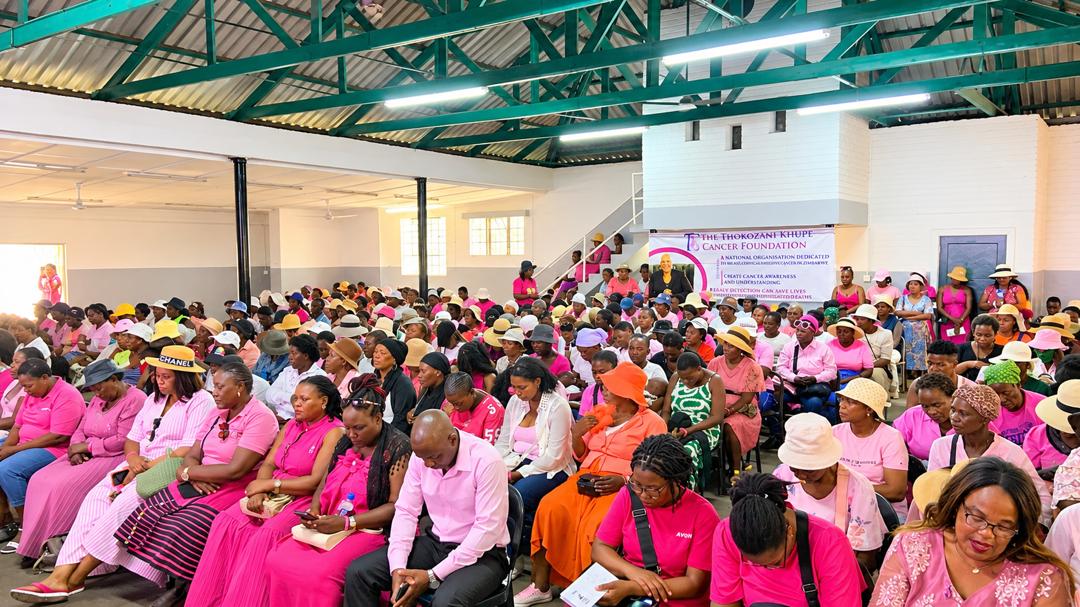
Zimbabwe must revive community-based healthcare strategies that helped the country tackle HIV and apply them to the fight against cancer, with communities taking the lead in awareness, early detection and supporting patients, former Health and Child Care Parliamentary Portfolio Committee chairperson, Dr Ruth Labode, has said.
Dr Labode said the fight against cancer should begin at community level through mobilisation, participation and the revival of community health workers, then escalating to clinics, hospitals and national policy interventions.
She was speaking during a belated Pink October commemoration organised by the Thokozani Khupe Cancer Foundation (TKCF) at Stanley Hall in Makokoba, Bulawayo, on Saturday, amid concerns that cancer is claiming an estimated 60 lives daily in Zimbabwe.
Dr Labode, a former provincial medical director for Matabeleland North and current commissioner with the Lancet Global Health Commissions, said Zimbabwe could draw lessons from its HIV response, which relied heavily on community participation and home-based care.
On this topic
She said the country’s progress in the HIV response had been recognised internationally, following her selection in January 2024, from a pool of 30 candidates, to serve on the Lancet Commission on People-Centred Care at Harvard University.
“When I was out of Parliament in 2023, in January 2024, I was told I was chosen out of 30 people to be part of the Lancet Health Commission on people-centred care at Harvard University. I asked why I was selected. They said it was because of the battle you fought and won in tackling HIV,” she said.
“If you can fight HIV, what of cancer? We managed to fight HIV through home-based care, which is people-centred care. It is because at the community level you mobilised yourselves. My wish is to go back to a community of health workers.”
Dr Labode said Zimbabwe needed to return to a model where communities actively participated in identifying health challenges, supporting patients and demanding action from authorities.
“As long as the community does not rise, the government will not rise. We need to rise the same way we did with HIV. Look at the collection of the AIDS levy, Zimbabwe was the first country to do it and HIV was dealt with,” she said.
“If communities stand up and say enough, cancer has overtaken HIV, but we are silent on cancer.”
She called for the development of coordinated community, health-sector and government strategies, arguing patients should be identified and referred through local clinics before accessing treatment at hospitals.
Dr Labode also called for increased government investment in cancer research, treatment infrastructure and access to affordable medication.
She proposed the establishment of a dedicated cancer board to coordinate national interventions, saying existing treatment centres were inadequate and that facilities should be expanded beyond Mpilo Central Hospital to other cities, including Masvingo, Gweru and Mutare.
She further questioned the implementation of the three percent sugar tax, which was introduced to support the health sector, and urged the government to make sure the revenue was channelled towards cancer prevention and treatment.
Dr Labode also called for collaboration between the University of Zimbabwe and the Zimbabwe National Traditional Healers Association (ZINATHA) to investigate traditional medicines that could potentially contribute to cancer treatment, subjecting them to scientific research and appropriate dosage testing.
Meanwhile, former Deputy Prime Minister and Bulawayo Member of Parliament, Dr Thokozani Khupe, said the country’s cancer burden required urgent government intervention, particularly in expanding access to treatment through public health institutions.
Khupe, who established the foundation in October 2012 to promote awareness and early detection, said Zimbabwe recorded approximately 31 200 new cancer cases annually, with an estimated 21 600 deaths.
This translates to 1 800 deaths every month, or about 60 people dying from cancer every day.
“Our cancer prevalence rate as we speak right now is 208 out of every 100 000, which means we have 31 200 people who are diagnosed with cancer every year,” she said.
“These are not small numbers. This is your skilled manpower, these are your farmers, your teachers, your doctors, your nurses, your professors and your engineers.”
Khupe said the high cost of treatment was placing cancer care beyond the reach of many Zimbabweans, calling on the government to strengthen public health institutions so that patients could access affordable services.
“At the moment there is no cancer treatment in our public hospitals except if you go to private hospitals, which is very expensive,” she said.
“We cannot continue having 60 people losing their lives every day from cancer. We must do something about it because something can be done to make sure that people do not die.”
The commemoration also provided a platform for cancer survivors to share their experiences, highlighting the financial, physical and psychological challenges associated with diagnosis and treatment.
Senator Linda Sibanda, who was diagnosed with cervical cancer on December 5, 2019, recounted undergoing 23 radiotherapy sessions in August 2020, as well as chemotherapy and other treatment.
She said she encountered challenges when a radiotherapy machine malfunctioned, forcing her to seek treatment in Harare.
The experience also exposed the financial difficulties patients face, with her friends having to pool resources to raise US$5 000 towards her treatment.
Another survivor, Linda, who was diagnosed with stage three breast cancer in 2024, said she initially discovered two sores on her left breast before seeking medical attention at Luveve Clinic, which referred her to Mpilo Central Hospital.
She subsequently underwent surgery to remove her left breast, followed by chemotherapy.
“We should encourage everyone that cancer is not a death sentence. We need support systems,” she said.
Ruth Memeza Ncube also shared how delaying chemotherapy after initially turning to herbal remedies contributed to the progression of her cancer.
She said she had initially been diagnosed with cancerous cells following treatment for fibroids but went into denial when doctors recommended chemotherapy.
After she was advised by some people to use herbs instead, she returned to hospital to discover that the cancer cells had doubled.
Ncube said she eventually underwent chemotherapy, spending approximately US$7 500 on treatment and associated travel and accommodation costs in Harare.
She called for increased government funding for research and public awareness to help communities make informed decisions about treatment.
Zimbabwe Human Rights Commission Commissioner and TKCF board member Addelis Sibutha said access to healthcare was a constitutional right that required functional hospitals, adequate equipment and sustained advocacy.
Bulawayo MP Nomvula Mguni urged communities to prioritise healthy diets and seek professional counselling, while MP Otilia Sibanda called for stronger engagement with lawmakers, particularly during parliamentary health and budget hearings.
She said communities should actively demand that cancer prevention and treatment receive attention in national budget allocations.
A representative from Mrs Sinkwa, Liticia Amanda Trindade, which supported the initiative, also pledged to continue raising awareness beyond October, arguing that cancer prevention should be a year-round effort.
The event brought together residents from Makokoba, Entumbane, Luveve, Njube, Lobengula, Magwegwe, Mzilikazi, Thorngrove, Iminyela and Mpopoma, alongside councillors, legislators, community representatives and cancer survivors.
The foundation said its awareness programmes, particularly on breast and cervical cancer, were aimed at promoting early detection and encouraging people to seek medical attention.





Leave a Reply