
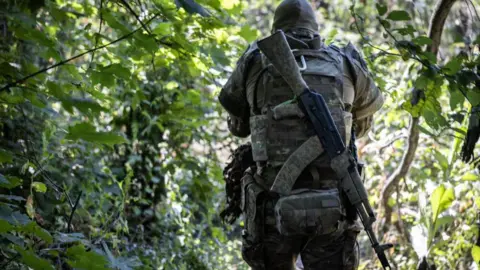
Nine Zimbabweans have been arrested in South Africa on suspicion of planning to travel to the Russia-Ukraine war, as Zimbabwe’s government warns that recruitment agencies may be exploiting jobseekers for financial gain.
The nine were arrested on Sunday, November 8, at OR Tambo International Airport and a hotel in Bruma, Johannesburg, during an intelligence-led operation involving South Africa’s Directorate for Priority Crime Investigation (Hawks), Interpol and other law enforcement agencies.
They appeared in two separate magistrates’ courts in Gauteng on Monday, facing charges under South Africa’s Regulation of Foreign Military Assistance Act of 1998, which regulates participation in foreign military activities.
Five of the accused – Weight Mudhanyane, 23, Javangwe Munyaradzi, 41, Wesley Sothole, 24, Abel Muchenje, 40, and Knowledge Ndunduma, 46 – appeared before the Kempton Park Magistrates’ Court.
On this topic
The other four, Bobo Chinhondo, 43, Batsirai Shereni, 24, Liberty Shereni, 44, and Niobe Zhou, 37, appeared before the Johannesburg Magistrates’ Court.
The Kempton Park case was postponed to November 10, while the Johannesburg matter was adjourned to November 12 to allow the accused to secure legal representation.
All nine remained in custody.
South Africa’s National Prosecuting Authority (NPA) said the arrests followed an investigation into allegations that the men intended to leave the country to participate in the ongoing conflict between Russia and Ukraine.
Authorities have not publicly identified the alleged recruiters or disclosed the specific arrangements under which the men intended to travel.
Government warns of recruitment exploitation
Zimbabwean government spokesperson Nick Mangwana has warned that agencies recruiting Africans to fight in foreign conflicts could be exploiting vulnerable jobseekers and profiting from their deaths.
In a post on X, Mangwana accused some recruitment agencies of withholding salaries, signing-on fees and other payments owed to recruits.
“They want you dead so they keep every penny,” he wrote.
“Joining foreign wars like the one between Russia and Ukraine is not as lucrative as the agencies (i.e. human traffickers) may make it sound.”
Mangwana alleged that some agencies receive money intended for recruits but fail to pass it on, adding that those who survive the fighting may struggle to recover their contractual payments.
He also warned that recruits who die on the battlefield could leave their families unable to claim money owed to them.
“Second, they prefer that you die at the front, because then you become less of a problem to them: they keep all the money, and your estate has no capacity to claim your dues,” he wrote.
Mangwana did not provide evidence to substantiate the allegations against recruitment agencies, and it is not clear whether they relate directly to the nine men arrested in South Africa.
Zimbabweans drawn into Russia’s war
The arrests come amid growing concern over the recruitment of Zimbabweans to fight for Russia in its war against Ukraine.
Some Zimbabweans have reportedly been lured by promises of lucrative civilian jobs before being deployed to the battlefield.
In March 2026, Information Minister Zhemu Soda confirmed that 15 Zimbabweans had died in the conflict, while 66 others were still alive in Russia. The government later revised the reported death toll to 18.
CITE investigations have documented recruitment networks operating in Zimbabwe and South Africa, targeting unemployed people and others seeking better economic opportunities.
Some Zimbabweans interviewed by CITE said they had been promised attractive salaries and employment opportunities, only to discover that they were expected to undergo military training and fight on the Russian frontlines.
Others alleged that their passports had been confiscated and that they were made to sign contracts written in Russian, a language they did not understand.
The recruitment of foreign nationals into the conflict has also attracted international scrutiny.
In October, a United Nations commission of inquiry reported that Russian authorities had engaged in human trafficking through deceptive and coercive recruitment practices involving nationals from 29 countries.
The commission documented cases in which people recruited for what they believed were civilian jobs were subsequently pressured into military service.
The arrests in South Africa highlight concerns about recruitment networks operating across southern Africa and the vulnerability of people seeking employment abroad.
They also raise questions about who finances the travel arrangements, how prospective recruits are identified and whether those being recruited fully understand the risks of joining a foreign military conflict.






Leave a Reply