
By Jeff Ndimande
When veterans remember the Soviet Union as ZPRA’s international ally, what history are they telling? And what happens to China and North Korea in that account? The Soviet relationship was important, but it was not the whole international history of ZAPU and ZPRA. The question is not simply whether some countries have been forgotten. It is how an African liberation struggle comes to be understood through the ideological disputes of the states that supported it.
This matters because historical narratives can reproduce the hierarchies of the worlds they seek to explain. The Cold War has often been narrated from the capitals of powerful states, making African liberation movements appear as instruments of competing geopolitical projects. From this perspective, the significance of an African movement rests on which foreign power armed it, trained it, financed it or claimed its political allegiance. African actors become the terrain on which somebody else’s history unfolds.
A history attentive to the Black radical tradition must begin from a different premise: African people were not merely objects of colonial rule or pawns in international politics. They were political actors who imagined freedom, organised to achieve it and negotiated the conditions under which their struggles could proceed. For ZAPU and ZPRA, international relationships were indispensable. But assistance did not automatically confer political authorship. The struggle cannot be reduced to the intentions of those who provided it.
On this topic
Beyond the map of the Cold War
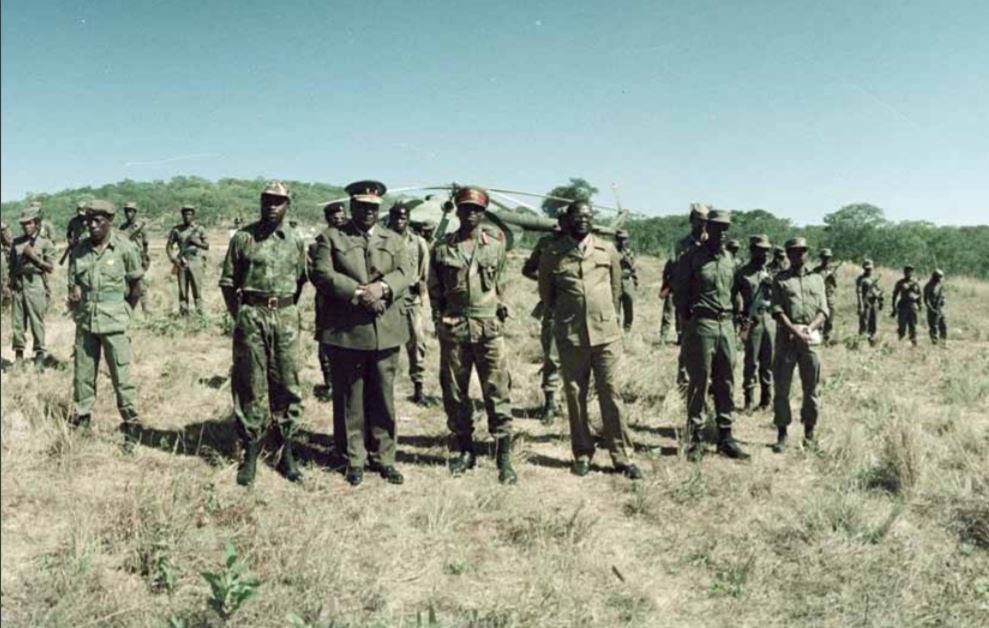
Brigadier (Ret) Abel Mazinyane’s 2017 account, “Lest We Forget: How ZPRA Rose from the Ashes”, recalls that ZAPU’s Special Affairs had soldiers in Zambia, Tanzania, Bulgaria, North Korea and the Soviet Union, as well as in Rhodesian prisons. He also remembers cadres who had received training in Eastern Europe and North Korea being brought to Morogoro, Tanzania, in 1970. These recollections complicate any account that makes the Soviet relationship the natural starting point, centre and culmination of ZPRA’s military history.
The earlier Chinese connection matters too. Accounts of the 13 young nationalists who went to China in 1963 describe training in explosives, disguise and guerrilla warfare. Clark Mpofu recalled that Mao Zedong’s Thoughts of Chairman Mao Tse-tung were “a daily food”. This is a significant recollection. But what, precisely, does it establish? That Chinese training took place; that Maoist texts formed part of the experience; and that particular ideas were encountered and perhaps taken seriously. It does not, by itself, establish that ZPRA possessed a fixed Maoist identity, any more than later Soviet assistance makes the organisation an extension of Moscow.
We must distinguish the circulation of ideas from their reception, and reception from political allegiance. What did cadres learn, adapt, reject or reinterpret? How did military requirements, political commitments and changing circumstances shape those processes? These questions restore African intellectual and political labour to a history too easily told as the transmission of doctrines from one capital to another.
Nor should we assume that the history of Special Affairs continued unchanged into the formal emergence of ZPRA as a military organisation in 1973. Continuities must be investigated, not presumed. Organisations change, political circumstances shift and relationships acquire different meanings. Historical recovery requires us to follow those changes rather than impose a single ideological identity retrospectively.
The quarrels of our former allies
Documents from the socialist world reveal why this distinction matters. In his 1959 outline on the international situation, Mao argued that China and the Soviet Union shared basic interests and should unite, even as he acknowledged disagreements with the Soviet leadership. In a January 1963 letter to Fidel Castro, Nikita Khrushchev defended Soviet assistance and criticised those who offered revolutionary rhetoric without equivalent material support, insisting that “only real forces can hold back the enemy”. These were interventions in contested political relationships, not neutral descriptions of socialist internationalism.
Leonid Brezhnev’s 1966 account of a conversation with Kim Il Sung similarly reflected Soviet concerns about Chinese influence. Later, Fidel Castro’s correspondence made the rivalry even more explicit. In 1977, Castro interpreted the alignments of Zimbabwe’s liberation movements through a regional and international struggle for influence. He advocated forming a ZAPU army from cadres in Angola, partly to “roll back China’s influence”.
These documents are valuable, but we must read them against the grain. They tell us how Mao, Khrushchev, Brezhnev and Castro understood their interests, their allies and their adversaries. They do not automatically tell us how ZAPU and ZPRA understood themselves. Castro’s interpretation of Nkomo’s relationships, for example, should not be mistaken for Nkomo’s own political calculations or for the full range of views within ZAPU.
The distinction is more than a matter of source criticism. It concerns the terms on which African history becomes knowable. If we accept the categories of powerful states as our own, we risk allowing those states to determine what African political action meant. We may then find ourselves asking whether ZPRA was closer to Moscow or Beijing, as though its historical significance depended on the answer.
The Sino-Soviet split mattered. But it was not ZPRA’s quarrel to resolve.
An African international
Rejecting this framework does not mean minimising international assistance or romanticising African autonomy. Following Angola’s independence, the relationships involving Angolan territory, Cuban military instruction, and Soviet weapons and uniforms reveal a differentiated international infrastructure. Cuban records reported that 6,168 ZAPU combatants had been trained at Boma by October 1978. The figures invite further questions about military organisation, the division of labour among international partners and ZAPU’s own strategic calculations. They do not support a history organised around a single patron.
We must also recover the African geographies of the struggle. Zambia, Tanzania, Angola and Botswana were not merely corridors between African liberation fighters and foreign powers. They were political spaces in which people crossed borders, sought refuge, encountered state authorities, received training and built relationships. Cadres passing through Botswana could report to a police station and be processed as refugees before proceeding to Zambia for training. On deployment, their routes could again take them through Botswana. Such journeys remind us that the international was experienced through African territories, institutions and encounters.
These places were not interchangeable backdrops. Their governments, regulations, diplomatic choices and material conditions shaped what was possible. An African-centred international history must therefore take seriously the politics of movement, refuge, territory and negotiation, not only the diplomacy conducted in distant capitals.
Why, then, does the Soviet connection loom so large in some recollections, while earlier Chinese and North Korean relationships recede? The scale of later assistance, the experiences most readily recalled, the survival of records and the political circumstances in which memories are narrated may all matter. These are questions for investigation, not conclusions to impose in advance. Veterans’ memories should neither be dismissed nor treated as exhaustive accounts of the past. They preserve experience, but they also invite us to ask how particular relationships acquired their prominence.
The task is not to correct an allegedly Soviet-centred history by replacing Moscow with Beijing or Pyongyang. That would leave the underlying problem intact. It would still make ZPRA’s history answerable to the ideological competition of foreign powers.
A history grounded in African agency begins instead with ZAPU and ZPRA: the purposes for which they sought international relationships, the choices they made under unequal conditions, and the ways they navigated a world in which solidarity could be both enabling and politically contested. Their international relationships were part of their history, but they did not exhaust their political imagination.
Otherwise, we risk embracing the collars of our former allies and mistaking their quarrels for the limits of our own past.




Leave a Reply