

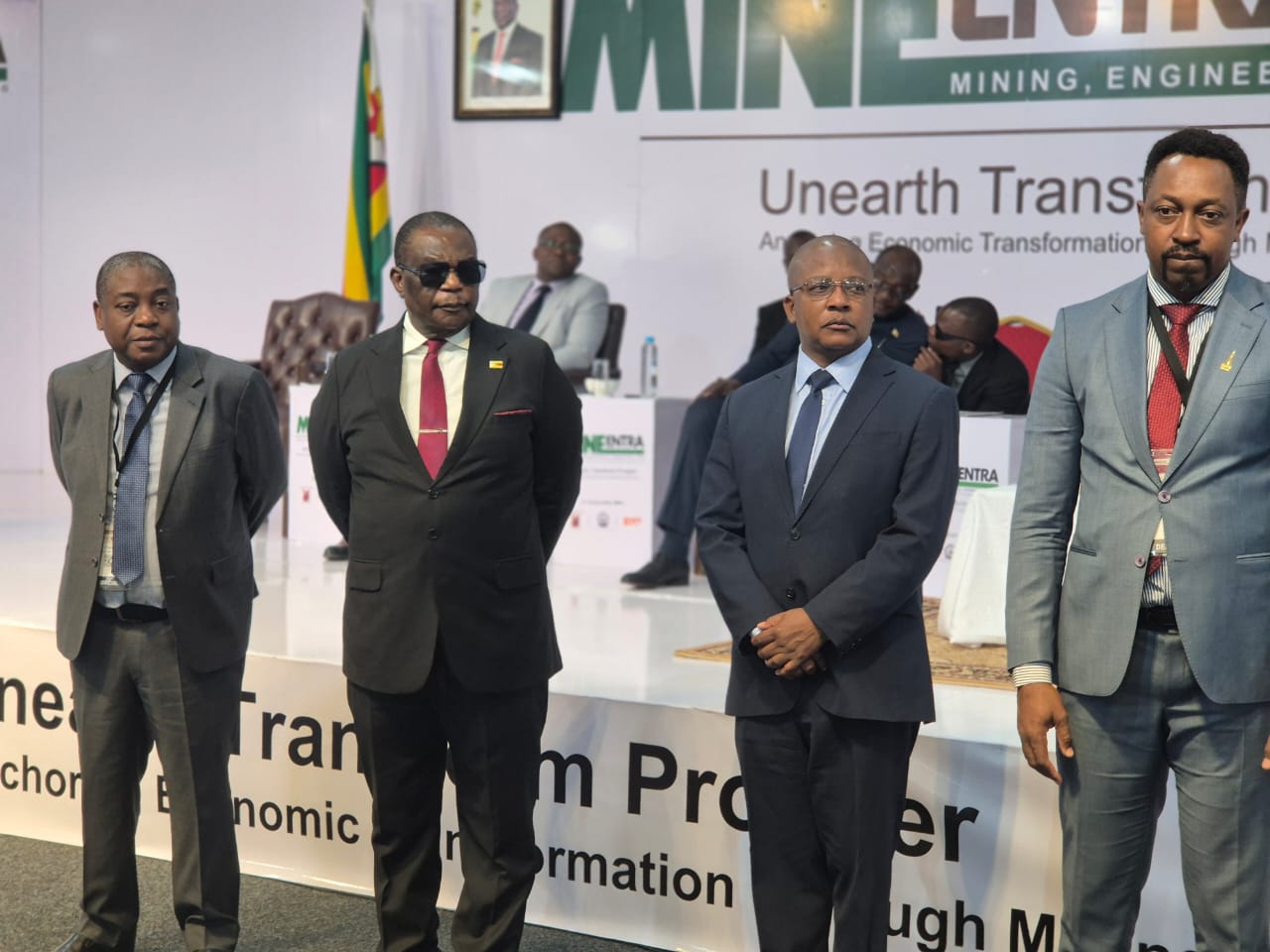
President Emmerson Mnangagwa has declared that Zimbabwe will stop exporting unprocessed strategic minerals, saying the country’s natural resources must be processed locally to create jobs, drive industrialisation and ensure communities benefit from the mining sector.
The announcement was made in a speech delivered on the President’s behalf by Vice-President Constantino Chiwenga at the opening of the 2026 Mine Entra Mining, Engineering and Transport Exhibition in Bulawayo on Friday.
Mnangagwa, who was the guest of honour, did not attend the event because of what organisers described as pressing State commitments. The president was later seen welcoming a delegation from the International Federation of Red Cross and Red Crescent Societies (IFRC) at State House in Harare.
Speaking under the theme “Unearth, Transform, Prosper: Anchoring Economic Transformation Through Mining Value Chains,” Mnangagwa said the government was determined to move Zimbabwe away from exporting raw minerals towards a value-added mining industry.
On this topic
“Under the Second Republic, the aim is to build a value-added mining economy. Through beneficiation and industrialisation, we want to guarantee maximum value from our God-given natural resources,” he said.
He said the country’s mineral wealth should improve the lives of ordinary Zimbabweans rather than simply increase export earnings or company profits.
“Ultimately the mining industry must not only aid in expanding the national wealth or economic growth, but result in tangible benefits to the ordinary citizens.”
Mnangagwa said the government would no longer tolerate the export of valuable minerals disguised as low-value ore or concentrates.
“The days where consignments leave our borders declared simply as ‘ore’ or ‘concentrates’, meanwhile containing valuable and rare earth minerals, are over,” he said.
As part of the new policy, he said Zimbabwe intends to export only lithium sulphate from January 2027, adding that the government had introduced transitional measures to allow companies time to complete local processing facilities.
“It is my expectation that, by January 2027, Zimbabwe will only export lithium sulphate. To ease that transition, my Government has put in place an orderly quota arrangement so that no responsible operator shuts down.”
Mnangagwa described the first export of locally produced lithium sulphate by Prospect Lithium Zimbabwe in April as a milestone for both Zimbabwe and the African continent. He also urged companies developing lithium processing plants at Bikita, Kamativi and Sandawana to complete the projects without further delays and said similar beneficiation requirements would be introduced in the platinum sector, including the establishment of a precious minerals refinery.
The President also warned mining companies against environmentally harmful practices, saying economic growth could not come at the expense of communities.
“Responsible mining is an essential condition for operating in Zimbabwe. A situation where mining practices result in environmental and social harms, destruction of the environment, toxic waste, increased carbon emissions, along with contamination of waterways and soil, will not be condoned,” he said.
He added that his administration would not allow the health and livelihoods of communities to be sacrificed for commercial gain.
Mnangagwa also issued a warning to corrupt public officials and mining companies involved in bribery, saying both those offering and receiving kickbacks would face severe penalties.
Calling for more inclusive growth, he urged mining companies to strengthen local procurement, create opportunities for surrounding communities and support domestic manufacturing of mining inputs to reduce dependence on imports.
He also called for increased mineral exploration, faster completion of Zimbabwe’s mining cadastre, improved transport infrastructure, greater electricity generation and wider adoption of digital technologies, including artificial intelligence, automation and geospatial mapping.
The President reaffirmed the government’s support for both large-scale mining companies and artisanal and small-scale miners, noting that the small-scale sector remains the country’s biggest contributor to gold deliveries.
He said mining should be viewed as a key pillar of Zimbabwe’s economic transformation rather than simply a source of export revenue.
“Mining, for Zimbabwe, is no longer merely a line of revenue. It is one of the central pillars through which we are building, developing, modernising and industrialising our beloved motherland.”
Vice-President Chiwenga officially declared the 2026 Mine Entra Mining, Engineering and Transport Exhibition open on the President’s behalf.




Leave a Reply