

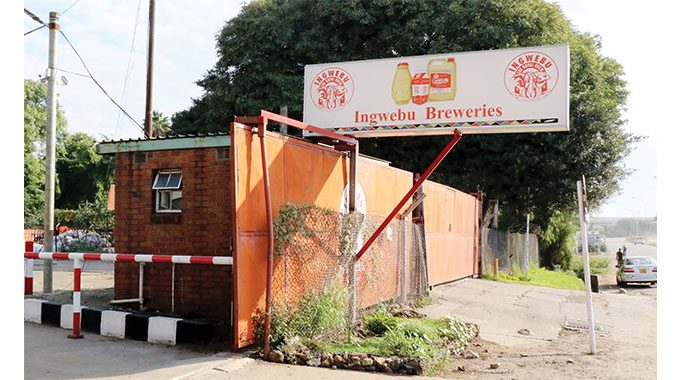
Ingwebu Breweries workers have gone for several months without salaries, forcing them to stage a strike at the municipal-owned brewery’s Bulawayo premises from Tuesday last week, exposing a business crippled by ageing infrastructure, collapsing production and years of underinvestment.
The strike comes as management admits employees are owed the equivalent of about 16 months’ salaries accumulated over several years, while revealing that production has fallen by more than three quarters after repeated equipment failures left the brewery operating with a single ageing boiler.
Management says Ingwebu is battling a deepening crisis driven by its ageing 1946 plant, obsolete boilers, outdated equipment and declining production, forcing the municipal-owned brewery to seek US$8.5 million for recapitalisation and appeal for investors to rescue one of Zimbabwe’s oldest beverage manufacturers.
The brewery once sold more than 50 million litres annually but is now producing less than a quarter of its former monthly output as it grapples with mounting losses and worsening operational challenges.
On this topic
Workers say they are demanding payment of salary arrears after enduring prolonged periods without wages amid the company’s financial distress.
In an interview with CITE, Ingwebu Breweries Managing Director, Dumisani Mhlanga, said the salary arrears had accumulated over several years rather than consecutive months.
“On the issue of outstanding salaries, we are looking at a total of about 16 months. These are not 16 consecutive months,” he said.
“We last paid our staff in January this year. The outstanding months accumulated because we paid salaries as and when we had the money.”
Mhlanga acknowledged the hardships workers have endured, saying management had also gone for long periods without salaries.
“I sympathise a lot with our employees. Going for so long without getting paid is difficult for anyone. We feel it ourselves as management. People think management is okay, but we’re not fine. We also haven’t been paid for a very long time and everyone’s struggling,” he said.
According to Mhlanga, the salary crisis is the result of years of declining production caused by obsolete infrastructure that has left the brewery unable to compete with rivals using modern technology.
The biggest challenge, he said, is Ingwebu’s ageing boiler system.
The brewery, commissioned in 1946, originally operated six boilers but now relies on a single 66-year-old boiler after the others progressively failed.
“Our boilers are as old as 1960. In fact, we are left with one boiler right now,” said the MD.
The boiler has been derated by the National Social Security Authority (NSSA), meaning it can no longer safely produce its original steam capacity because of its age.
It frequently operates for only two or three days before breaking down, forcing production to stop while engineers wait several days for it to cool before repairs can begin.
“We used to sell an average of four million litres a month. Today, we are below one million litres, producing about 900 000 litres a month,” Mhlanga said, noting production had already begun declining before the latest boiler failed in January.
“In August last year, we sold 2.5 million litres before dropping to 2.3 million litres. When another boiler failed in January this year, production plunged to just 900 000 litres.”
The fall in production has also severely reduced revenue.
Mhlanga said monthly revenue has dropped from around US$1.2 million to US$1.3 million to about US$300 000, leaving the company unable to cover fixed operating costs, pay suppliers or settle employee salaries.
The decline marks a dramatic reversal for a company that remained profitable only a few years ago.
“In 2019, we sold 50.4 million litres. Those are good numbers. In 2020, despite Covid-19, we still sold more than 44 million litres. But the numbers have just been declining,” Mhlanga said, adding years of repairing obsolete equipment had reached their limit.
“It’s a 1946 plant and you can only repair so much. Our pressure cookers have patches everywhere. It should have been written off long ago.”
The MD said the brewery’s ageing packaging technology was also reducing its competitiveness because it produced beverages with a shorter shelf life than those of competitors using modern equipment.
“Our (Calabash) containers are using old technology, and that affects shelf life. We are trying to sell a product that is not supported by the kind of technology the market now expects,” he said.
Although the brewery recorded a relatively modest loss of about US$50 000 in 2024, Mhlanga said another boiler malfunctioned in 2025 before another one completely failed in January, this year, accelerating the collapse in production.
Beyond the ageing boilers, Mhlanga identified three other operational failures that have steadily undermined the brewery’s competitiveness.
He said outdated pressure cookers and fermentation tanks have significantly reduced production capacity and affected product quality.
Of the brewery’s nine pressure cookers, only two remain operational, limiting daily production to between 20 000 and 40 000 litres, well below the plant’s capacity of 130 000 to 140 000 litres.
The company is also operating an ageing distribution fleet, with trucks and trailers dating back to the 1960s frequently breaking down while transporting products, resulting in delayed deliveries, product spoilage and lost sales.
In addition, Ingwebu lacks adequate refrigeration infrastructure in the market.
Management said the brewery’s products have a relatively short shelf life, making it difficult to distribute them to hotter markets such as Hwange and Beitbridge without sufficient cold-chain facilities.
Mhlanga said the only sustainable solution is recapitalisation through investment in modern equipment.
“This business is a 1946 business and therefore needs recapitalisation. The only way we are going to get this business back on track is to put in new, modern equipment that will allow us to compete with other players in the market,” he said.
The MD said Bulawayo City Council had authorised management to seek investors and discussions with potential financiers were at an advanced stage.
“We have some serious investors that are keen to come and put in money and modernise this business. I think we are very, very close to getting an investor,” Mhlanga said.
The potential investors are currently carrying out due diligence, a process Mhlanga said could not be rushed because of the size of the proposed investment.
In the meantime, the company plans to stabilise operations by purchasing a second-hand boiler, refurbishing its pressure cookers and fermentation tanks, and restoring production while pursuing long-term investment.
Mhlanga said a new boiler would cost about US$760 000 and take six to seven months to deliver, while a refurbished second-hand boiler could be installed within four to five weeks. Refurbishing the brewery’s pressure cookers and fermentation tanks is expected to take about two months once funding is secured.
Overall, Ingwebu estimates it requires about US$8.5 million to fully modernise the brewery.
Reflecting on the company’s history, Mhlanga said Ingwebu had previously faced possible closure before recovering.
“When I joined, they wanted to sell the business because it had been making serious losses. We restructured, cleared our creditors and turned the business around. We were doing well, but Covid-19 affected us negatively,” he said.
Mhlanga said management continues engaging workers despite growing frustration over unpaid salaries.
“They are frustrated, and I think they are justified. But we believe if we secure the funding, repair the boilers and refurbish the brewery, we will restore production and start paying salaries on time,” he said.
Sources familiar with discussions between management and workers said the brewery has about 200 000 litres of beer in storage with a shelf life of only five days, raising concerns the product could expire before it reaches the market due to the ongoing strike.
The sources said some workers have demanded they be allowed to sell the stock themselves as a way of recovering part of their outstanding salaries.
Management is understood to be considering a proposal under which the beer would be sold, with part of the proceeds going towards workers’ salary arrears and the remainder used to purchase raw materials needed to keep the brewery operating while it pursues investment.
According to the sources, the stock is valued at about US$60 000.
Management believes allowing the product to expire would worsen the brewery’s financial position and could undermine efforts to keep the business operating while negotiations with potential investors continue.





Leave a Reply