
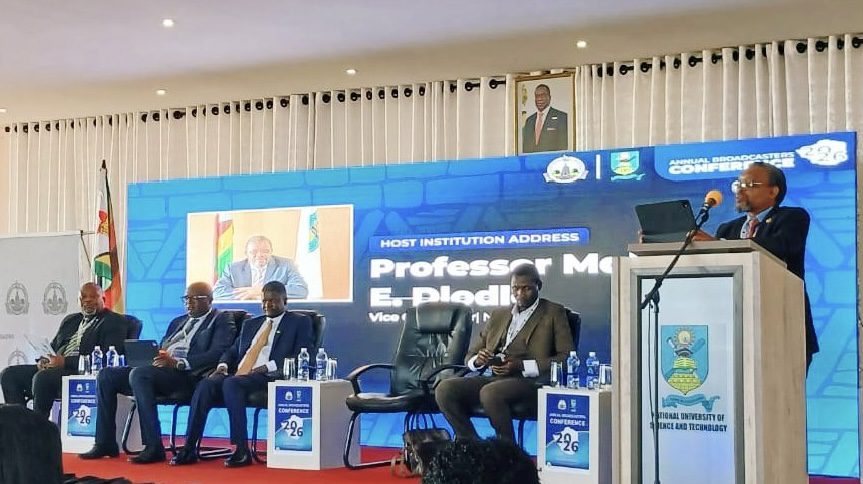
The solutions to the disruptions facing the media industry lie not in boardrooms, but in lecture halls and research laboratories, a senior academic has declared.
Professor Mqhele Dlodlo, Vice Chancellor of the National University of Science and Technology (NUST) told delegates at the Annual Broadcasters Conference 2026 on Wednesday that academia must be at the forefront of shaping a sustainable future for broadcasting.
“Solutions to media industry disruptions belong in the spaces where knowledge is generated and tested,” said Prof Dlodlo, who was speaking on the role of academia in media transformation.
The conference, held at NUST in Bulawayo under the theme “Shaping the Future of Broadcasting: Sustainability, Innovation and Collaborative Regulation,” was strategically co-hosted by the Broadcasting Authorities of Zimbabwe (BAZ).
On this topic
The day’s proceedings were held under the banner of Policy Leadership, Regulation, and Industry Sustainability.
Prof Dlodlo argued that universities are uniquely positioned to provide the data-driven insights and technological innovations that broadcasters desperately need to remain relevant.
“The media practitioner who has not prepared for this change risks being rendered irrelevant. The future belongs to those who embrace and accept this change,” he warned.
He highlighted the critical role of NUST as a pioneer in journalism and media studies, noting that many of the country’s seasoned media executives are alumni of the institution.
Among them, he pointed to the deputy minister of Information, Publicity and Broadcasting Services, Dr Omphile Marupi, stating this connection is “a living reminder that seeds planted in academia grow into leaders who drive our broadcasting sector forward.”
A key aspect of Prof Dlodlo’s argument was the need to bridge the gap between research and practice.
He lamented there were too many research findings and innovations “gathering dust” in publications and hubs, rather than going through implementation by the industry.
“There is a need for strong academia-industry collaboration within the media sector,” he said.
He cited NUST’s campus radio station, “Umsakazo oTops,” as a living laboratory where students gain hands-on experience, experiment with new formats, and set trends that ripple into the wider media landscape.
He described the station as a vital tool for equipping the next generation of broadcasters with digital-ready skills.
The conference was told that bringing regulators and researchers under one roof ensures broadcasting companies are grounded in their ability to train and adapt.
NUST also announced that the institution is currently revising its curriculum to make sure students are equipped for the evolving industry demands.
“In a disrupted media landscape, this academia-media industry bridge is critical,” Prof Dlodlo said, adding that the conference theme speaks to the critical dimensions of how broadcasting and journalism must evolve in the face of digital disruption.
“May the NUST spirit of thinking in other terms inspire bold ideas, ignite innovation and set the pace for broadcasting transformation across the continent,” he concluded.
Support CITE’s fearless, independent journalism. Your donation helps us amplify community voices, fight misinformation, and hold power to account. Help keep the truth alive. Donate today








Leave a Reply