
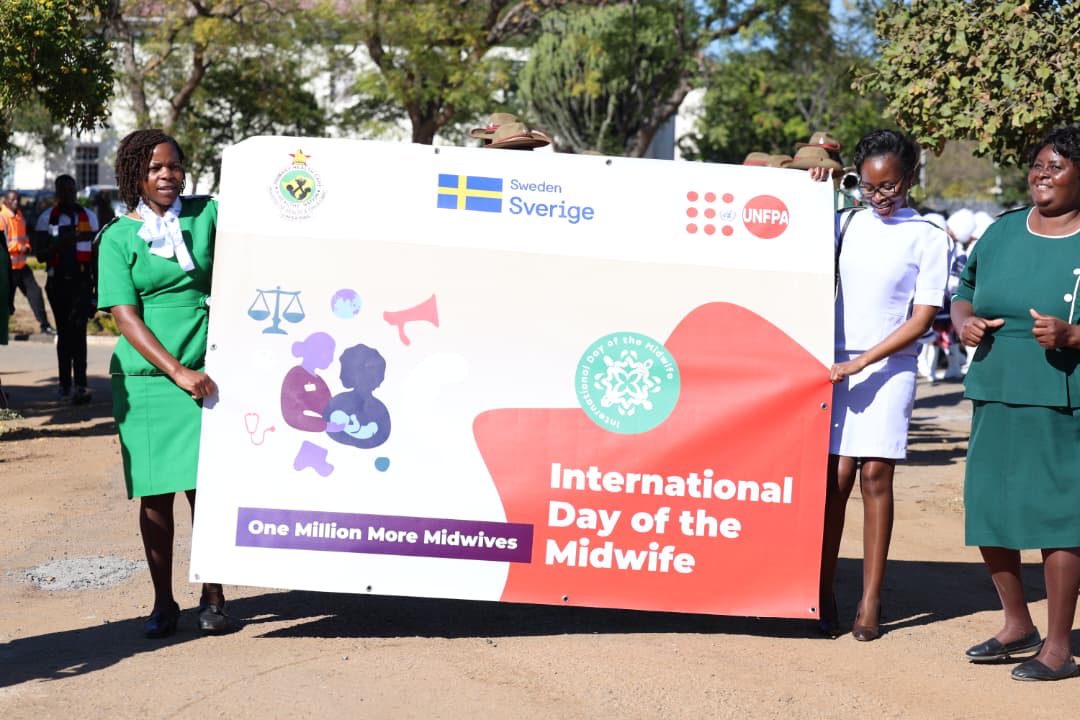
Zimbabwe’s Deputy Minister of Health has appealed to midwives not to abandon labour and maternity wards over pay disputes, as the country marked the International Day of Midwives.
Sleiman Kwidini made the appeal on Friday at United Bulawayo Hospitals (UBH), where officials were also celebrating what they described as a national first, 91 consecutive days without a neonatal death.
“It’s not good for a midwife to leave a maternity home or labour ward unattended because of remuneration,” Kwidini told delegates, health professionals and development partners gathered for the commemorations.
“We know there might be some challenges, but please, I beg you, midwives, not to leave our pregnant mothers unattended.”
On this topic
The appeal reflects persistent tensions in the public health sector, where workers have repeatedly cited poor pay and difficult conditions as reasons for leaving their posts or the country.
Kwidini acknowledged those concerns but said government was working to address them, with plans to reduce health worker attrition by 50% and “progressively increase” remuneration under the Zimbabwe Health Workforce Strategy 2023–2030.
The strategy also commits to doubling the country’s healthcare workforce by 2030, training up to 7000 health graduates annually and creating 32 000 new health sector posts, many targeted at rural and underserved communities.

91 days without a neonatal death
The centrepiece of Friday’s celebrations was UBH’s neonatal health record.
Chief Medical Officer Dr William Busumani said no other hospital in Zimbabwe had sustained such a streak.
“We’re the only hospital that has gone the longest without a neonatal death, 91 days,” he said. “No one has ever done that in this country.”
The commemorations took place under the global theme One Million More Midwives, which calls for urgent investment in recruiting, training and retaining skilled maternal healthcare workers worldwide.
Global partners back Zimbabwe’s strategy
Miranda Tabifor, the UN Population Fund’s (UNFPA) country representative, said the global shortfall of midwives remained critical but praised Zimbabwe for its policy response.
She said every dollar invested in midwifery could yield up to $16 in social and economic returns.
UNFPA is currently supporting both pre-service and in-service midwifery training in Zimbabwe through the Health Resilience Fund and Maternal and Newborn Health Fund.
Swedish Ambassador Per Lindgärde, whose country funds maternal health programmes through UNFPA, said Zimbabwean midwives continued to serve “with professionalism, resilience and commitment, often under difficult conditions and with limited resources.”
Sweden sponsored awards for outstanding midwives at the event, each receiving a $100 voucher and shield.
The event also showcased the use of an electronic partograph, a digital tool used to monitor mothers and babies in real time during labour, as part of a broader push to modernise maternal healthcare.
Kwidini urged the sector to accelerate a shift to digital record-keeping.
“Let’s move from paper to paperless,” he said.
Support CITE’s fearless, independent journalism. Your donation helps us amplify community voices, fight misinformation, and hold power to account. Help keep the truth alive. Donate today







Leave a Reply