

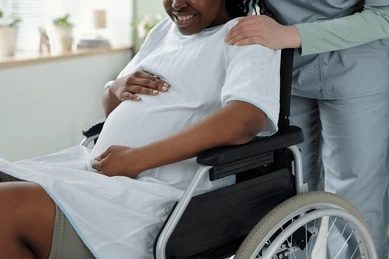
“The year was 1983. I still remember it like it was yesterday.”
Sihle* pauses, her voice heavy as she revisits a moment that has never fully left her. Now a wheelchair user, she says the experience shaped not only her life as a mother, but also her journey into disability advocacy.
“I was young and unaware of my rights,” she recalls. “Fresh out of school, I fell pregnant with my first child.”
Her parents wheeled her into the hospital on a cold winter day. Inside, a nurse sat near a heater, offering little attention.
“She barely gave me much attention,” Sihle says. “She just told me to sit there until it was time.”
As labour pains intensified, Sihle says she repeatedly tried to explain what she was feeling, but was told to “hold on”.
Then came a turning point.
“I felt a gush of liquid,” she says. “When I checked, it was blood.”
She was eventually wheeled into the delivery room, but faced another barrier, the bed was too high.
“I asked her to help me get onto the bed,” Sihle says. “She told me that if I was able to get pregnant, then I should be able to get onto the bed.”
Left unattended as the nurse attended to another patient, Sihle had no choice but to manoeuvre herself onto the bed.
By then, the urge to push was overwhelming.
“I could not hold it any longer.”
Her baby arrived quickly.
“When the nurse realised, she rushed over and took him,” Sihle says. “It was a boy.”
Moments later, the nurse returned with devastating news.
“She said he was not breathing,” Sihle recalls. “When she came back, she told me my baby had died.”
“Just like that, my son was gone,” she says, tears rolling down her face. “For years I kept asking myself if things would have been different if I had received just a little more attention.”
Sihle’s experience is far from unique.
Across many communities, women with disabilities, including those who are wheelchair-bound, continue to face significant barriers when accessing maternal healthcare. These range from poor communication and lack of support to facilities that are not designed to accommodate their needs.
Nokuthaba* recalls a more recent case involving a deaf neighbour who gave birth in 2025.
“There was no one immediately available to help translate using sign language,” she explains.
Without proper communication, the already difficult labour became more complex.
“The nurses were trying to sign to her when to push and when to stop, but it was difficult,” Nokuthaba says.
The baby later died.
“It was also difficult for her to fully understand what had happened because there was no one to clearly explain it,” she adds.
Despite such painful experiences, Sihle says her life did not end in despair.
Over time, she learned more about her rights as a person with a disability and found support through advocacy groups.
“In those spaces I met other women who strengthened me,” she says.
Through counselling and support, she began to heal. Today, she is the mother of three daughters.
“I now speak for other women,” she says. “I help them find their voices.”
Research across sub-Saharan Africa shows that women with disabilities face similar challenges when accessing maternal healthcare. These include inaccessible facilities, lack of specialised care, and negative attitudes from some healthcare providers. Essential equipment such as adjustable delivery beds and mobility aids also remains limited in many institutions.
In Bulawayo, disability rights advocates say while progress has been made, gaps remain.
Bulawayo Progressive Residents Association (BPRA) Secretary for Gender, Sukoluhle Mhlanga, says awareness and infrastructure have improved, with more facilities now equipped with ramps.
“But some challenges still remain,” she says.
For deaf patients, the absence of sign language interpreters continues to be a major obstacle.
“When a deaf person goes to the hospital, they often need to bring someone to assist,” she says. “Yet sign language is recognised as one of the country’s official languages.”
Infrastructure also remains a concern.
“Some facilities have multiple floors without elevators,” Mhlanga adds. “For someone with mobility challenges, that becomes a barrier to accessing care.”
Disability rights activist Soneni Gwizi says the challenges extend beyond physical infrastructure.
“Women with disabilities often face financial constraints because many are not formally employed,” she says. “There is also fear, fear of discrimination or being treated as though they are not capable of having children.”
She adds that stigma can discourage women from seeking care.
“A woman with a disability may hesitate to request family planning services or discuss personal health issues if she feels she will not be understood,” Gwizi says.
Different disabilities also bring different challenges.
“A woman with a hearing impairment, visual impairment, mobility challenges or intellectual disability may each experience the health system differently,” she explains.
Still, Gwizi notes that awareness is slowly improving.
“Women who are empowered and know their rights are often better able to demand proper treatment.”
*Not her real name
Hi l hope l find you well,as a women with a disability im very glad that you are looking into these maternal challanges that we go through,i hope and pray that the government will look into it and provide a more accessible and conducive environment to every mother giving birth to a child,so as to ensure safety and dignity and to make so no child is lost during child birth due to barriers,negligence and unaccessability