

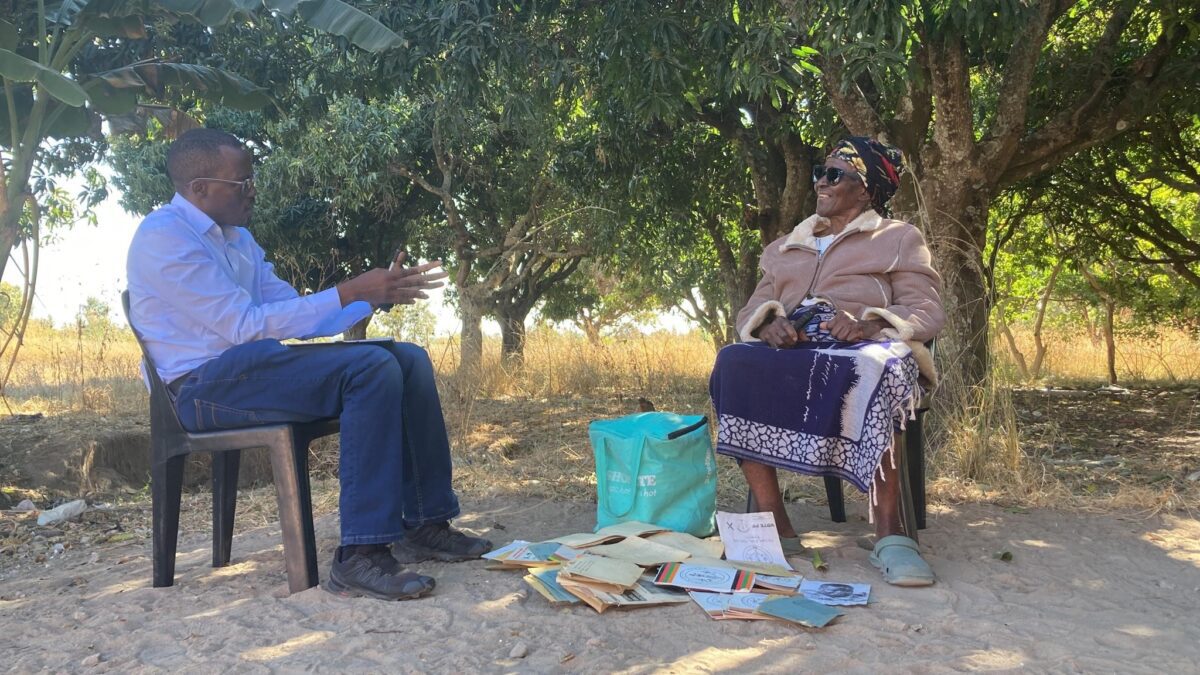
We left Bulawayo in the early hours of the morning, the streets still sleeping under a curtain of darkness. By 4:30 a.m., we were on the road, destination: Zvimba District in Mashonaland West, about 450 kilometres away.
There, we were set to meet Gogo Julia Gowo and listen to her story: a long, defiant life as a supporter of Joshua Nkomo and the Zimbabwe African People’s Union (ZAPU). As dawn broke, we sped along smooth tar roads, passing village after village just beginning to stir. Children walked in groups along the roadside, heading to schools that dotted the highway every few kilometres.
It was a stark contrast to what I’m used to in rural Matabeleland, where you can drive 15 kilometres or more without seeing a single school; just children lining the roadside, hands outstretched, hoping for a lift to the nearest one.
The road to Zvimba was surprisingly forgiving from our experience driving across Zimbabwe. We covered nearly 450 kilometres in just five hours, arriving around 9:30 a.m. I couldn’t help but compare it to the gruelling five-hour crawl to Nkayi, barely half the distance, on bone-rattling, pothole-ridden dirt roads.
Here in Zvimba, the smooth roads, power lines, and even piped water told their own story. This was clearly a region that had benefited from its status as the home of the former president. But we hadn’t come to admire infrastructure, we were here for something far more important.
After turning off the main highway, we wound our way through narrow rural roads until we reached Gogo Julia Gowo’s homestead in Matvitsi village, Mudimo Kraal. As we pulled into the yard, I spotted her right away – a 91-year-old woman seated on the veranda, already dressed up and waiting for us.
Before I could even open the car door, she was on her feet to greet us. In her hand, she held something that instantly caught my eye: a “Father Zimbabwe” badge, a small metal pin bearing the image of the late Joshua Mqabuko Nyongolo Nkomo, Umafukufuku.
She had kept this memento safe for nearly half a century. I couldn’t help but reflect on what that meant; during Gukurahundi, simply owning ZAPU memorabilia like this could have been a death sentence if the Fifth Brigade had discovered it. But then, I mused, Gukurahundi never reached Mashonaland West. Here, history had remained safe; intact, unburned, unburied.
We exchanged greetings in a warm mix of Shona and Ndebele, stumbling over words, correcting each other, and laughing through it. It instantly melted the ice.
As we set up our camera gear, I thought about how this moment came to be. A few weeks earlier, one of Gogo Julia’s grandsons had messaged me on X (formerly Twitter) after seeing my posts about untold liberation war stories. He told me about his late grandfather, Jack Musokeri Mukonowatsauka Gowo, Gogo Julia’s husband, a staunch ZAPU supporter who volunteered as a logistics officer for ZPRA, the movement’s armed wing. When he died, he was buried with full military honours in recognition of his role in the struggle. “My grandmother has incredible stories from those days,” the grandson wrote. “She won’t disappoint you.”
It took just that one message to convince me, I knew this trip would be different. For years, I’ve felt that the story of ZAPU and its military wing, ZPRA, has been sidelined. Too often, our national history is filtered through a tribal lens: ZAPU reduced to a regional, Ndebele party, its legacy buried beneath the dominant narrative of the ruling party. Historian Ian Phimister captured this attempt to undermine liberation history when he lamented that “Zimbabwean history is reduced to a succession of chimurengas – never … umvukelas.”
Yet here we were, in Mashonaland West, preparing to record the memories of a woman who had risked everything for ZAPU’s cause. Her story was living proof that the liberation struggle crossed tribal lines. By capturing Gogo Jane’s testimony, we had a chance to challenge the myths that convoluted the true story of Zimbabwe’s liberation, and present a more inclusive history of our freedom.
Before our cameraman could even say “rolling!,” Gogo Jane was already deep in her memories, her words spilling out in Shona, laced with the occasional Ndebele phrase. Her energy was infectious. At 91, she was sharp, strong, and full of life. Her voice rang out with clarity, her eyes lit with the fire of someone half her age. It felt like standing before a living archive of Zimbabwe’s liberation struggle.
Born in the early 1930s in Mhondoro, Julia grew up in Kadoma, where her father worked as a police officer under the colonial administration. She married and moved to Zvimba in the late 1950s, just as the embers of resistance to colonial rule were beginning to flicker into a flame. Her husband was already deeply involved in nationalist politics.
“In 1960, we joined the National Democratic Party (NDP),” she said, referring to the first black-led political party to openly confront white minority rule. There was pride in her voice as she recalled those days: rallies, whispered strategy meetings, and the growing momentum of defiance. But the NDP’s existence was brief, the Rhodesian government banned it within a year.
Gogo Julia leaned forward on her stool, hands moving animatedly as she recounted how, after the NDP was banned, ZAPU emerged to carry the torch under Joshua Nkomo’s leadership. But the crackdown was swift, by 1962, ZAPU too had been outlawed.
As the armed struggle intensified, Zvimba became a key operational zone for ZPRA guerrillas moving in from Zambia. Gogo Julia’s face lit up as she recalled how villagers quietly rallied behind the fighters. “We’d hear our boys were coming,” she said, beaming. “At night, we prepared food for them,” she added, as she described how they set up hidden supply caches in the bush and built a covert network of messengers to support the cause.
As she spoke, it was as if the war of liberation came alive around us.
Her memory was razor sharp. She rattled off dates, names, and events – bannings, protests, battles – with effortless precision. Every few minutes, I was struck by the humbling realisation: the older woman sitting across from me hadn’t just witnessed history, she had lived it. What I had only read in books, she had lived and survived.
Every so often, I glanced at our cameraman to make sure he was capturing everything. Gogo Julia’s story was pure gold; not just dates and facts, but the raw emotion and humanity woven through them. Her voice sometimes cracked, like when she described the day Rhodesian soldiers raided a nearby village, killed a guerrilla, and forced a local man to transport the body on a bicycle to the nearest growth point. Other times, she broke into laughter, recalling the clever tactics they used to outwit the Rhodesians. It struck me then, I wasn’t just conducting an interview. I was witnessing living history personified in the old woman.
Gogo spoke about her husband, how he spent years in detention, survived the war, only to pass away just a few years into independence. “He was given full military honours,” she said with a sad, conflicted between loss and pride.
Just as we were packing up, Gogo Julia offered one last gem. “You must speak to Tobias in the next village,” she urged. “He was one of us. He’ll remember things I’ve forgotten.” The name rang a bell immediately. In my research, I’d come across a reference to a Tobias from Zvimba in one of the Rhodesian accounts.
The author had written detailed accounts of ZPRA operations in the area. If this was the same Tobias, he wasn’t just a witness to history; he was part of it, a legendary ZAPU intelligence contact who had outsmarted Rhodesian authorities for years. I couldn’t hide my excitement. It felt like the threads of history were weaving themselves together in real time. What we didn’t know then was that meeting Tobias would take our day in Zvimba to a whole new level.
Driving back to Bulawayo, I found myself replaying the day’s conversations, emotions swirling. As the landscape rolled by, one question weighed on my mind: When did tribalism begin to poison our society and politics?
emotions swirling. As the landscape rolled by, one question weighed on my mind: When did tribalism begin to poison our society and politics?
In Zvimba, I had caught a glimpse of a Zimbabwe I feared we had lost – where people from opposite ends of our vast country could meet as strangers and leave as kin, bound by mutual respect and the love for Zimbabwe. Gogo Julia had welcomed us like her own grandchildren. At no point did we feel like outsiders.
Yes, language could have a bit of an obstacle – most in this community speak Shona, while we’re more at home in Ndebele – but we bridged that gap with grace and laughter. Gogo tossed in a Ndebele word now and then, her smile playful. I reached for my rusty Shona. We stumbled, corrected each other, and laughed our way through it. In the end, we understood each other perfectly. The conversation flowed with warmth, empathy, and a sense of genuine connection.
What struck me most was that Gogo Julia never once referred to ZAPU as a “Ndebele party” or a regional movement. To her, ZAPU was simply the party of freedom fighters – the vehicle through which she, her husband, and their neighbours hoped to liberate all of Zimbabwe. When she spoke of the struggle, it was always “we Zimbabweans,” never “us” and “them.” And yet, here I was, decades later, driving home through a country where political loyalties are still too often assumed based on tribe.
Where did we go wrong? When did the unity of purpose that people like Gogo Julia fought for fracture into mistrust and tribal division?
There are no easy answers. But Gogo Julia Gowo’s story – and the wider, often-overlooked ZAPU story in places like Zvimba, must be told and retold, in all its depth and human truth. These are the stories that remind us: Zimbabwe’s liberation was a collective effort. And if we can remember that, perhaps we can begin to rediscover the sense of camaraderie and shared purpose that once bound us together.
I salute you Mr Ndebele for telling us about true untold stories that unite us as people to the ruling part is the one that dividing us even today because of undermining orther tribes if Zapu lead our Country now we will far better than what we we’re being reduced to bcz of selfish leaders I thank you 🙏
This is a master peace ..lve read a number of your articles but leti mmmmmh Ndebele ……
Great story right there Zenzele and well-captured. I can’t wait to watch this episode. The strategy of dissecting the nation can only be for one reason, and one reason alone, divide, conquer and rule. So far, it has worked well.
When we say elections were rigged what other evidence do you need