
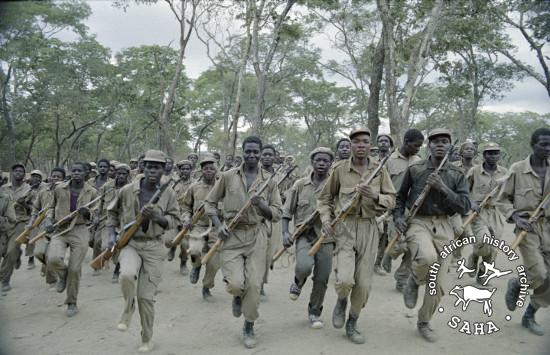
The ZPRA Liberation Archives are proving that history lives beyond paper. Through memories, conversations and shared experiences, former cadres are rebuilding a lost archive, preserving the untold stories, sacrifices and legacy of Zimbabwe’s liberation struggle for future generations.
By Jefferson Ndimande
The history of the Zimbabwe People’s Revolutionary Army (ZPRA), the military wing of the Zimbabwe African People’s Union (ZAPU), is often approached through the question of archives. Historians search for documents, reports, correspondence, training manuals, intelligence assessments, and operational records in the hope of reconstructing the liberation struggle. Yet the history of ZPRA raises a more profound question: what happens when an archive itself becomes a target of violence?
Throughout the liberation struggle, ZPRA produced an extensive documentary record. The archive emerged in the everyday work of a movement at war. There were personnel files recording recruits and fallen comrades; intelligence reports and operational plans; communications records and political education materials; training manuals, camp reports, and assessments of cadres. There was correspondence with allies across the world, including the Union of Soviet Socialist Republics (USSR), the German Democratic Republic (East Germany or GDR), Cuba, Algeria, Libya, Angola, Zambia, and numerous liberation movements beyond Africa. There were records of diplomatic missions, military training programmes, and educational initiatives. There were also biographies of cadres and evaluations of those sent abroad for specialised training as pilots, aircraft technicians, intelligence officers, commissars, communications specialists, and military instructors.
On this topic
This archive was produced in the theatre of struggle itself. It recorded how a liberation movement organised its operations, cultivated international alliances, understood its personnel, and imagined a future beyond colonial rule.
The tragedy is that much of this archive did not survive the political conflicts that followed independence.
During gukurahundi, the post-liberation state moved against both ZAPU and ZPRA. Former cadres were arrested, detained, tortured, dismissed from the military, denied promotions, subjected to surveillance, imprisoned, and killed. At the same time, ZAPU and ZPRA records were seized, confiscated, scattered, destroyed, and, according to some accounts, burned. What came under attack was not only a political organisation and its supporters. What came under attack was also a historical record painstakingly assembled over years of struggle.
The consequences continue to shape Zimbabwe’s historical landscape. The destruction of records created openings for distortions, appropriations, erasures, silences, exclusions, and competing claims. Some emerge from official narratives. Others emerge within communities themselves as individuals and groups struggle over authority, memory, and representation. Operations associated with ZPRA, including the December 1978 Salisbury fuel tank bombing, continue to generate debate and contestation. The problem is not that evidence never existed. The problem is that much of the documentary record was seized, scattered, destroyed, or rendered inaccessible.
Gukurahundi therefore produced more than physical and political violence. It generated epistemic violences. It targeted bodies, institutions, memories, archives, and historical transmission itself. The campaign pushed many former ZPRA cadres into marginalities marked by suspicions, exclusions, exiles, insecurities, and contested belongings within a country they had helped liberate. In the process, it threatened not only lives but also the knowledge systems through which those lives could be remembered and understood.
Yet history has a remarkable capacity to survive.
One of the most fascinating sites of historical recovery today is the ZPRA Liberation Archives WhatsApp group established by the Centre for Innovation and Technology (CITE). The group brings together former combatants, former refugees, researchers, younger generations, and individuals who supported the liberation struggle in different capacities. Participants are scattered across Zimbabwe, South Africa, Botswana, the United Kingdom, the United States, and elsewhere. What unites them is a shared commitment to remembering.
The conversations move constantly between the extraordinary and the ordinary. Veterans recall commanders, camps, training exercises, military operations, friendships, songs, routes, losses, and arguments. A discussion about one commander opens onto memories of training camps in Zambia. A disagreement over chronology revives recollections of the Mthimkhulu crisis, the Front for the Liberation of Zimbabwe (FROLIZI) split, the disastrous Zimbabwe People’s Army (ZIPA) experiment, the Mgagao massacres, and other crises. A debate about pilots trained abroad evolves into detailed discussions about military doctrine, aircraft, training institutions, and integration into the Air Force of Zimbabwe after independence.
What is striking is not simply what veterans remember but how they remember.
Participants entered the struggle at different moments and occupied very different positions within the liberation movement. Some joined in the 1960s when military strategy was still largely oriented toward guerrilla warfare. Others entered during the 1970s as the organisation increasingly developed the infrastructure, training, and doctrine associated with a conventional army. Some trained as intelligence operatives, reconnaissance personnel, communications specialists, engineers, commissars, instructors, and logisticians. Others specialised in artillery, anti-aircraft warfare, aviation, military engineering, and conventional operations. Some rose to become company, battalion, or camp commanders. Others remained rank-and-file cadres.
After independence, some were integrated into the Zimbabwe National Army and the Air Force of Zimbabwe, while others returned to civilian life, entered business, joined the civil service, or found themselves pushed to the margins. These varied trajectories produced different memories, experiences, and temporalities. A veteran who crossed into Zambia in the late 1960s remembers a different ZPRA from one trained in conventional warfare in the late 1970s. An intelligence officer recalls the struggle differently from an artillery specialist, a commissar, or a pilot trained abroad. What emerges from these conversations is therefore not a single story but a constellation of overlapping histories, shaped by different locations, responsibilities, generations, and experiences of war.
The everyday exchanges are often the most revealing. A discussion about toyi-toyi may begin with a simple request for a voice note. A veteran records the familiar chant and another identifies one of its recurring refrains, remembered by some as deriving from an Arabic word associated with strength or power.
The discussion quickly turns to the early years of the struggle. According to one account, elements of the chant and aspects of toyi-toyi culture entered ZPRA through some of the movement’s earliest cadres and commanders, including Nikita Mangena, who trained in Algeria during the 1960s. Over time these practices were absorbed into camp life, reshaped by local experiences, and passed from one generation of cadres to another.
What begins as a conversation about a chant opens onto a much larger history of movement, encounter, and exchange. Algeria appears alongside Zambia, Bulgaria, Libya, Angola, Cuba, and the USSR. The liberation struggle emerges as part of a wider world of anti-colonial solidarities, military training networks, and revolutionary connections stretching across Africa, Eastern Europe, and beyond. What survives today is not only the memory of those encounters but their embodiment. Veterans still address one another as comrade; former commanders are often called commandiri; words such as povo, quatro, and other fragments of the struggle’s multilingual world continue to circulate in conversations. These linguistic traces reveal how ideas, practices, and vocabularies travelled across borders before being domesticated within ZPRA’s own political and military culture.
The written archive remains indispensable. Historians need documents. Communities need access to records. The seizure and destruction of ZAPU and ZPRA archives deprived Zimbabwe of an important part of its historical inheritance.
Yet the conversations unfolding in the ZPRA Liberation Archives group reveal something equally important. Archives do not exist only in boxes, files, and repositories. They also exist in memories, languages, songs, arguments, humour, and everyday acts of recollection.
Not every contradiction will be resolved. Veterans remember differently because they experienced the struggle differently. The disagreements that emerge in these conversations are not weaknesses of memory. They are evidence of history’s complexity.
For a movement whose records were seized, scattered, destroyed, and rendered inaccessible, these exchanges perform important archival work. They preserve names, places, events, relationships, registers, vocabularies, and experiences that might otherwise disappear. They reconnect fragments separated by violence and time. They allow forgotten histories to circulate once more.
The archive produced during the liberation struggle suffered devastating losses during Gukurahundi. But it was never destroyed. Part of it survived in the men and women who carried those experiences into the decades that followed.
And when they remember, debate, correct one another, exchange voice notes, recall fallen comrades, or tell stories from camp life, that archive speaks again.






Leave a Reply