
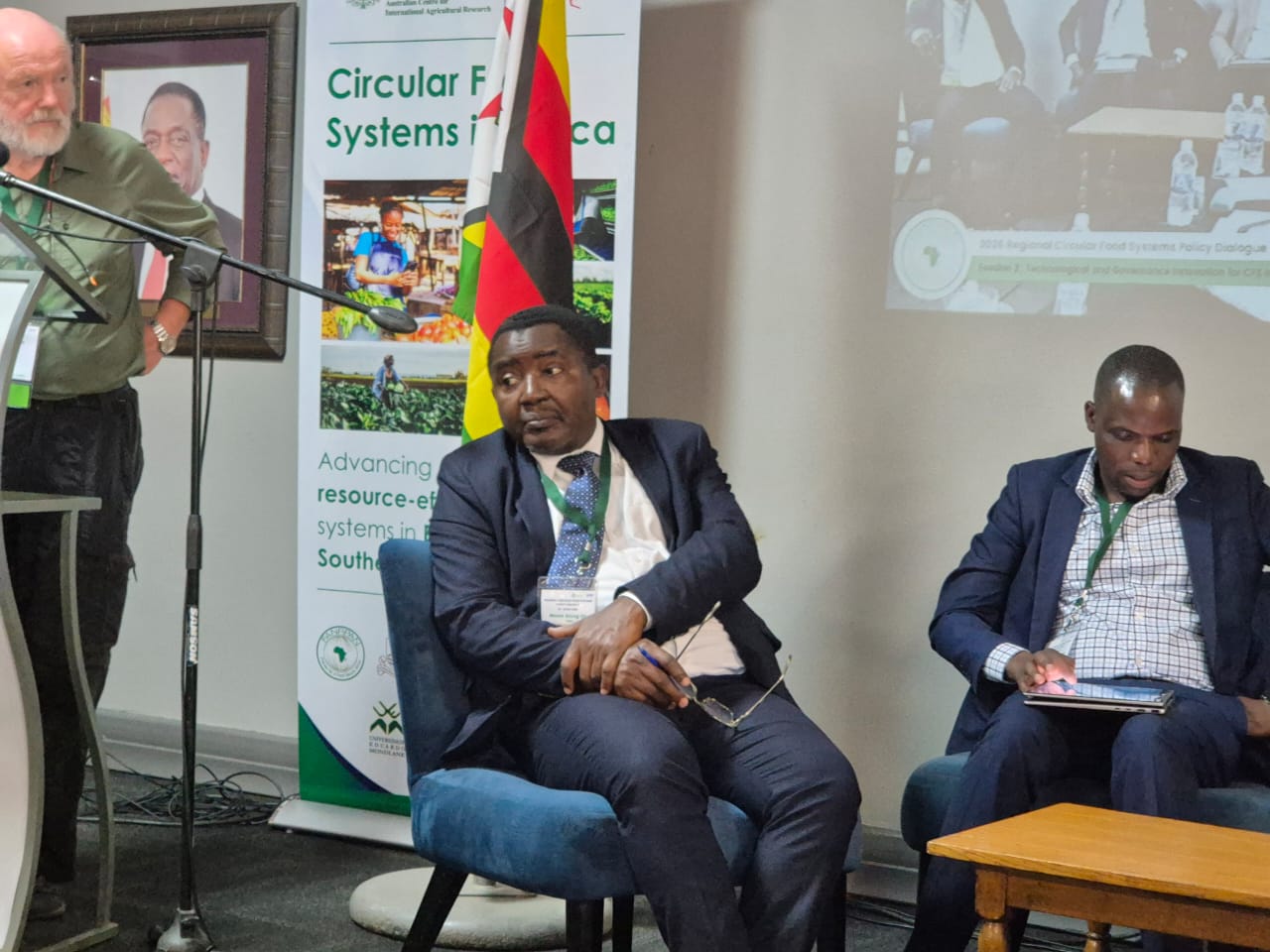
Technology on its own will not transform Africa’s agriculture sector without proper governance systems, a leading agricultural researcher has said.
Dr Moses Azong Cho, Chief Researcher in the Advanced Agriculture and Food Cluster at the Council for Scientific and Industrial Research (CSIR), said countries across Africa needed stronger technology governance mechanisms to enable circular food systems amid climate change, water shortages and rising production costs.
Speaking during a regional dialogue on circular food systems, Dr Cho said innovation must be supported by policies and institutions capable of balancing technology, society and environmental sustainability.
“Circular food systems require more than innovation. They require intelligent governance capable of aligning technology, society and ecology,” he said.
On this topic
Dr Cho said African countries were under pressure to increase food production while using fewer resources and protecting biodiversity.
“There are rising costs and scarcity of inputs. This part of the world is semi-arid to arid. Water is a limiting factor to food production in the region. The region also faces energy challenges,” he said.
“So we are called upon to help address these issues. There’s a need to produce more with less.”
He said although Africa was often described as having 60% of the world’s uncultivated arable land, much of that land lies in ecologically sensitive areas.
“If you look at the map, you will see that most of these areas are located in parks and regions rich in biodiversity, such as the volcanic soils in the Goma region in Congo and the highlands of Cameroon,” he said.
“Would we want to encroach into these rich biodiversity areas to cultivate food? We have to produce more on existing farming landscapes.”
Dr Cho warned that current linear agricultural systems were contributing to soil degradation and environmental decline.
“The current systems of production will continue to degrade our soils. We need to reconsider circular agriculture and produce in a circular way,” he said.
“The soils on the continent are quite delicate and we need to sustain them.”
He said poor water management and food waste were further undermining sustainability.
“About one third of all food produced is lost or wasted each year,” he said.
“When it comes to water, South Africa loses between 30% and 40% due to poor management in the agricultural sector.”
Dr Cho also said new environmental regulations from international markets were increasing pressure on African producers to adopt sustainable farming methods.
He cited European Union regulations on deforestation as an example.
“They wouldn’t import anything from the continent cultivated on degraded land,” he said.
“That is enormous pressure on us. Our farmers need to adapt.”
To address some of these challenges, Dr Cho said his team began developing digital agricultural tools in 2019 aimed at improving resource efficiency and decision-making.
One of the tools, called the Precision Agriculture Information System, uses satellite imagery from the European Space Agency to monitor soil and crop conditions.
“We can provide information on soil and crop conditions weekly,” he said.
“We can detect potato diseases and fall armyworm infestations in maize as soon as they begin affecting the crop.”
The system can also monitor soil organic content, nitrogen, pH levels and moisture content while predicting crop yields.
Dr Cho said the technology had been tested in countries including the Netherlands and had also been used to predict yields in Zimbabwe during recent drought periods.
He also highlighted another digital platform designed for small-scale farmers.
“The system allows farmers to use their phones to identify the location of their farms and receive information on soil conditions, climate and suitable crops,” he said.
Dr Cho said such technologies support circular economy principles through nutrient cycling, water reuse and biomass residue utilisation.
However, he said adoption remained low because of governance failures, infrastructure challenges and weak institutional coordination.
“In South Africa, departments do not even talk to each other effectively to implement useful policies,” he said.
He also cited regulatory delays and weak data governance systems.
“We bought a drone in 2019. It took three years to get a licence to fly it. By the time we started using it, the batteries were no longer available on the market,” he said.
Dr Cho warned that many African farmers risked being left behind as digital systems and artificial intelligence technologies rapidly advance.
“Our farmers in rural areas cannot keep up with all these developments,” he said.
“AI is being trained using data from elsewhere. It is not speaking to local realities.”
He said the greatest challenge facing the continent was not the lack of technology, but the absence of inclusive and scalable governance systems.
“The satellite data are there and freely available. We have developed systems that add value to that data,” he said.
“The problem is the absence of integrated, inclusive and scalable socio-technical governance systems.”
Support CITE’s fearless, independent journalism. Your donation helps us amplify community voices, fight misinformation, and hold power to account. Help keep the truth alive. Donate today





Leave a Reply