


By Nokuthaba Dlamini
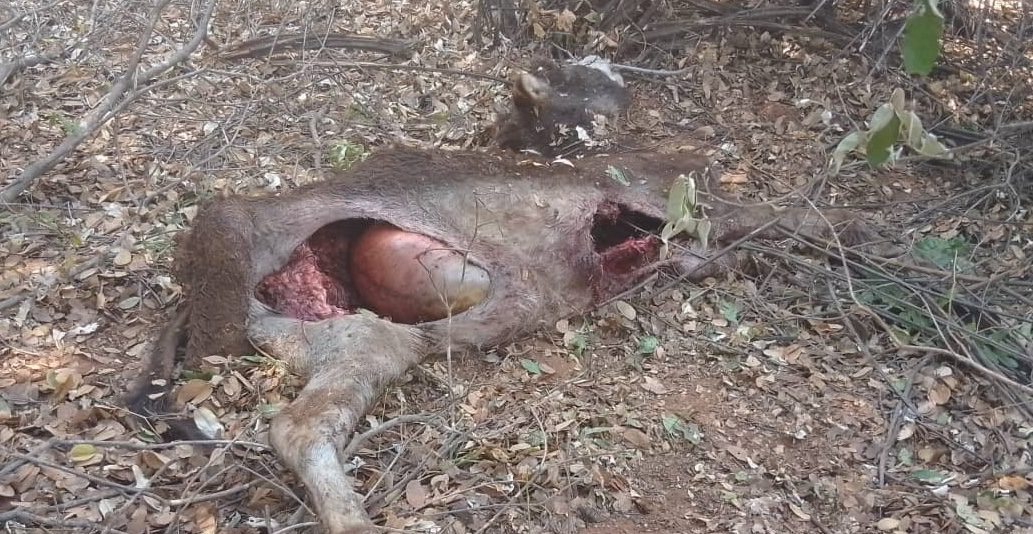
The carcass of a donkey, mauled and half-eaten by lions, lies in the dry bushland. For Members Ndlovu, a smallholder farmer in Hwange West, this sight has become painfully familiar.
Over the years, he has lost six cows and countless goats to predators that roam freely between the Forestry Commission area and surrounding homesteads.
“They come and attack in the kraals, mainly targeting goats and donkeys,” Ndlovu said, pointing to a kraal gate reinforced with thorn branches. “Sometimes they wipe out 11 or 12 goats in a single night. I have lost six cows over the years. Two bulls, four females. One calf starved to death after its mother was killed, I couldn’t afford supplements.”
In his notebook, Ndlovu has carefully recorded every loss.
“We report these cases, but the response is slow. They promise to come, but most of the time, nothing happens. We are not safe. We are under pressure every day.”
“These animals, especially in the off-farming season, are the lions,” Ndlovu told CITE.
He recalls a three-month-old calf that starved after its mother was killed in a grazing field. Another orphaned calf barely survived after being nursed on another cow’s milk, only for that foster mother to die later from stress and malnutrition.
“We have abandoned our fields because elephants devour everything within a night,” he added. “If nothing changes, in ten years there will be no livestock left here.”
The ordeal is not unique to Ndlovu. In BH29, just off the Bulawayo–Victoria Falls highway, villagers say lions regularly leave the Forestry Commission estate to target livestock. Goats and donkeys are the first victims, but cows and calves are not spared.
“Tracking is difficult,” Ndlovu explained. “During the day, they hide in the forest, but at night, they come straight for us. We have even abandoned our fields because elephants devour everything overnight. Planting has become pointless.”
In Masuwe, Baobab village, Esline Ncube has stopped sleeping through the night. She is raising her late daughter’s children but is forced to spend long hours listening for the sound of predators.
“Our cattle and donkeys are being eaten in the grazing fields, and our goats are taken from the kraals,” she said, tears welling in her eyes. “I am looking after orphans, how do I explain to them that the goats they depended on for milk are gone? We were told to buy lights for our kraals, but how will we afford them? Dogs bark, but they cannot stop lions. The next victims will be us.”
For Councillor Given Moyo of Kachechete Ward, the situation is both an economic and political crisis.
“We have held multiple meetings about lions killing livestock and elephants destroying crops year in and year out,” he said. “Our call, which has gone beyond a plea, is for the government to compensate people who have lost their livestock. The economic loss is huge. Some people spent pensions buying cattle, young people invested in goats, all gone.
“To make you understand, it is not just lions. Chickens are wiped out by amagola (wild cats), amaqaqa (wild dogs), and other predators. It’s layer upon layer of destruction. Yes, there is CAMPFIRE, but the money that trickles down is too little. It can’t even develop one village.”
Moyo believes corruption is blocking change. “It is clear to us that there are corrupt people benefiting from wildlife revenues while communities suffer. Otherwise, why would Parliament hold hearings and still ignore our pain?”
The anguish in Hwange West is reflected across Zimbabwe. Statistics from the Zimbabwe Parks and Wildlife Management Authority (ZimParks) show that between 2019 and July 2025, there were 10 368 reports of human-wildlife conflict, resulting in 370 deaths and 453 injuries. A total of 3 086 problem animals were eliminated and 2 592 livestock destroyed, including 939 cattle, 166 donkeys, and 1,487 goats.
In 2021 alone, 319 cattle were lost, the highest in recent years. Goats, often the backbone of rural households, accounted for more than half of all livestock killed.
The government is working on the Parks and Wildlife Amendment Bill, which is awaiting gazetting. The proposed law is expected to strengthen frameworks for compensation, community benefit-sharing, and wildlife management. For Hwange villagers, however, the delays feel like another broken promise.
“They promise they will come, but it ends there. We want ZimParks rangers living with us in the villages, trained and armed to kill or scare away these lions. Otherwise, we are finished,” said Ndlovu.
“They tell us the Bill will help,” said Ndlovu, “but we have been losing livestock for decades. How much longer should we wait?”
Hwange District is home to some of Zimbabwe’s largest elephant and lion populations, drawing thousands of tourists each year to Hwange National Park and surrounding conservancies.
“We love wildlife, but how can we protect it when it is destroying our livelihoods?” asked Cllr Moyo. “At night, when lions roar, we don’t hear the sound of conservation; we hear hunger coming.”
For villagers like Ndlovu, the future is uncertain. He looks at his almost empty kraal, once filled with cattle, and shakes his head.
“If nothing is done,” he warns, “we will be left with nothing. No livestock. No crops. Just fear.”
there are so many enviornmental ngos out there that do not charge that would be able to assist
One is Natural Justice based in Cape Town South Africa
email : info@naturaljustice.org
website https://www.naturaljustice.org/
The other Enviornmental NGo is
Zimbabwe Enviornmental Law Association
Mobile no. +263 47573601
26B Seke Road Hatfield Harare
the other alternative is to have electric fences