
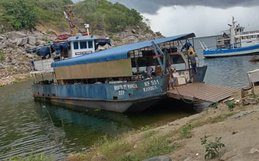
The government says it will procure additional boats for the Kariba-Mola-Chalala route following the fatal ferry accident that exposed overcrowding and limited water transport options for communities living around Lake Kariba.
Transport and Infrastructural Development Minister Felix Mhona, claimed the government was working with the private sector to increase the number of boats operating on the route, with the aim of reducing overcrowding and improving access to transport.
Mhona was responding to a question from Senator Irene Zindi in the Senate on Thursday, who raised concerns over the continued reliance on water transport by communities such as Mola despite the existence of a road linking the area to other parts of the country.
Zindi asked what the government was doing to speed up the maintenance of the road to allow residents to use road transport instead of relying heavily on boats following the accident where 97 people died when an overloaded passenger ferry capsized on Lake Kariba on August 11, 2026.
On this topic
“A few weeks ago, there was an accident at Kariba on the Kariba ferry. That was the only means of transport for the Mola community, the road was there, but it was not maintained. My question is, because of that accident and for us to reduce accidents that can happen to those travelling through water, what is the Ministry doing to speed up the maintenance of the road so that people may use the road instead of travelling by water, because the accidents are claiming a lot of lives,” he said.
Mhona, however, said water transport remained an important mode of transport for communities around Kariba and should not be viewed as a form of desperation.
“When we talk of modes of transport, there is air, rail, road as well as water. So, water transport is not desperation; it is another form of transport, but whoever travels by water must travel safely, the same as the person who travels by air, rail or road,” said the minister.
He said the construction of the Kariba Dam had separated communities, making water transport a practical and shorter option for some residents.
According to Mhona, the distance between Kariba Urban and Chalala by water is about 64 kilometres, while travelling by road from Karoi to Chalala covers 437 kilometres.
From Kariba, the shortest road route is about 313 kilometres.
He said the government had also identified the need to strengthen safety awareness campaigns for water transport operators and passengers following the accident.
“We have not witnessed accidents of this kind, but as a country, we relaxed. We did not expect to have this tragedy that occurred,” Mhona said.
“We have realised that awareness campaigns were mostly done for roads, so we are going to take those campaigns towards water and urge them to take caution when there are waves and that they should not travel.”
The Minister said the government had also gathered boat operators in Kariba and was working with the private sector to restore safe transport services.
He said a new boat was expected to be introduced after inspections and regulatory processes had been completed.
“Very soon there will be a boat that will be coming. We are now analysing it, but that does not mean that the Minister of Transport will be operating a board as the regulator, that could be the private sector who will be applying that route. After inspections, we will inform the nation that it is now allowed to travel, but now we have been warned and we are going to enforce it differently,” Mhona said.
Responding to a supplementary question from Zindi on whether the government would increase the number of boats to prevent overcrowding, Mhona said more vessels were under planning.
He said the government-operated boat, which was involved in the accident, was operated under the Rural Infrastructure Development Agency (RIDA).
“The government is doing something because that boat was a government boat under RIDA. We are not stopping and we are looking at procuring more boats, but if we have more boats, it means we will not have overcrowding,” Mhona said.
He added additional boats would come from both RIDA and private operators, which he said would also create competition and potentially reduce fares for passengers.
“There will be a boat coming up from RIDA as well as the private sector and the fares will become competitive for the good of the travelling public,” he said.
Mhona also said the government would tighten enforcement of safety regulations, particularly around passenger numbers and weather conditions.
He said the boat involved in the accident had been designed to carry 90 passengers but was carrying more than 100 people when the tragedy occurred.
The Minister said the government would not apportion blame prematurely, but those found responsible would face justice.
“I do not intend to apportion blame, but those who are supposed to face justice will do so,” he said.
The government’s plans to increase the number of boats come amid renewed scrutiny of transport safety around Lake Kariba, where communities on both sides of the dam depend on water transport to access homes, schools, fishing camps and other services.







Leave a Reply