

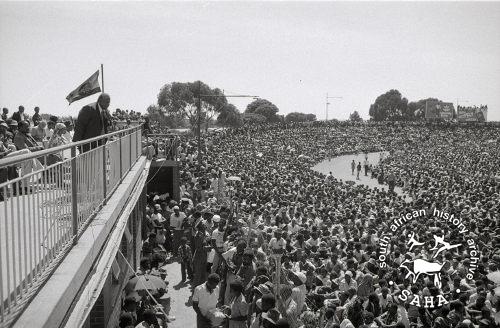
Countrymen, Comrades and Friends, I address you on a unique and important occasion in the history of our country. I am not addressing P.F. (ZAPU) supporters alone; I am addressing the country as a whole.
Recent events in our country have left each and every family astounded. Were it not for the maturity and discipline exercised by the PF (Z.APU) leadership and supporters, we would not be gathered here this morning. The country would have been in flames. We did not fight for decades to bring Zimbabwe to flames after our hard won independence. Our sons and daughters, fathers and mothers, sisters and brothers, aunts and uncles, nephews and nieces did not shed their blood for a section of our people, but for Zimbabwe as a whole.
We did not fight to liberate Zimbabwe as tribal or regional groupings. For indeed, if it were so, Zimbabwe would still not be born. What really has happened to plunge our country into the brink of chaos?
It all started with the discovery of a cache of arms in one of Nitram farms, Ascot, a few miles West of Bulawayo. This discovery was followed by a display of these arms to the press on the 6th February by Emmerson Munangangwa.
The following day, allegations were made against me and the Party P.F. (ZAPU) by Robert Mugabe at a rally in Norton. He alleged that I and the party had cached these arms for the purpose of overthrowing his Government. He further alleged that I had earlier conspired with South African Generals using General Walls as an intermediary. All of these allegations were a pack of lies and Robert Mugabe knows it. From that day on, Mugabe took pleasure in insulting me as a person, calling me names, questioning my status as a leader in this country at all his televised rallies for almost two weeks.
But who is this man, Mugabe politically? How did he become a political leader and when, what part did in fact play in our country’s liberation struggle. I do not intend to insult Comrade Mugabe and will not do so. I will just give you hard facts of the situation to answer insults on me and the party I represent, in fact, the people I lead, and those who respect me just as a person. To answer these questions, let us turn to a brief history of our liberation struggle since occupation, that is, from 1890 to 1980. Our people fought as one in the initial war against British colonialists in 1892-93. They fought again as one in 1896 – 1897. Mugabe was not there, nor was I.
The struggle took various forms from there on. In 1920s men like Masotsha Ndlovu and others waged the struggle as ICU. A number of other organisations sprang up in the country. Mugabe was not there, nor me. In the l930s – 40s, the ANC (African National Congress) led by men like Rev Samkange and others, pursued the struggle. Although the aims and objectives of these organisations were ill-defined nonetheless, they made their mark towards the liberation of our country.
In 1947, I was elected President of the ANC (African National Congress). We continued the work done by our predecessors and made our mark. Mugabe was not there. In the early 1950s I was elected President of the Railways Employees Association and later made 1st Secretary General. In the mid 50s, still Secretary General of the Railways Employees Association and President of the ANC, I was elected President of the Federation of African Trade Unions. Mugabe was not there. We experienced great difficulties because of the non-recognition of Black Trade Unions, but all the same, we made progress.
I took part as a leader of the old ANC in the struggle against the Federation of Rhodesia and Nyasaland. Mugabe was somewhere teaching in Ghana. In 1956, an African Youth League was formed by men like James Chikerema, J.Z. Moyo, George Nyandoro, Joseph Msika and others. Robert Mugabe was not one of them.
We who lead the old ANC continued with our work, assessing the good work that the Youth League was doing. In 1957, together with the Youth League League we formed a revitalised African National Congress (ANC) I was elected its president. Robert Mugabe was not there. In 1958, I was sent by Congress to Ghana to attend a meeting of the All-African People’s Conference where I was chosen to be a member of its steering Committee representing Central and Southern Africa. Robert Mugabe was not there.
The ANC spearheaded the struggle so much so that the Whitehead Regime felt threatened. This was the beginning of mass mobilisation. In 1959, the ANC (African National Congress) was banned while I was in Egypt, sent there to represent the Congress. All the leaders of Congress had been arrested and thrown into jail l was urged by our friends to open an office in Cairo in order that I may propagate the problems of our country, which I did. Robert Mugabe was not there. I t was then that I opened another office in London travelled almost throughout the world making the case of our country known. Robert Mugabe did not feature then.
In 1960 representing Congress banned in Southern Rhodesia then I managed to place the problem of Southern Rhodesia on the agenda of the United Nations Fourth Committee against bitter opposition by the British. Mugabe was not there. For the first time, the myth regarding Southern Rhodesia as a self-governing British Colony was exploded and regarded by the outside world as just a colony of Britain subject to discussion by the United Nations Organisation. Robert Mugabe was nowhere near.
In 1960 the people of Zimbabwe formed the NDP (National Democratic Party) and at the inaugural meeting of the Party, I was elected its president in absentia. It was there that Mugabe’s name was first known when he was co-opted as a member of Executive Committee. Just a member.
Because of the NDP’s effectiveness and the way it prosecuted the struggle against the oppression and exploitation of the masses, it was banned.
The NDP leadership decided to form the Zimbabwe African Peoples Union (ZAPU) and vowed that in the event ZAPU is banned no other party would be formed. It was agreed ZAPU would, at whatever cost, operate underground. Mugabe was part to the decision.
I was elected ZAPU’s President and I appointed Mugabe my Publicity Secretary. It was at this stage that ZAPU sent its first cadres outside the country for military training. The struggle was prosecuted even more vigorously.
ZAPU was soon banned. There after a handful of dissidents, by then in Dar-es-Salaam including Mugabe plotted to overthrow the elected ZAPU leadership. To avoid a crisis the people of Zimbabwe called for a Congress at Cold Comfort Farm, outside Salisbury to settle the “dispute” once and for all. The dissidents who included Mugabe, refused to attend and were expelled from ZAPU by the Congress. The Congress decided to form the People’s Caretaker Council (PCC) not as another party, but as a Council to oversee the banned ZAPU’s affairs. I was elected President of the PCC. Mugabe was again not there.
Prior to the ban of ZAPU in 1962, I had been ordered by the Central Committee of ZAPU to procure weapons from any friendly country. On 12th September, 1962 I brought the first ever consignment of arms to this country which were supplied to us by Egypt. These weapons included 12 machine guns, 20 rifles, 100 grenades and ammo.
It was because of this and that when I returned to Tanzania in 1965 and continued to ferry arms through there, I was expelled from that country by President Nyerere. Immediately I arrived back home. I was detained. Mugabe was not involved. The first liberation shot was fired near Mana Pools in 1966. The second was at a real battle in the Wankie Game Reserve in 1969.
I am glad to say when I met President Nyerere after our release from prison in 1974, he apologised to me and said he did not fully understand the situation in Southern Rhodesia at that time. He at that time did not believe that armed struggle was necessary to free Zimbabwe.
The dissidents, meanwhile, had decided, without the support of the people, to form ZANU. The party had no branches, no districts, or provincial structures. The dissidents shared positions among themselves and proclaimed themselves a Party in August 1963.
Ndabaningi Sithole became President of ZANU and Mugabe its Secretary General, not the leader of the Party. In 1964 the PCC was banned; I and the entire leadership of PCC placed in detention at Gonakudzingwa, Wha Wha and at other centres throughout the country. Later I and a few colleagues were removed from Gonakudzingwa and detained in Gwelo and finally in Buffalo Range Prison near Chiredzi. The handful of ZANU leadership was detained at Sikombela near Que Que. Then in Salisbury Prison and finally Mugabe and three others, in Que Que prison. Sithole and a few others remained in Salisbury prison.
It was in Que Que prison where Mugabe and three of his colleagues who included Enos Nkala decided to overthrow Ndabaningi Sithole from ZANU Presidency and installed himself President of ZANU. We stayed in detention for over 10 years. In 1974, we were informed that through the efforts of the Frontline Presidents, a conference had been organised in Lusaka, Zambia over the problems of our country. On our arrival in Lusaka we discovered that Mugabe had attempted to overthrow Ndabaningi Sithole, then ZANU President, whilst in detention. Sithole had been elected ZANU president at a Congress held in Gwelo in 1963. The move by Mugabe to overthrow Ndabaningi Sithole was not accepted by the Frontline States. Mugabe and Morton Malianga who accompanied him was sent back home without meeting the Frontline Presidents, they called for Sithole who finally came.
At the Lusaka Conference ZAPU led by me, ZANU led by Ndabaningi Sithole, Frolizi led by James Chikerema it was agreed to formalise the ANC which was under the acting leadership of Bishop Abel Muzorewa. It was further agreed that Bishop Muzorewa should continue as acting leader until the leadership of the ANC was elected in Zimbabwe in four months’ time. Mugabe was not there.
Meanwhile, despite the Lusaka agreement, Mugabe was appointed leader of ZANU in Maputo in 1977 by a group of 25 people most of whom are now his Cabinet Ministers.
Soon after, we formed the Patriotic Front, I and Mugabe became its co-leaders. ZAPU and ZANU worked as the Patriotic Front throughout the balance of the struggle until the Lancaster House Conference in 1979. ZPRA and ZANLA also worked as one throughout the balance of the struggle under the banner of the Patriotic Front.
We spoke at Lancaster with one voice as we fought in the bushes and valleys of this country as one. After the conclusion of the Lancaster House Conference, we had a meeting in London as the Patriotic Front to plan our strategy for the elections. The late Josiah Magama Tongogara insisted at the meeting that we were coming home and facing the elections as Patriotic Front. Where is he today? All I can say is, rest in peace Tongogara. We shall never let you down.
Little did we know, when we were discussing at Lancaster that ZANU PF had decided to go into the elections without us. We even delayed to register for the elections, waiting for a word from them, which never came. What treachery! I even had to send Comrade Chinamano to Maputo, but all was in vain.
When we were still waiting for the election results, we heard Mugabe was in Maputo and Dar-es-Salam having a meeting with General Walls, General Malan of South Africa and the British. The next we heard from Dar-es-Salaam was that ZANU had won 57 seats before election results were declared. We took it as a joke and yet the election results had been decided outside Zimbabwe.
I have given you this record to answer the insults by Mugabe. I have served this country as a leader in the struggle before independence for 33 years. Comrade Mugabe as a top leader of his group for 3 years. Each of the times I was elected by a Congress of the people of Zimbabwe. Mugabe to this day has never been placed leader of whatever group at any Congress. He is still not ready to face a Congress of his own Party today.
At our independence in 1980, I was 33 years leader of one organisation or another, all of them engaged in the liberation struggle. Comrade Mugabe 3 years. Excess over Mugabe 30 years.
Infact the leader of ZANU from 1963 to 1974 when all of us became ANC was Ndabaningi Sithole. From 1974. to 1977 Sithole officially was leader of ZANU in the ANC, Mugabe became the leader by default in 1977.
I am now accused of having met General Walls with a view to overthrow the Mugabe Government. What nonsense: The only time I had contact with Walls was when I missed him in a downed Viscount because he had swapped his plane with one that brought passengers to Kariba. The other is when he missed me when his men demolished my house in Lusaka.
Despite all else after the elections, in an effort to bring about unity among our people, and to consolidate our independence, we agreed to join the Mugabe Government. All the Assembly Points became the responsibility of the Joint Military Command, based in Salisbury, with Mugabe in charge and Emmerson Mnangagwa as chairman. I had no say in that set-up. No Assembly Point or arms remained the responsibility of ZANU PF or PF ZAPU.
I became Minister of Home Affairs and worked hard to ensure that our hard-won independence becomes a reality. It is known that train load of ZLNLA weapons from Mozambique disappeared somewhere inside Zimbabwe. The weapons have never been found or reported found to this day.
I detained ZPR cadres, myself, who had absconded from Assembly Points, in an effort to recover hidden arms and did recover some, but when I tried to do the same in ZANU areas I met a solid wall of resistance from the top hierarchy of ZANU PF. The new amendment to the allegation that we have been plotting to overthrow the Government is that we planned that in Lusaka.
How could we have planned to overthrow the Government from Zambia when we were certain of winning the elections. We had hardly ever thought that election results would be arranged outside the country.
After a year as Ministers of Home Affairs, there was a Cabinet reshuffle and after some discussion, I was made Minister without Portfolio, with some responsibility for certain aspects in the Ministry of Defence and the Civil Service.
I was not a member of the Joint Military Command which continued to have the sole responsibility over Assembly Points and all that happened there, including arms. I was from time to time asked by Mugabe to assist where there were problems in the Assembly Points of former ZPRA as was the case in Chitungwiza and Ntumbane.
On February 5, I and two colleagues, Josiah Chinamano and Joseph Msika met Robert Mugabe at his official Residence. He was with Edison Zogbvo, Emmerson Mnangagwa and Kumbirai Kangai. The meeting was at our request because we were getting very concerned by Robert Mugabe’s public statements then, these statements among other things
dealt with:
- One Party State which seemed to us meant “One ZANU PF Party State” with Robert Mugabe as permanent head of that State.
- Unity which seemed to mean unity between ZANU PF and PF ZAPU with the PF being grafted into ZANU PF, while other elements within the population of Zimbabwe are completely ignored.
- The insistence by ZANU PF on the Supremacy of ZANU PF over the elected Parliament and Government of Zimbabwe which of necessity meant the supremacy of ZANU (PF) organs over the organs of Government. These statements make ZANU PF Party organs to ignore Government organs such as Police, army, law courts and various other Government organs.
We of ZAPU made it clear to Robert Mugabe and his colleagues that the question of unity was being hampered by ZANU PF’s approach to a number of issues. To mention some of these issues we pointed out that the use of Radio and TV as propaganda machinery of ZANU PF is viewed by us seriously.
The manipulation of the Press by the Government for political purposes does not help things. The way employment in the Civil Service is being handled is of grave concern to us because it appears to us to get a job one has to belong to the right political party or speak the right language at least.
The nature and meaning of resettlement seemed to us to fall far short of the people’s expectations. One has to take to account that the l and question was the main issue underlying our war of liberation.
We were left with the impression that our discussion had gone well although one felt that Mugabe appeared unhappy with our approach to Unity as he saw it as well as the question of a One Party State.
Before the meeting dismissed we mentioned that we had information that the army and police one of Nitram farms. We were told by Prime Minister Mugabe that Police had information that there were illegal arms in the particular farm. So we left things at that and waited to be informed later on the results.
To our shock and surprise, we saw on TV and heard on Radio that weapons had been displayed by Mnangagwa to the press. This was followed the following day by Mugabe’s allegation that the arms were intended for a plot hatched by me and the PF ZAPU to overthrow his government. Mugabe said he had “brought some people” in ZAPU and ZPRA who revealed the arms caches to the police.
I told the press the following day that I and the Party knew nothing about the arms cache. I made it plain that since the Prime Minister bought certain people to chow him the caches, I took it that the bought and the buyer should know how the arms came to be there. One could not know whether the arms were cached before or after the buying.
I must say I was baffled by the manner the arms cache issue was handled by Mugabe. As a Minister under him at the time, I would have expected him to have summoned me and confronted me with the discovery. I would have expected him to enquire deeply from me whether I knew anything about the arms. I would have expected him further to have ordered me, if I said I knew nothing about the arms, as I did, to assist Mnangagwa to investigate the whole issue before accusing me of plotting to overthrow him as he did. Nothing of this was done. In fact, I never saw Mugabe again to this day.
I must emphasise that the question of illegal arms is a very serious matter. No Government anywhere in the world could tolerate illegal arms floating about. But the manner this particular issue was handled by Robert Mugabe raises many questions. Why did Mugabe order the display of arms, a security matter, the way he did? Why did he make such serious allegations against me a few hours after the discovery and display of the arms? Why did he avoid meeting me and confront me on the whole matter? Why did he avoid meeting the delegation from PF ZAPU? Why did he really move in such a hurricane speed on such a deliberate and dangerous issues that could bring serious conflict to the country? I wish I could answer all these questions, but I am unable to.
The whole issue to me to be highly politically charged. The aim seems to be to crush me not only politically even physically. What do phrases such as “hang him” “kill him” crush his head on public platforms and TVs from highly place people mean?
It would appear people are desperate hurry to declare a One Party State. Infact I can say without contradiction “declare” a One ZANU (PF) Party State now.
But I believe, it is felt before that could be done successfully, certain obstacles have to be removed. These obstacles seem to be me and the Party I lead. It also seems that it is thought some portion of the Party could be retained to help speed the process.
I have a very strong feeling that the noise that is made by Mugabe that I have been plotting to overthrow his government is being used as a cover for a real plot by ZANU ( PF) to overthrow the constitutional Government they are in now and impose an unconstitutional one i.e., One Party State.
If this infact is what they are planning to do, then we and all the people of this country will have no alternative, but oppose them with every vigour we have at our disposal.
Comrades and friends, let me assure you with all the sincerity at my command, that at no time have I ever contemplated to overthrow Mugabe’s Government. If there is any person connected with the party I lead, that is PF (ZAPU), who did so, it was without my knowledge and support or that of the Party I lead.
I believe one of the problems that has haunted Comrade Mugabe personally, possibly his Party as well, is my personal support for him and his Government and that of my Party which has been so overwhelming despite my long years in the struggle that he finds difficult to believe is genuine. Or is it over awe that he could not bear my presence in his Government any longer.
Whatever is the reason, let me say with all my sincerity that I and ZAPU supported and continue genuinely to support that which we suffered for f or many years, that is the independence of Zimbabwe.
Despite all the diatribe bv Mugabe, we on our part as P.F. ZAPU tried to reduce tension which was brought by the manner the whole problem was handled by Mugabe.
On the 14th of February the P.F. (ZAPU) Central Committee met to discuss the developments and decided to appoint a delegation of six to meet Mr Mugabe to discuss the whole issue. Mugabe’s office was contacted on Monday the 15th February to try and arrange a meeting with him.
Mugabe hit us on the face by banning what he called companies connected with ZAPU on the 16th of February. This action was followed by me being dismissed from Government on the 17th of February together with my three colleagues, Chinamano, Msika and Ntuta. We were all dismissed in absentia despite the fact that we were told to be on stand-by in Salisbury the whole day.
On Thursday the 18th I was prevented from leaving Salisbury by Mnangagwa’s men. However, on the 19th I managed to leave despite heavy harassment by the same young men. From that day I have remained under close surveillance.
P.F. ZAPU held another Central Committee meeting on the 28th February in Bulawayo. At this meeting the Central Committee was unanimous that P.F. ZAPU quit Government completely. But after serious discussion and close assessment of what could happen in the country if we did so, the Central Committee agreed that a status quo be maintained, that is that those who have been left in Government by Mugabe be allowed continue in their present positions.
But despite all we did to calm the situation in the country the diatribe continued. It was felt by the Central Committee that a complete pull out in the country might lead to disintegration in some of the vital organs of Government such as the army, the police and to some extent the Civil Service. That type of thing could lead to a serious instability in the country. I would like to urge all those in these organs to remain in their various positions for the good of our country.
I now understand why we never have free, just, fair and independent elections in Zimbabwe to date.
Thankyou very much cite for your support iwas younger during those years it was hard to understand what was going on it really shows that Joshua Nkomo was a president who thinks for people if he wasn’t true leader ihope some of us we where going to be written had bords of greves
Interesting read
What a leader he was, Joshua Nkomo! It’s clear that the elections in 1980 were stolen. This history by JN explains clearly why we will never have free and fair elections