
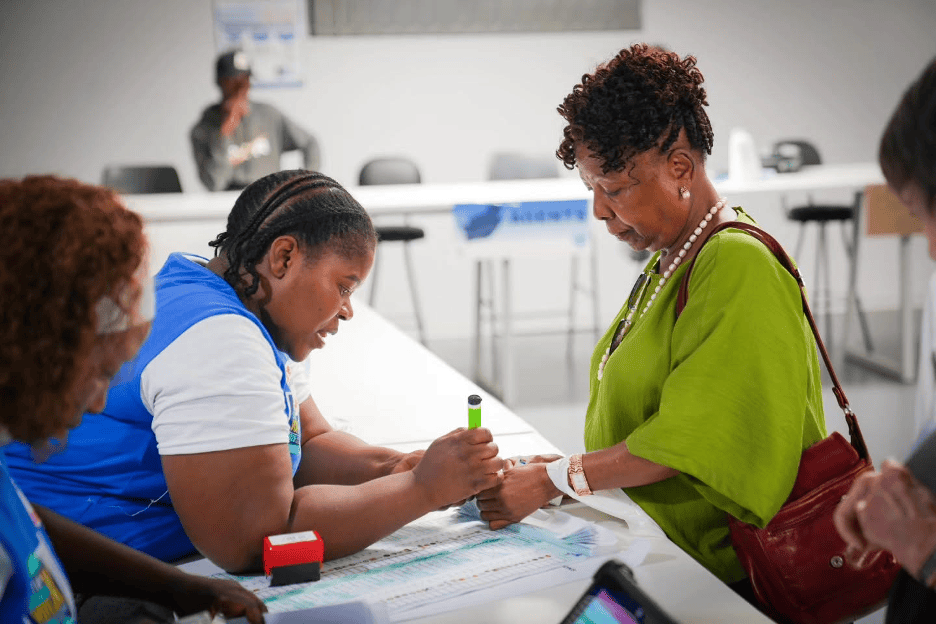
Foreign nationals, including Zimbabweans, became targets of xenophobic narratives on X (formerly Twitter) ahead of South Africa’s November 4 local government elections, amid unverified allegations that some had attempted to register to vote. The claims fuelled concerns about the spread of anti-migrant disinformation and its potential to deepen hostility towards expatriates during a politically sensitive period.
The spread of misinformation about asylum seekers and immigrants allegedly registering to vote followed a July 2026 Constitutional Court ruling in the case involving the Scalabrini Centre of Cape Town and the Department of Home Affairs.
The judgment found that asylum seekers should not be denied access to the asylum application process solely because of procedural issues, such as entering the country irregularly, lacking the required transit visa or failing to report to a refugee reception office within the prescribed period. However, the ruling did not grant asylum seekers automatic refugee status, South African citizenship or voting rights.
Its implementation was subsequently misrepresented on social media, where claims circulated that undocumented migrants were being granted legal status, accessing public benefits and being registered to vote ahead of the November 2026 municipal elections. The narratives tapped into existing anti-immigrant sentiments and concerns about immigration, border control and access to public resources.
On this topic
On August 3, 2026, an X account belonging to Nana_Ndz, operating under the handle @nhanha_nd, published a post alleging that foreign nationals, including Zimbabweans, had attempted to register for South Africa’s November 4 municipal elections.
The post claimed that Independent Electoral Commission (IEC) volunteers had detected and blocked the alleged attempts. It subsequently attracted reposts and comments questioning the integrity of the electoral process.
The allegation emerged shortly after the IEC’s August voter registration weekend, during which 1.7 million registration transactions were recorded.
The account, which was created in February 2023, describes itself as: “IT 👩🎓 | Content Creator, Proudly South African, Proud Supporter of March & March ✊🏽.” Its profile also carries the hashtag #STANDUPFORSOUTHAFRICA🇿🇦 🇿🇦 and has nearly 3,360 followers.
The post attracted more than 4,000 views, 190 likes, 54 reposts, 11 replies and four bookmarks.
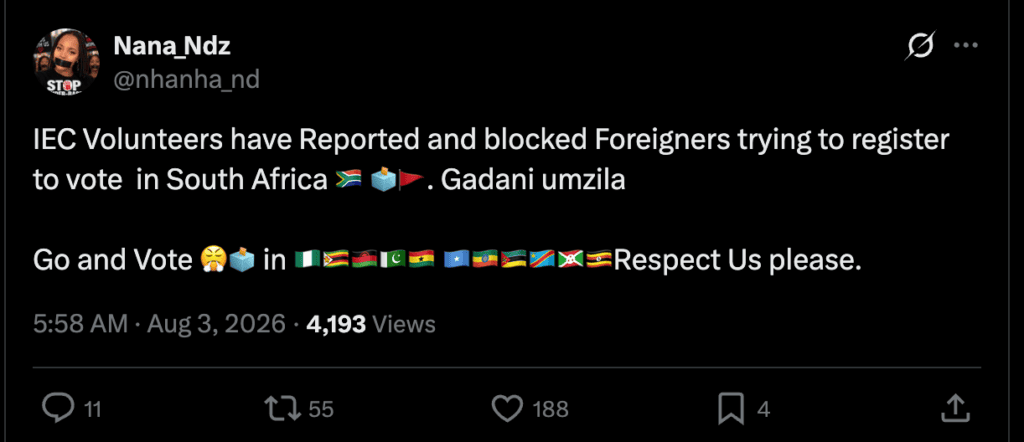
Screenshot of the post by @nhanha_nd.
Among the responses was a mocking comment by X user cousinavi031, operating under the handle @cousinavi031, who wrote: “Ag shame man. Let them vote. Like not for real of course just like playfully. So they can experience how it is to partake in a democratic process such as that cos I mean really they haven’t in most cases had the ability to do so. Cos their countries are so pathetically backward.” Another user, His Beloved 🌟 (@tumi_Gee), responded: “This is weird though, they never want to vote in their countries but try so hard in SA.”
The narrative was also extended to allegations that the African National Congress (ANC) could benefit electorally from the country’s asylum-seeking population.
Reposting an earlier post by Nkanyezi (@NkanyeziKubheka), which stated, “Home Affairs to launch the online Asylum registrations by 10 November, despite everything that has been happening,” Mshengu 👑💐 (@Mxola) claimed: “The ANC messed up their footprint with IEC just recently. Hence, they’re speeding up this asylum process. Meaning before we even vote, ANC has 3+ million votes from these asylum seekers. 😭”
On October 9, 2026, another account, #TheUncapturedActivist ✊🏿 (@AneleMda), alleged that the IEC was allowing undocumented foreign nationals to vote using fraudulent identities.
“@IECSouthAfrica why are you allowing illegal foreigners to vote using FAKE identities in South Africa? Are you part of the syndicate actively working to dispose us South Africans for a takeover by Foreigners?” the post read.
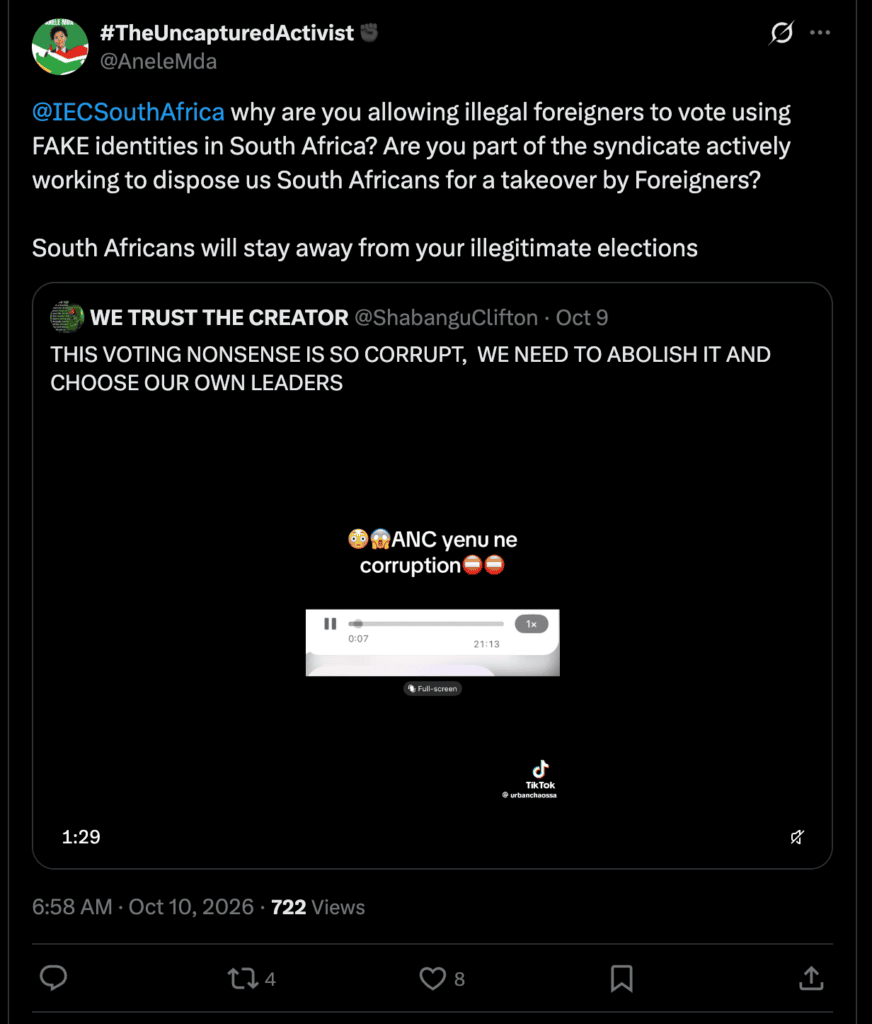
Screenshot of the post by @AneleMda
Many other similar posts were made on the social media platform in the weeks leading up to the election, with some suggesting that the suspicions were because people did not trust the Department of Home Affairs and IEC officials. Others pointed fingers at various political parties, such as the ruling ANC, Democratic Alliance (DA) and Economic Freedom Fighters (EFF), describing the scheme as a means to secure support from foreign nationals.
While @RebrandMerchant expressed scepticism about asylum seekers voting in the November 4 local government elections, the account suggested that such a scenario could become a reality in the 2029 national elections.
The anti-immigrant rhetoric continued into the final days of the electoral campaign.
On November 3, a day before the elections, Born Again (@Born_Again_Man) claimed that Nigerians, Pakistanis, Somalis, Ethiopians, Zimbabweans and Bangladeshis were among those most concerned about the outcome of the polls.
“All of them are worried about their asylum status should their protector the ANC lose most municipalities 😂🤣🤣,” the account posted.
The message attracted more than 63,700 views, 2,100 likes, 500 reposts and 134 replies.
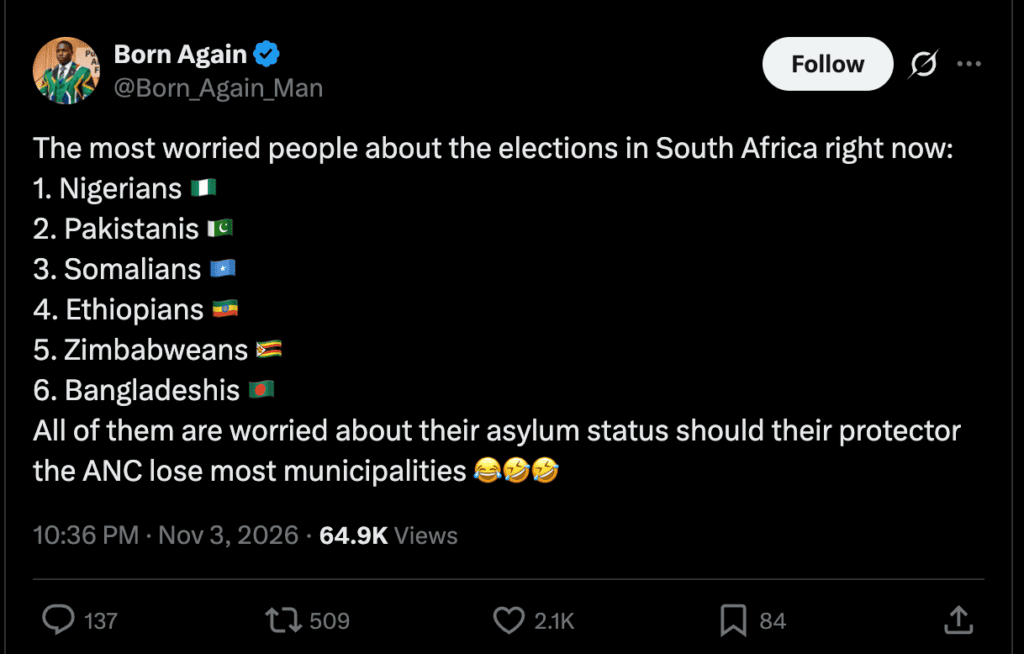
Screenshot of the post by @Born_Again_Man
On election day, the same account published another post, claiming that foreign nationals had been disappointed after discovering they could not participate in the municipal elections.
“It dawned to Nigerians and Pakistanis today that they are not South Africans when they could not vote in our Local Government Elections. It also dawned to EFF followers that Africans can be foreigners in an African country. Oh, I saw their pain… they wanted to vote. Asidlali! (We are not playing games!).”
Also on voting day, Zwidenya (@zwidenyapT) questioned whether foreign nationals could vote in South Africa, alleging that a couple encountered at a polling station appeared to be foreigners but produced green identity documents.
“Guys, can a foreigner vote in South Africa? I am 100% that the couple that was behind me are foreigners, from the accent and looks. Am defeated, as they produced the green ID book. 🙆,” the account posted.
One of the responses to the message, posted by another user, alleged that the couple’s identity documents were fraudulent. “Its fraudulent votes. They have fraudulent IDs, aided by @HomeAffairsSA officials,” the response read.
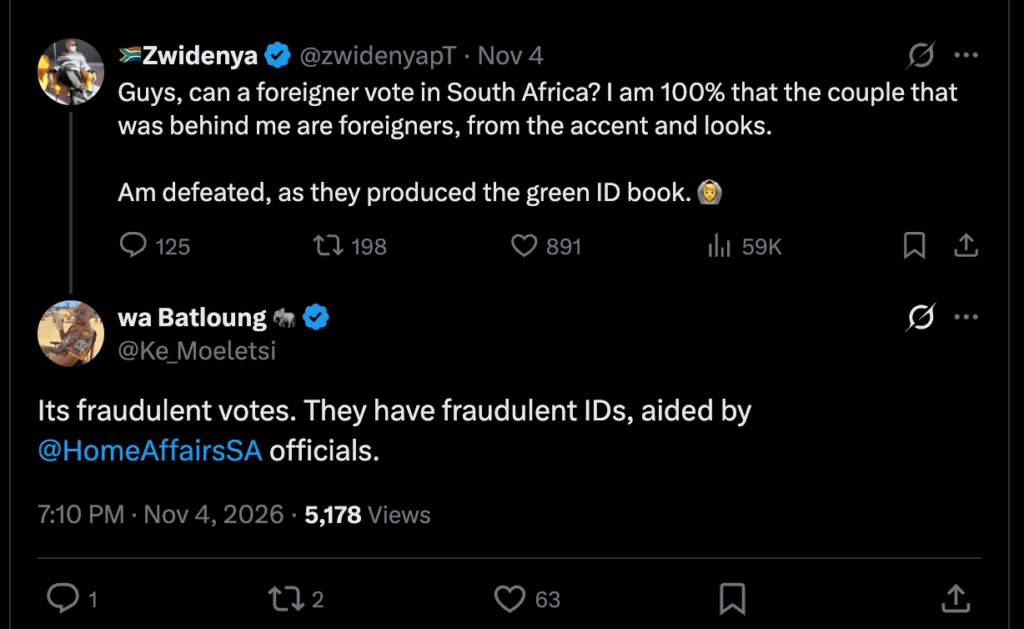
Screenshot of the post by @zwidenyapT and response by @Ke_Moeletsi
On Facebook, another popular social media platform in Southern Africa, similar xenophobic narratives targeting foreign nationals circulated ahead of South Africa’s November 4 local government elections. These included unverified claims that efforts to document undocumented migrants were part of a political strategy by certain parties to facilitate their acquisition of citizenship after five years, thereby securing their future votes. Another recurring narrative portrayed foreign nationals as exploiting South Africa’s economic opportunities, particularly the estimated R180 billion spaza shop market, at the expense of local entrepreneurs. Such claims framed migration not merely as an immigration enforcement issue but as a threat to economic opportunities, political representation and national resources.
In October 2026, Kabelo Morgan published a reel accompanied by a caption claiming: “Our highly skilled illegal Ethiopian brother who escaped the underdevelopment and ethnic divisions of Ethiopia is in South Africa to take his slice of the R180 Billion spaza shop market and teach lazy, drunk South Africans business skills and family management #Ethiopia #TPLF #Oromo #Bashangulgumuz #afar.” The post attracted hostile responses that extended beyond criticism of undocumented migration or competition in the informal retail sector to derogatory generalisations about Ethiopians as a people. One user wrote: “Ethiopia is a dead country and its people think they can develop other countries. These are only on a destruction mission. Send them back to their confused country.”
The exchanges reveal how discussions about migrant entrepreneurship and competition in South Africa’s informal economy were intertwined with derogatory representations of foreign nationals and their countries of origin.
Meanwhile, the South African government and the IEC have dismissed allegations that foreign nationals and asylum seekers had voted in the November 4 municipal elections, describing the claims as unfounded disinformation.
“Those granted refugee status do not have the right to vote in terms of our laws in the country, contrary to what is being circulated in the country,” the Inter-Ministerial Committee on Migration clarified in a statement released in October.
President Cyril Ramaphosa also described claims that his party, the ANC, was relying on asylum seekers to remain in power as “a rubbish story”.
Zimbabwe Community in South Africa chairperson, Ngqabutho Nicholas Mabhena, said there was no evidence that foreign nationals and asylum seekers, including Zimbabweans, had attempted to register unlawfully or voted illegally in the neighbouring country’s recently concluded local government elections.
Mabhena, however, linked the developments to violence in Durban, which resulted in the government suspending physical visits by people applying for asylum documentation and opting for an online application system.
“There is no party that has won elections by pursuing this anti-immigrant rhetoric,” said Mabhena. “There is none. The main issue in these elections is service delivery. That’s the main issue, because look at Western Cape. There are so many migrants in Western Cape, but the Democratic Alliance has politically closed out other political parties.”
He added that those spreading disinformation were unnecessarily fuelling xenophobia and should be held accountable for their actions.
Local governance expert Teddy Ncube said South Africa’s electoral laws were clear about who qualifies to register and vote.
“Foreign nationals, including Zimbabweans and asylum seekers, do not acquire voting rights in national elections simply by residing in South Africa,” said Ncube.
“Therefore, allegations of illegal registration should be supported by actual IEC records, documented cases or investigations. You cannot take an isolated incident, or a claim circulating on social media, and present it as evidence of widespread electoral interference. The danger is that such claims create the impression that foreign nationals are undermining South Africa’s democracy without establishing that this is actually happening.”
Ncube said South Africa’s socio-economic environment, particularly youth unemployment, inequality and pressure on public services, had created genuine public frustration.
“The problem arises when political actors redirect that frustration towards foreign nationals instead of engaging with the structural causes of these challenges,” he explained.
“During election periods, immigration becomes an emotionally powerful political issue. Social media further amplifies this through sensational claims and unverified information. The consequences are not theoretical. We have seen how anti-immigrant rhetoric can contribute to intimidation, attacks on businesses and the displacement of foreign nationals. This is a serious social cohesion and regional development concern.”
Ncube said the IEC needed to take a particularly firm position on the issue. He added that whenever allegations emerged that Zimbabweans or other foreign nationals had registered illegally, the Commission should investigate and publicly communicate its findings.
“Political parties must also be held accountable for statements made by their leaders and candidates. Law enforcement cannot wait until rhetoric translates into violence before intervening,” he said.
Political analyst Fortune Mlalazi, however, cautioned against assuming that foreign nationals had influenced either voting patterns or the outcome of South Africa’s recent elections.
He argued that individuals of Zimbabwean, Congolese or other foreign origins who might have participated in the elections could have been naturalised South African citizens with full voting rights.
“If ever you have people that are of Zimbabwean origin or Congolese or any other nationality that did vote, you must remember that they are naturalised individuals from various countries in South Africa who have rights to vote,” said Mlalazi.
He questioned the legitimacy of complaints about foreign nationals participating in the elections, arguing that even if isolated cases existed, their numerical significance would need to be established.
“So any complaint is not genuine and besides, we must look at the percentage of those that would have voted. Suppose it is true, the percentage would be very minute. But the asylum question is non-existent because you can’t vote as an asylum-seeker.”
This article was produced with mentorship from the African Academy for Open Source Investigations (AAOSI) as part of an initiative by the Ministry of Foreign Affairs of Norway and Code for Africa (CfA). Visit https://disinfo.africa for more information.




Leave a Reply