
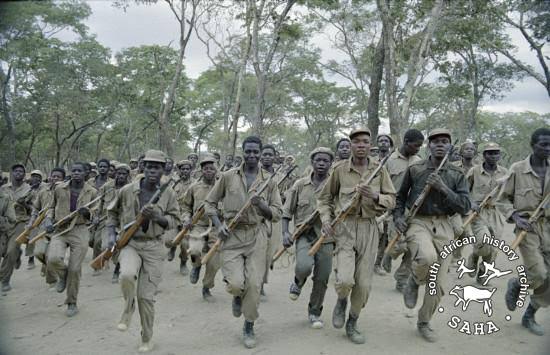
The toyi-toyi is among the most enduring drills associated with southern Africa’s liberation struggles. Accounts of its adoption by ZAPU fighters trace it to Algerian FLN training camps in the mid-1960s, where cadres reportedly encountered a demanding, high-kneed drill taught by Algerian and Egyptian instructors. This account is also echoed in recent interviews with ZPRA veterans in Bulawayo.
Historians Jocelyn Alexander and JoAnn McGregor offer the most detailed published account of this journey. In their 2020 article, “The Travelling Toyi-Toyi: Soldiers and the Politics of Drill”, the two renowned scholars trace the drill through the recollections of liberation war veterans, from Algeria to ZAPU training camps in Tanzania and Zambia. Their research also describes how cadres of Umkhonto we Sizwe (MK), the African National Congress’s armed wing, learned the toyi-toyi from ZAPU fighters in shared military camps.
Alexander and McGregor say ZAPU veterans remembered the toyi-toyi as “a defining feature of their army”, helping create “powerful bonds of loyalty” and physical toughness. Their findings establish an important history of how liberation movements taught, remembered, and passed on the drill. They do not, however, conclusively establish whether every element of its movement originated with its Algerian instructors.
That distinction is central to the question this article explores.
On this topic
The question therefore lingers: was the toyi-toyi entirely new to these cadres, or did it resonate with practices they already knew before arriving at the Algerian camps?
Rhythm, movement and song were features of African societies long before colonialism or the liberation struggles of the 1960s. There were songs for funerals, celebrations, work, weddings and other occasions. Many of these songs and dances were adapted into new experiences as Africans came to terms with colonial rule in its many forms.
Across different African societies, praise poets and performers, including izimbongi in Nguni traditions and griots in West Africa, preserved histories and celebrated people and events through words, music and performance.
Closer to home, Ndebele regiments had their own war cries, drills and formations. Some of the chants still popular in modern Zimbabwe include “Nglamlela! Nglamlela Ngilamlela, Nglamlela Nampa Bafo beng’ bulala!”
The amabutho moved in unison to reinforce discipline, solidarity and a formidable military presence. Their coordinated movement and rhythmic chanting invite comparison with the toyi-toyi as it came to be practised by southern African liberation movements.
Resemblance, however, does not by itself establish a direct line of descent.
An account attributed to a Rhodesian intelligence officer observing ZPRA fighters at Entumbane likened their movements to those of older Nguni impis. Before treating this comparison as documentary evidence, the original statement and its context would need to be established.
Media and cultural studies scholar, Professor Brilliant Sigabade-Mhlanga, insists that the toyi-toyi reflects the rhythmic and disciplined society from which many fighters came. He draws a parallel with the development of gumboot dancing among miners, who used rhythm and movement in response to their working conditions. In his view, such examples suggest that local communities did not simply borrow every form of collective dance or movement from outsiders.
Sigabade-Mhlanga questions the suggestion that the toyi-toyi’s origins can be explained solely through Algerian and Egyptian military training. He uses the idea of a ‘cultural phaneron’ to explain why a movement encountered in a new setting might nevertheless feel familiar.
“This is what is called a ‘cultural phaneron’ in cultural studies, where some knowledge or information is ingrained or embedded in us at birth and so, as we are socialised from birth, it stays with us, sometimes consciously or unconsciously, it remains somehow in the back of our minds”, he explained.
In his account, a cultural phaneron refers to a body of ideas, knowledge and associations that people draw upon, sometimes without being conscious of it, when interpreting unfamiliar situations. He suggests that ZPRA cadres may have embraced the toyi-toyi readily because aspects of its rhythm, movement and collective discipline resembled practices already embedded in their cultural experience.
That interpretation also recalls the place of war dances and military drills among earlier Nguni regiments. Such performances could serve several purposes, including preparing fighters for battle, building morale and strengthening camaraderie. The similarities are worth investigating, even if they cannot alone prove that the practices shared an identical origin.
Sigabade-Mhlanga also points to the traditional dance known as ‘amantshomane’, performed during ceremonies he describes as ‘imigido yamadlozi’, associated with honouring or appeasing ancestral spirits. He traces the dance to a war drill called ‘iNjomane’ and observes that its earlier military associations have since become less visible. This proposed connection warrants further historical and ethnographic examination.
The claim that ZAPU fighters learned the toyi-toyi from Algerian and Egyptian instructors should therefore be considered alongside the longer history of rhythmic group movement and military drill in southern Africa. The practices of Nguni regiments associated with figures such as Mzilikazi and Shaka provide useful comparative context, although a specific historical link to the modern toyi-toyi remains to be demonstrated.
Alexander and McGregor also show that the meaning of the toyi-toyi was never fixed.
Whereas ZAPU veterans often recalled it as a source of solidarity and military resilience, some MK veterans associated it with the harsher side of militarised discipline. The authors’ comparison is a reminder that military practices can be adopted, adapted and understood differently by those who experience them. This history of transmission and changing meaning can be considered alongside Sigabade-Mhlanga’s argument about cultural familiarity without treating either as proof of an unbroken precolonial origin.
The question is not simply where ZPRA cadres first encountered a drill called the toyi-toyi, but how they interpreted and adapted it. Algerian and Egyptian instructors may have helped formalise or transmit a particular version of the drill during liberation training. Whether they originated the practice, named it or drew on earlier traditions is a separate historical question that calls for stronger evidence




Leave a Reply