

Opposition leaders have accused the Southern African Development Community (SADC) of protecting incumbent governments at the expense of citizens, arguing that the regional bloc increasingly prioritises political stability and state sovereignty over democracy, human rights, and accountability.
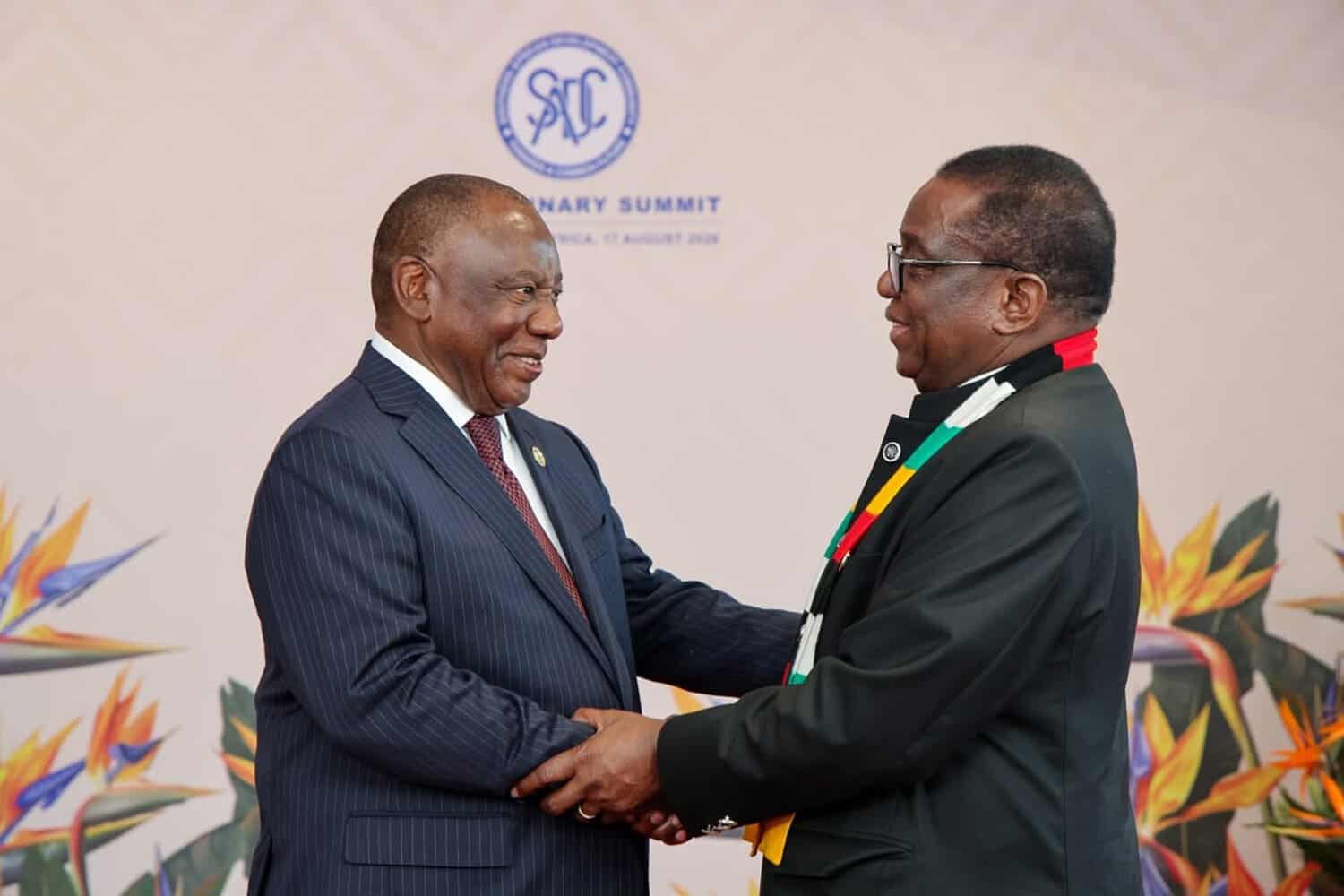
The criticism follows the 46th SADC Summit held in Durban on August 17, 2026 where regional leaders renewed commitments to regional integration, industrialisation, peace and security, however did not specifically address Zimbabwe’s controversial constitutional reforms.
Instead, the official summit communiqué congratulated Zimbabwe on its election as a non-permanent member of the United Nations Security Council for the 2027–2028 term and expressed confidence in the country’s ability to represent the interests of SADC, Africa and the Global South.
SADC also reiterated its long-standing call for the removal of sanctions imposed on Zimbabwe, arguing that they constrain the country’s economic potential.
On this topic
Opposition leaders lamented how this contrast is telling, while SADC publicly endorsed Zimbabwe’s international role and repeated its support for Harare on sanctions, the regional bloc did not address the contentious constitutional changes that undermine democratic accountability and extend President Emmerson Mnangagwa’s hold on power.
Mthwakazi Republic Party (MRP) led by Mqondisi Moyo said SADC had increasingly become “a political shelter for incumbent governments rather than a defender of the people of Southern Africa”.
“SADC continues to present itself as the guardian of regional peace, stability, democracy, human rights, economic integration, and collective security. Yet, from the standpoint of the Mthwakazi Republic Party, the reality is profoundly different,” he said.
Moyo accused the regional bloc of retreating behind sovereignty and non-interference whenever member governments face allegations of human-rights abuses, electoral manipulation, institutional corruption or violations of the rule of law.
“SADC cannot claim to be a guardian of regional peace while continuously protecting the political comfort of governments at the expense of millions of ordinary citizens,” he said.
“The organisation must stop confusing regime survival with regional stability.”
Zimbabwe’s constitutional changes
The criticism comes after Zimbabwe enacted the Constitution of Zimbabwe Amendment (No. 3) Act, 2026, (CAA3), which introduced significant changes to the country’s constitutional and electoral framework and was heavily criticised by many citizens, opposition parties and civil society groups.
The reforms have been particularly controversial because of their implications for the country’s presidential election system and the length of political terms.
The constitutional changes weaken direct popular participation in the election of the president and could allow the current political leadership to remain in power until 2030.
The controversy therefore has broadened to question the extent to which SADC, a regional organisation committed to democracy and constitutionalism should intervene when a member state undertakes changes that weaken democratic safeguards.
The issue was not specifically addressed in the final communiqué of the Durban summit.
The Zimbabwe Communist Party (ZCP) also criticised SADC’s silence on the constitutional process.
ZCP general secretary, Nicholas Ngqabutho Mabhena, said he had examined the summit resolution and found no specific reference to Zimbabwe’s constitutional amendments.
“I looked into the SADC resolution, I did not see a mention of Zimbabwe. SADC thinks the constitutional amendments are a sovereign duty which the neighbours have no say,” he said.
“It did not bother to look into how the process to make those constitutional changes were arrived at.”
Mabhena said the position was unsurprising given SADC’s broader democratic shortcomings.
“It is no surprise given that Eswatini, for example, is not a democratic state and other countries like Mozambique had disputed election outcomes yet nothing was said,” he said.
“SADC is a club of dictators, we should not look into it for any recourse.”
SADC’s own Treaty commits the organisation to democratic principles, human rights and the rule of law, while its stated objectives include promoting political values, systems and institutions that are democratic, legitimate and effective.
Critics have argued how these gaps between those commitments and the bloc’s political conduct are becoming increasingly difficult to ignore.
The MRP’s criticism also went beyond Zimbabwe, arguing SADC has become too comfortable with failures by member governments.
Moyo said sovereignty should not be used as a shield against regional accountability.
“When governments misbehave, SADC whispers. When citizens protest, governments shout. When institutions collapse, SADC convenes meetings. When elections are disputed, SADC issues carefully worded statements. And when accountability is demanded, sovereignty suddenly becomes the shield,” he said.
He said southern Africa needed a regional institution capable of protecting citizens from abuses of political power rather than a “club of presidents protecting one another.”
His criticism touched on one of SADC’s most controversial institutional failures, the collapse of its Tribunal.
The SADC Tribunal was established as a regional judicial mechanism to interpret the SADC Treaty and adjudicate disputes involving member states and other parties.
Its authority became particularly significant in the landmark Mike Campbell case involving Zimbabwe’s controversial land reform programme.
The Tribunal found against Zimbabwe and ruled that the government’s treatment of the applicants breached its obligations under the SADC Treaty.
When Zimbabwe failed to comply, the Tribunal subsequently found continuing non-compliance and referred the matter to the SADC Summit for appropriate action.
The Tribunal was subsequently rendered effectively non-operational after the terms of its judges were not renewed, removing a significant regional avenue for legal redress.
Read: https://cite.org.zw/sadc-
The MRP said this episode remains a symbol of SADC’s unwillingness to confront powerful member governments.
“When a regional court became inconvenient to a powerful member government, the regional political establishment chose to weaken the court rather than confront the government,” Moyo said.
The MRP supports the revival of the Tribunal but says restoration without genuine judicial independence and enforceable authority would be meaningless.
“No government … should be above regional law,” he said and was particularly critical of SADC’s prolonged “political babysitting” of Zimbabwe.
Moyo argued decades of diplomatic accommodation had failed to resolve Zimbabwe’s political and economic problems while shifting the consequences onto neighbouring states.
“Zimbabwe has been treated as a special political case requiring endless diplomatic protection, political accommodation, and regional patience,” he said.
“But patience without accountability becomes complicity.”
The consequences, he argued, are increasingly regional.
Zimbabwe’s economic and political difficulties have contributed to sustained migration, with South Africa bearing a significant portion of the impact.
The MRP rejects attempts to treat Zimbabwean migration solely as a border-control issue, arguing that migration is also a symptom of political and economic conditions.
“When people cannot find meaningful employment, when public institutions deteriorate, when political freedoms are restricted, when economic opportunities collapse, and when citizens lose confidence in their country’s future, they naturally seek alternatives,” Moyo said.
South Africa has consequently carried a substantial portion of the regional burden.
The 46th SADC Summit itself acknowledged the wider regional dimension of migration, receiving an update from South Africa and calling for coordinated and multidimensional dialogue to address the underlying drivers of migration and develop comprehensive responses.
“If Zimbabwe’s political and economic circumstances continue to produce mass migration, then Zimbabwe’s situation is no longer exclusively a Zimbabwean matter. It is a SADC matter,” Moyo said.
The MRP argued Zimbabwe’s crisis is increasingly producing consequences across the region.
Zimbabweans continue to seek work and economic security in neighbouring countries, particularly South Africa, while host countries face pressure on employment, housing, public services and immigration systems.
The resulting tensions have contributed to increasingly securitised approaches to migration and growing anti-foreigner sentiment.
Moyo said SADC could not indefinitely manage those consequences without confronting the conditions driving people out of Zimbabwe.
“You cannot permanently manage a regional migration crisis by deporting the victims of an economic and political crisis,” he said.
The MRP acknowledged South Africa’s responsibility to enforce its immigration laws but said Pretoria should not be left to carry the consequences of Zimbabwe’ crisis alone.
If Zimbabwe’s political and economic conditions continue to drive mass migration, Moyo argued, the issue should be treated as a regional governance concern rather than simply a bilateral immigration matter.
Moyo also noted the deeper problem is rooted in the political culture that has shaped SADC since its liberation-era origins.
He said the region’s history of solidarity against colonialism and apartheid should not translate into unconditional protection for governments simply because they emerged from liberation movements.
“Our solidarity must be with the people, not with political incumbents. Our solidarity must be with justice, not impunity,” he said, noting SADC should not confuse African solidarity with political protection.
“African leaders must stop protecting one another from accountability while ordinary Africans pay the price for their failures.”
Mabhena also weighed in and said their criticism goes beyond SADC’s economic performance but moral authority.
SADC’s stated objectives include achieving development, peace and security, economic growth and improved living standards through regional integration built on democratic principles and equitable and sustainable development.
“But those principles lose credibility when the organisation protects governments from scrutiny while citizens bear all sorts of failures,” said the ZCP leader.
Meanwhile, analysts have called for a fundamental change in the organisation’s approach and that challenge now falls partly on South Africa, which assumed the SADC chairpersonship at the recent Durban summit, with President Cyril Ramaphosa elected as the new chairperson.
The summit commended outgoing chairperson President Mnangagwa for his contribution to regional integration and economic development.
“The central question is whether South Africa will use its chairmanship to strengthen regional accountability or simply continue the established practice of quiet diplomacy and consensus among governments,” said Dr Khanyile Mlostshwa, a critical studies scholar.
“Is regional stability measured by the absence of open conflict between governments, or by whether citizens are able to live under accountable institutions and democratic systems.”
The MRP leader said the two are not interchangeable.
“The stability of governments is not the same as the stability of nations,” Moyo said, arguing that until SADC recognises that distinction, the region will continue protecting political elites while ordinary citizens bear the cost.






Leave a Reply