

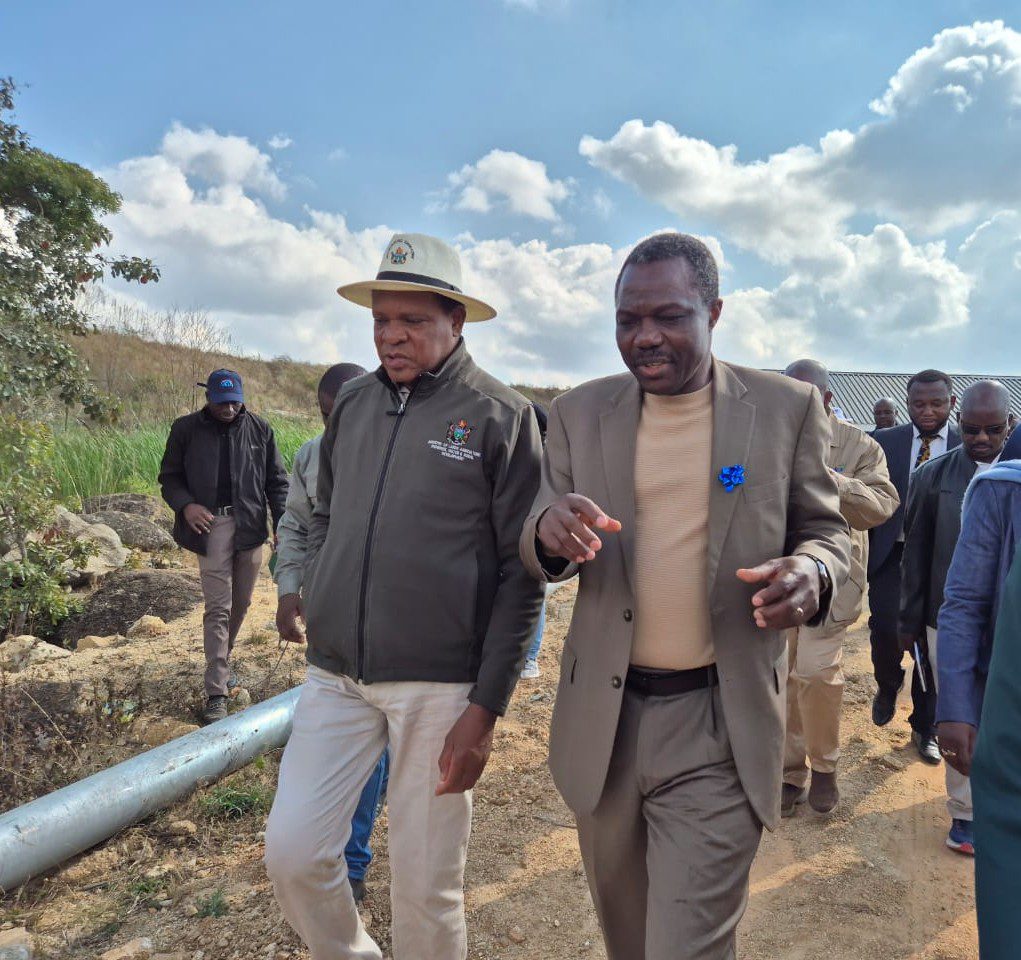
Minister of Agriculture, Mechanisation and Water Resources Development, Dr Anxious Masuka, has revealed that the government is on a drive to transform Zimbabwe’s irrigation schemes into commercially viable businesses.
He said this during the commissioning of the Wanezi Dam, Irrigation Scheme and Piped Water System in Insiza, Matabeleland South last Friday where he said so far, government converted 368 of Zimbabwe’s 460 irrigation schemes into commercially managed business entities under the Vision 2030 Accelerator Model, with the remaining schemes expected to be transformed by the end of the year.
The minister said Zimbabwe has significant irrigation potential but many schemes are underperforming because of governance and business management challenges.
“Zimbabwe’s irrigation schemes are capable of irrigating a potential of 26 000 hectares. Sadly, only 19 000 hectares are irrigated simply because of issues of scheme governance, viability, profitability and sustainability,” Masuka said.
On this topic
“That is why we now have the Vision 2030 Accelerator Model to convert these scheme business units into viable businesses, and we are registering them as companies.”
The government said it had already converted 368 irrigation schemes under the model and expected all 460 schemes to be operating under the new framework by the end of the year.
“We think by the end of the year we will have converted all 460 irrigation schemes into viable, profitable and sustainable businesses so that the beneficiaries become businesswomen and businessmen,” Masuka said.
Under the new model, every new irrigation scheme will be registered as a company and managed as a single business entity rather than operating as a traditional communal scheme.
“All new irrigation schemes will now be on what we call the Vision 2030 Accelerator Model. First, the irrigation scheme is registered as a company, so it becomes one irrigation scheme business unit,” Masuka said.
Instead of expecting farmers to manage complex commercial enterprises without formal business training, the minister said professional managers would be recruited to oversee operations.
“The irrigators are not expected to go to school to learn how to run the business. We must employ a professional manager to run it, while the irrigators become shareholders in the scheme,” he said.
The minister added companies will develop five-year business plans, hold quarterly board meetings and operate under sound corporate governance structures.
“On a daily basis, the irrigators, who are the shareholders, become the workers, and each day they work they are paid,” he said.
He said the new approach would make sure farmers receive regular incomes instead of waiting until after harvest to earn money.
“At the moment, when you harvest your groundnuts, you hope to sell them and then get some payment. But now the scheme is run as a business,” Masuka said.
The minister said operating irrigation schemes as larger commercial entities would also improve their ability to access bank financing.
“If you are looking for a loan for half a hectare, no one looks at you. But if you have 30 hectares under irrigation, it becomes a bankable project. We are then able to secure working capital support,” he said.
Agricultural and Rural Development Authority (ARDA) would oversee implementation of the corporate model by recruiting qualified local managers capable of working closely with scheme members.
“We want to convert these schemes through a corporate model run by ARDA, which will recruit a capable local person who can interact with the irrigators and run the scheme as a business,” the minister said.
The new management structure, he added, would improve planning, crop rotation and financial management while allowing shareholders to benefit from profits.
“They will be able to determine crop rotations, manage production and, when they sell their produce, generate a surplus. At the end of the crop cycle, they will be able to declare dividends,” said Masuka.
He added that commercially managed irrigation schemes would be better positioned to finance maintenance and repairs without relying entirely on government support.
“When repairs are needed, because it is a business, the scheme can approach a bank or use its own resources to carry out the repairs,” he said.
Echoing the government’s vision of commercialising agriculture, United Nations Development Programme (UNDP) Zimbabwe Resident Representative, Dr Ayodele Odusola, said the initiative was aimed at transforming farming from subsistence production into profitable business enterprises.
“This is one way we are trying to change our farming system from a way of life into a business enterprise. The idea is for farmers to be able to stand on their own because development is not something that the government alone can achieve,” Dr Odusola said.
“The private sector alone cannot do it, and development partners alone cannot do it. It requires collaboration between Government, the private sector, development partners and communities to achieve the intended goals.”







Leave a Reply