
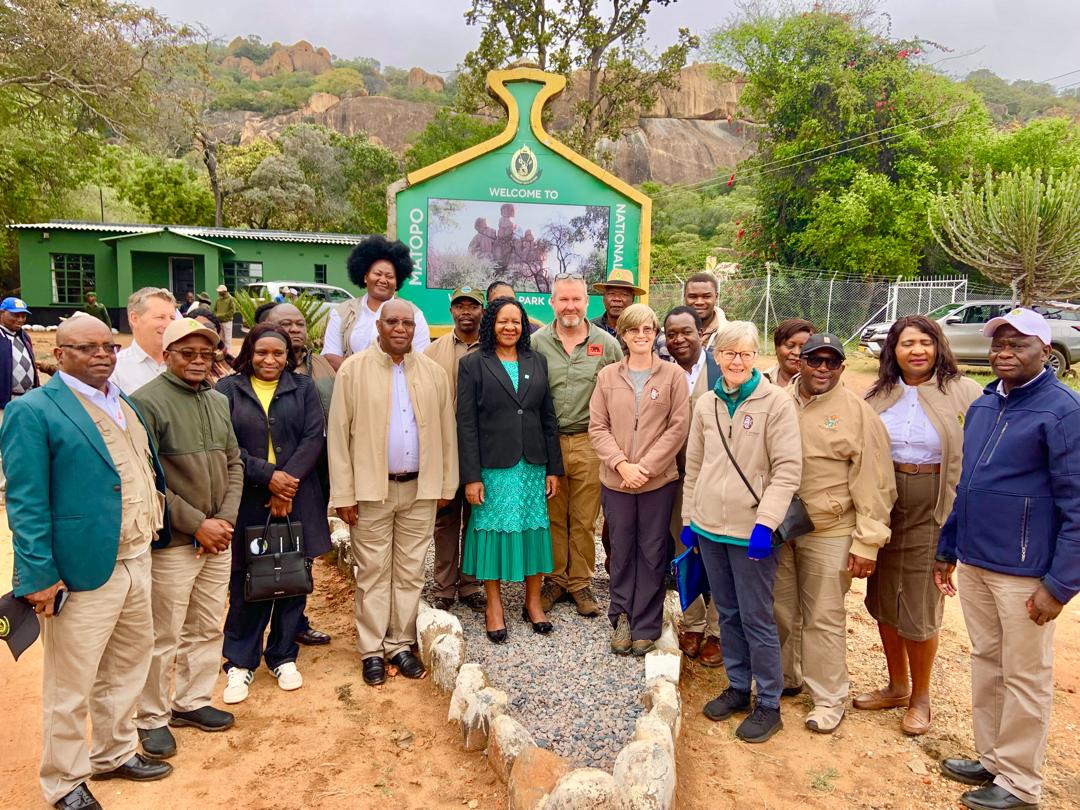
Public-private partnerships are transforming biodiversity conservation in Zimbabwe, helping the government strengthen protection efforts, enhance operational capacity and sustain critical ecosystems in the face of growing environmental threats.
This was evident during a high-level tour of Matobo National Park last Friday, where Environment, Climate and Wildlife Minister, Dr Evelyn Ndlovu commissioned a series of jointly funded conservation projects designed to strengthen wildlife protection, improve ranger welfare, reduce human-wildlife conflict and boost operational efficiency within the country’s parks system.
The commissioned projects, funded through collaborations between conservation groups, private sector partners and the government signal a growing shift toward integrated conservation models that combine technology, logistics and community involvement.
“What I have witnessed here is truly inspiring,” said Ndlovu on Friday at the last site visit at Tshabalala Game Sanctuary.
On this topic
“This is not merely a collection of projects. It is a blueprint for the future of conservation in this country.”
The commissioned infrastructure included a state-of-the-art operations control room established at Whitewaters in partnership with Chengeta Wildlife, valued at US$23 152.96.
The facility, complete with EarthRanger software, is designed to provide real-time wildlife monitoring, poacher detection, fire surveillance and improved ranger coordination.
Ndlovu described the control room as “the nerve centre of conservation in this region,” marking a significant leap in Zimbabwe’s adoption of modern conservation technologies.
“Poaching syndicates are organised, well-resourced and technologically equipped. If we are to protect our wildlife, we too must evolve,” she said.
The minister said the integration of advanced monitoring systems would enable authorities to track key species, detect threats early and coordinate responses with precision, setting a precedent for replication across the country.
Beyond technology, the partnerships have also prioritised improving conditions for frontline conservation staff.
A ranger base and game fence constructed by the Matobo Conservation Society at a cost of US$10 400 will provide on-site accommodation, allowing for rapid emergency response while boosting ranger morale.
Additional mobility assets were handed over to support patrols and law enforcement operations, particularly at Tshabalala Game Sanctuary.
These include two patrol boats donated by businessperson, Mr Marconati (US$20 000) to enhance lake surveillance and anti-poaching efforts, as well as a staff bus from Time Streams Mine (US$50 000) to facilitate efficient transportation of rangers.
Deployment vehicles valued at US$19 000 were provided by S and E Mine, alongside motorcycles, bicycles and quad bikes from various partners to enable access across rugged terrain and during adverse weather conditions.
“These are not small gestures. They are strategic investments in conservation,” Ndlovu said, commending private sector partners for their “co-ownership” of Zimbabwe’s conservation mission.
The Matopo region, which spans approximately 905 square kilometres, is one of Zimbabwe’s most ecologically and culturally rich landscapes.
Matopo is home to key wildlife species including white and black rhinoceros, elephants, leopards, hyenas and diverse birdlife.
Its strategic location, bordering Botswana and South Africa, places it at the heart of transboundary conservation efforts, reinforcing its importance in regional ecological connectivity.
Throughout the tour, stakeholders were taken through various sites demonstrating how partnerships are leveraged to address conservation challenges and improve outcomes on the ground.
The minister said these projects reflect broader national goals under Vision 2030, which seeks to transform Zimbabwe into an upper-middle-income economy, with environmental protection and sustainable resource management as key pillars.
She added that conservation and development are not mutually exclusive, but rather complementary.
“Here in Matopo, they are partners moving forward together to build Zimbabwe,” Dr Ndlovu said.
“Through your work, you are not merely implementing projects, you are laying bricks in the foundation of Vision 2030.”
The minister called for continued investment in innovation, including drone surveillance, data integration and collaboration with academic institutions to develop home-grown conservation technologies.
“Our wildlife is a national treasure. It brings revenue through tourism and creates jobs. Every visitor who comes to see our rhinos contributes to our economy,” she said.
The minister also underscored the importance of teamwork, describing the partnerships as a model worth replicating nationwide.
“Team Zimbabwe, Team Matobo, Team Hwange, we must work together to achieve our goals,” she said.
Chairperson of the Matobo Rhodes Committee, Dr Leslie Ncube, said the region’s conservation efforts are anchored on collaboration and sustainable development principles.
“Matopo brings together Matabeleland South Province and Bulawayo Metropolitan Province under one administrative umbrella, forming a region rich in both natural and cultural heritage,” Ncube said.
He noted that conservation work in the region is guided by national legislation and policy frameworks, including the Parks and Wildlife Act, the Constitution of Zimbabwe and the National Development Strategy 2 (NDS2).
“We are committed not only to conserve, but also to partnering with local communities to support livelihoods through wildlife-based projects. Conservation succeeds when communities prosper alongside it,” he said.
Dr Ncube highlighted the role of transfrontier conservation areas in promoting cross-border ecological stewardship, noting that biodiversity conservation must extend beyond national boundaries.
The event drew a wide range of stakeholders, including senior government officials, conservation organisations, mining companies and development partners, reflecting the multi-sectoral nature of modern conservation efforts.
Among those present were Permanent Secretary in the environment ministry Ambassador Tadeous Chifamba, Zimbabwe Parks and Wildlife Management Authority (ZimParks) Director-General Professor Edson Gandiwa, ZimParks Board Chairperson Dr Agrippa Sora, Environmental Management Agency (EMA) Director-General Aaron Chigona, EMA Board Chairperson Ambassador Zenzo Simbi, Forestry Commission Zimbabwe Board Chairperson Ambassador Mohamed Jasset also Special Advisor to the President on Global affairs among others.
Representatives from the Matopo Conservation Society, Matopo Rhino Trust, Chengeta Wildlife, Bushmen Travel, Big Cave, Dambari Trust, S and E Mine , Time Streams Mine and other stakeholders were also in attendance.
Dr Ncube said the projects commissioned were a testament to collective effort.
“There is a saying in our culture: if you want to go fast, go alone. If you want to go far, go with others. The projects we see today are not ZimParks projects, they belong to all of us,” he said.






Leave a Reply