

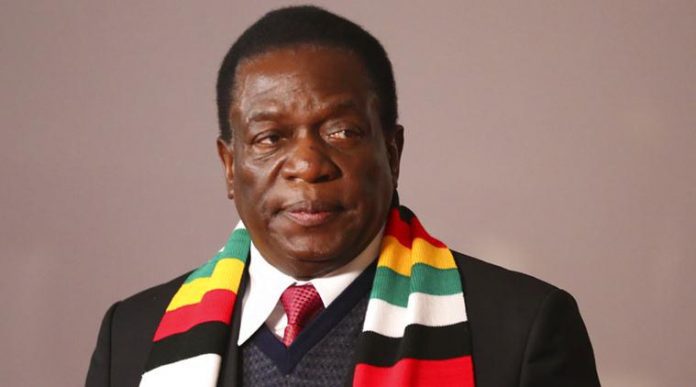
Zimbabwe is grappling with widespread socio-political and economic challenges, according to new findings from the Human Rights Measurement Initiative (HRMI), which point to serious concerns over civil liberties, personal safety and living standards.
The 2025 HRMI Rights Tracker shows that Zimbabwe continues to perform poorly in safeguarding civil and political freedoms, with citizens facing growing restrictions on free speech, political participation, and personal safety.
The Empowerment score, which measures civil and political rights, places Zimbabwe at a dismal 3.7 out of 10, far below the global average, categorising the country in the “bad” range.
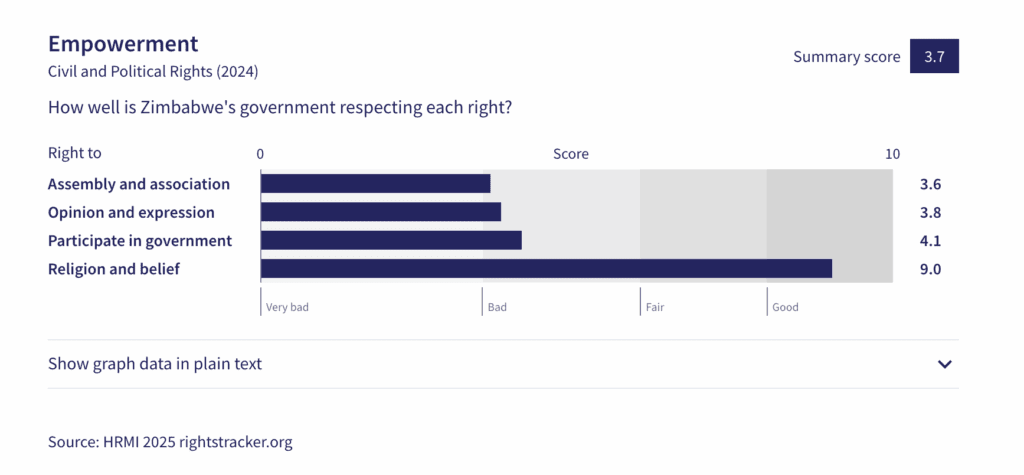
“This score reflects the daily reality for many Zimbabweans: people cannot freely express their opinions, gather for peaceful protests, or participate in political processes without fear of retaliation,” said Nkosi Sibanda, HRMI’s East and Southern Africa Lead.
“These are foundational rights in any democracy and in Zimbabwe, they are under threat.”
The report further highlights that opposition activists, civil society leaders, journalists, and student union members were particularly vulnerable in 2024.
Arbitrary arrests, prolonged detention without trial, and torture in custody were frequently reported, especially during sensitive political periods such as by-elections and the Southern African Development Community (SADC) summit in August 2024.
One notable case of prolonged detention was that of opposition leader Jameson Timba, who was arrested and held for five months alongside 34 activists simply for holding a private political meeting.
The report lists numerous other vulnerable groups, including members of the Citizens Coalition for Change (CCC), trade union leaders, LGBTQIA+ people, and even homeless individuals arrested under colonial-era laws like the Vagrancy Act.
A full look at Zimbabwe’s data can be seen here: https://rightstracker.org/country/ZWE
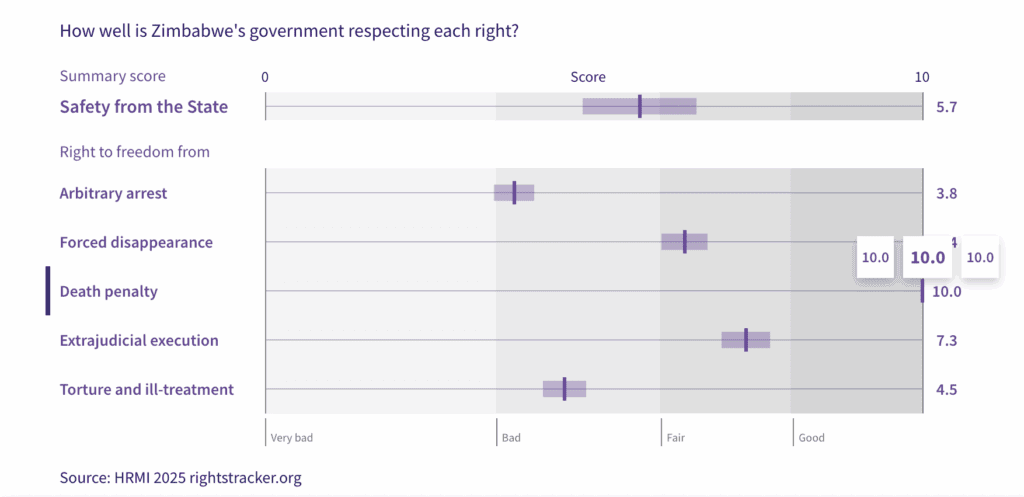
On the “Safety from the State” metric, which assesses the risk of arbitrary arrest, torture, or extrajudicial killing, Zimbabwe scored 5.7 out of 10.
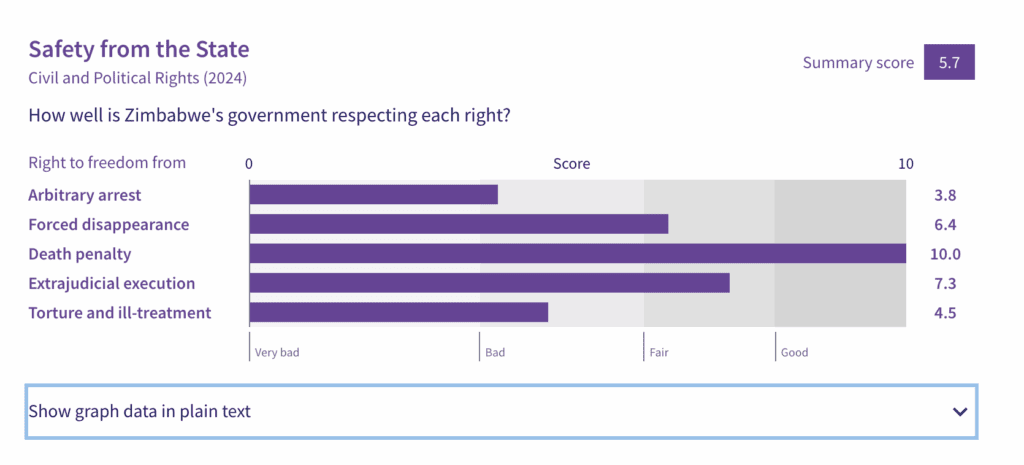
Though this sits near the average of other countries in the HRMI dataset, it remains troubling.
“These figures validate reports by groups like Amnesty International and show a pattern of state-led or state-sanctioned repression,” said Sibanda.
“There is a systemic failure to protect human rights defenders and pro-democracy campaigners.”
Even more damning is the country’s record on economic and social rights. Zimbabwe scored only 67.8 percent of its potential on HRMI’s Income-adjusted Quality of Life benchmark, indicating that despite its resources, the state is failing to meet international obligations for making sure access to food, health care, education, housing, and work.
HRMI ranks Zimbabwe’s performance on these rights in the “very bad” category.
The country’s water and sanitation infrastructure is in particularly dire strait, with the report recording just 36.7 percent fulfilment of the right to water and 40 percent for sanitation, meaning Zimbabwe is achieving less than half of what it should be capable of at its income level.
This aligns with recent findings from UNICEF, which reported a significant decline in access to basic water services in Zimbabwe, from 60 percent of households in January 2024 to just 52 percent by mid-year. This drop has left millions vulnerable to water-borne diseases, further undermining public health.
“It is deeply concerning that despite Zimbabwe’s available resources, its people continue to endure systemic repression and deprivation,” Sibanda said.
“These scores show not only that civil and political freedoms are being eroded, but that basic economic and social rights, water, sanitation, food, health, and education, are being neglected. The government must urgently translate its resources into meaningful improvements for its people.”
The report also compares Zimbabwe’s performance to global and regional benchmarks.
When measured against the best-performing countries globally, Zimbabwe’s score on Quality of Life rights is a meagre 54.6 percent.
In the Sub-Saharan African context, it ranks near the regional average, a sobering fact that underscores the wider rights challenges across the continent.
HRMI’s Empowerment and Safety from the State scores show that large sections of the Zimbabwean population, especially those critical of the ruling party, live in constant fear of surveillance, arbitrary detention, or worse.
Laws such as the Private Voluntary Organisations (PVO) Act and state crackdowns on peaceful gatherings continue to shrink civic space.
The HRMI Rights Tracker, a global project measuring human rights systematically across over 40 countries, uses peer-reviewed and internationally recognised methodologies.
The data are freely accessible and are utilised by global bodies like the United Nations, the World Bank, and Amnesty International.
Since its launch in 2017, HRMI has sought to create a world where “what gets measured, gets improved.”
At CITE, we dig deep to preserve the stories that shaped us—ZPRA Liberation Archives, the DRC War, and more. These are not just stories—they’re our roots. We don’t hide them behind paywalls. We rely on you to keep them alive. Click here to donate: https://cite.org.zw/support-local-news/