

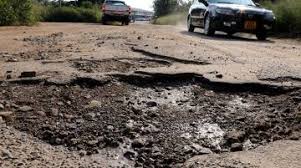
Poor drainage systems, worsened by blocked waterways and littering in urban areas, are a major cause of Zimbabwe’s deteriorating roads, the government has said, as motorists continue to complain about the poor quality of many key routes.
The Minister of Ministry of Transport and Infrastructural Development, Felix Mhona, told the Senate of Zimbabwe during a recent question-and-answer session that stagnant water is accelerating damage to road surfaces, particularly during the rainy season.
He said many cities are increasingly prone to flooding because drainage systems are clogged by waste, despite repeated efforts by local authorities to clear them.
“The number one enemy to our roads is water. When we allow water to flow over the surface of our roads, it ultimately leads to significant damage,” Mr Mhona said.
“It is paramount that we incorporate effective drainage systems whenever we construct new roads.”
Zimbabwe’s road network remains in a poor state in many areas, making travel difficult for motorists, especially during periods of heavy rain.
The government is rehabilitating roads under the Emergency Road Rehabilitation Programme, which has been extended to December 2027 to allow continued upgrading of key routes.
Among those under rehabilitation are the Harare–Masvingo–Beitbridge Highway, Bulawayo–Nkayi Road, Harare–Kanyemba Road and Matopos Road.
The Zimbabwe National Road Administration (Zinara) says it has disbursed ZiG 6.1 billion for 2025/26 road projects, with more than 50,000 kilometres of roads rehabilitated or reconstructed since the programme began.
Mr Mhona said the ministry is now prioritising drainage in all new road construction and reviewing policies to deal with weaknesses on existing roads.
“We face challenges with existing roads, particularly in our cities, where drainage systems are often clogged,” he said.
“We will continue to educate the public about the importance of keeping our environments clean and preventing the clogging of drainage systems.”
The minister said improving drainage alongside road construction was essential to prevent recurring damage and protect public investment in infrastructure.
In Bulawayo, residents and motorists who frequently use Matopos Road have expressed mixed reactions to ongoing rehabilitation works, saying the project may offer only temporary relief.
While some welcomed the patching of potholes, easing the movement of traffic, others criticised the work as substandard and unlikely to provide a lasting solution to the road’s long-standing deterioration.
The ministry said Matopos Road was temporarily closed from February 1 to February 16, 2026 to allow rehabilitation works, carried out in two phases, from Cecil Avenue to Four Winds shopping centre, and from Four Winds to the Matabeleland South boundary. The project is being implemented by Zada Construction as part of broader Bulawayo road rehabilitation plans.
Rebecca Muchemwa, a regular user of the road, said the repairs had brought some relief.
“This road was now impassable. Cars were encroaching into oncoming lanes to avoid potholes. At the junction of Matopos Road and Cecil Avenue robots, there were huge potholes that made that section impassable, but now it is better,” she said.
But public transport operator Thabani Ncube said expectations of a more comprehensive overhaul had not been met.
“It seems like only patching the potholes was done, rather than the thorough rehabilitation we expected. We were hoping for a new layer of tar or similar comprehensive work,” he said.
Other motorists raised safety concerns, particularly in residential and shopping areas where speeding vehicles and the absence of traffic calming measures could increase the risk of accidents.
Nomusa Moyo described the rehabilitation as “shoddy patchwork,” saying the surface remained uneven and new potholes were already emerging.
“Matopos is a high-traffic road that has been neglected. The light patching will only serve for these coming months, but come the rainy season we will be back to square one,” she said.
Support CITE’s fearless, independent journalism. Your donation helps us amplify community voices, fight misinformation, and hold power to account. Help keep the truth alive. Donate today