

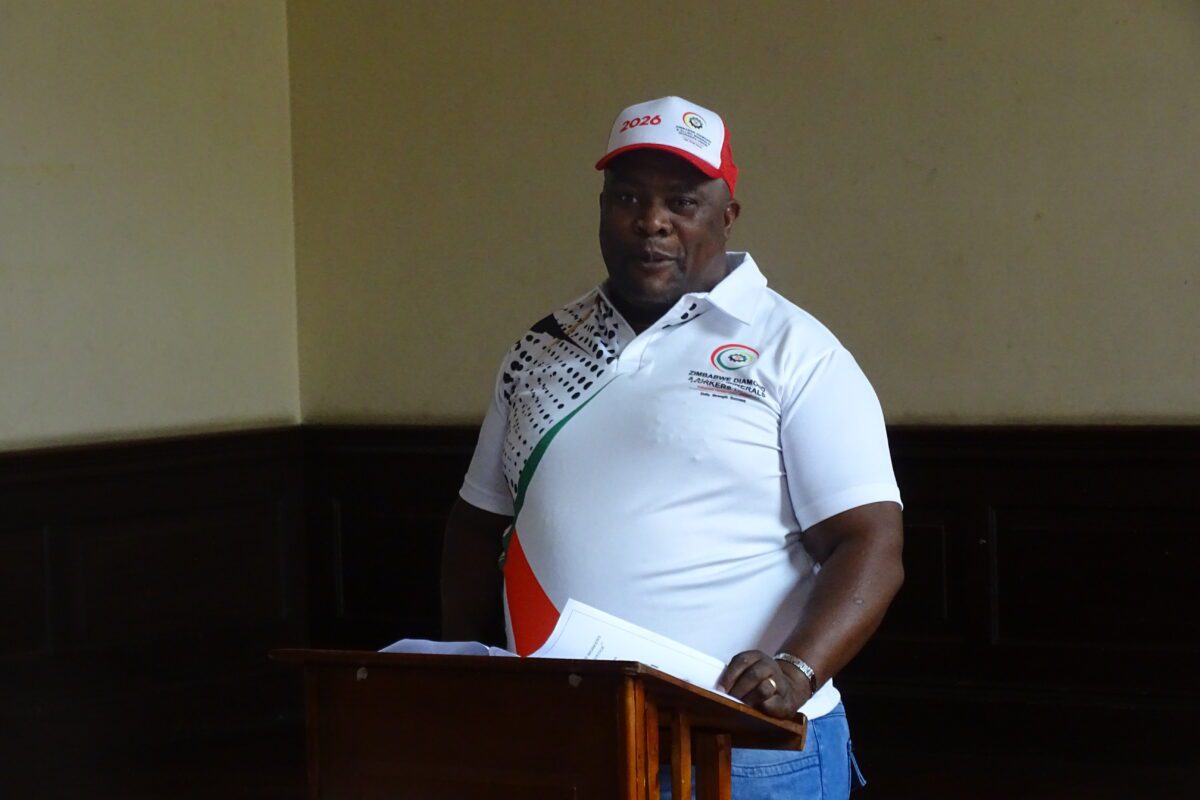
The Zimbabwe Diamond and Allied Workers Union (ZDAMWU) has called for urgent reforms in the mining sector, including compulsory health insurance for workers, stronger safety standards and stricter environmental rehabilitation measures.
Speaking during the union’s annual national council meeting held in Bulawayo over the weekend, ZDAMWU General Secretary Justice Chinhema said many mine workers are operating without health insurance despite being exposed to hazardous working conditions.
“Mine workers do not have insurance yet most of them are sick,”
“We have seen employers pushing workers to take up funeral policies without necessarily providing health care cover. That must be addressed through proper health insurance schemes supported by the salaries workers earn,” said Chinhema.
He said ensuring health insurance coverage for miners is part of the union’s broader 2026 strategic pillars which focus on worker welfare, community engagement and advocacy.
He said the union plans to expand its role beyond workplace representation to include working closely with community leaders and civil society organizations to promote safe and sustainable mining practices.
“As a union, one of our pillars for 2026 speaks about community engagement and community advocacy. We will be focusing on working with community leaders and civil society organizations on safe mining and standard mining practices,” he said.
ZDAMWU intends to collaborate with organizations such as the Centre for Natural Resources Governance (CNRG), Zimbabwe Environmental Law Association (ZELA) and other relevant government ministries including the Ministry of Mines.
Chinhema emphasized the need for mining companies to rehabilitate their operations once extraction activities cease.
“We need to engage mining companies to rehabilitate their mining operations so that when they leave, they do not leave gullies and environmental degradation behind.
“If an employer deliberately leaves environmental damage, there must be a remedy,” suggested the ZDAMWU General Secretary.
The union also wants to play a more active role in occupational safety and health matters.
Chinhema said while many companies have safety departments, trade unions have often been sidelined in advocacy and monitoring.
“Our coming in as a union means we must be at the forefront and be involved in safety, health insurance and health care issues,” he said.
He added that employers must comply with established safety and health standards, including periodic medical check-ups and testing for diseases commonly associated with mining activities.
The union also plans to engage regulatory bodies such as the National Social Security Authority (NSSA), Ministry of Health, Ministry of Energy as well as the Ministry of Mines to ensure enforcement of safety regulations.
“Where safety is not prevalent, what is the remedy? We are there to push for that remedy as an organization. We want to ensure that compensation happens where necessary and that preventive measures are put in place,” Chinhema added.
ZDAMWU said it will also intensify advocacy efforts to ensure mining companies are held accountable for worker welfare and environmental protection as part of its expanded mandate to safeguard both miners and the communities in which they operate.
This call for stronger enforcement and rehabilitation measures follows renewed concerns about the dangers posed by abandoned and poorly managed mining or quarry sites.
Over the past weekend in Bulawayo, two 11-year-old girls drowned while swimming with friends in a disused water-filled pit in Pumula North, in an incident confirmed by police that has spotlighted the risks of open pits left in residential and peri-urban areas.
The pit, which filled with rainwater was among abandoned excavation holes that have become deadly traps for children and others in the community.
Across Zimbabwe, similar hazards have underscored the human and environmental cost of poorly rehabilitated mining sites.
In Shurugwi and other districts, villagers have recounted how abandoned pits from chrome and other mineral extraction have claimed lives and livestock over the years because they were neither reclaimed nor properly fenced off once operations ceased.
Elsewhere, communities in the Umzingwane Dam area of Matabeleland South have decried abandoned mining pits allegedly left by Chinese-linked operations which have turned once-safe grazing and watering areas into “death traps” for livestock, forcing local residents to repeatedly recover trapped cattle.
Support CITE’s fearless, independent journalism. Your donation helps us amplify community voices, fight misinformation, and hold power to account. Help keep the truth alive. Donate today