

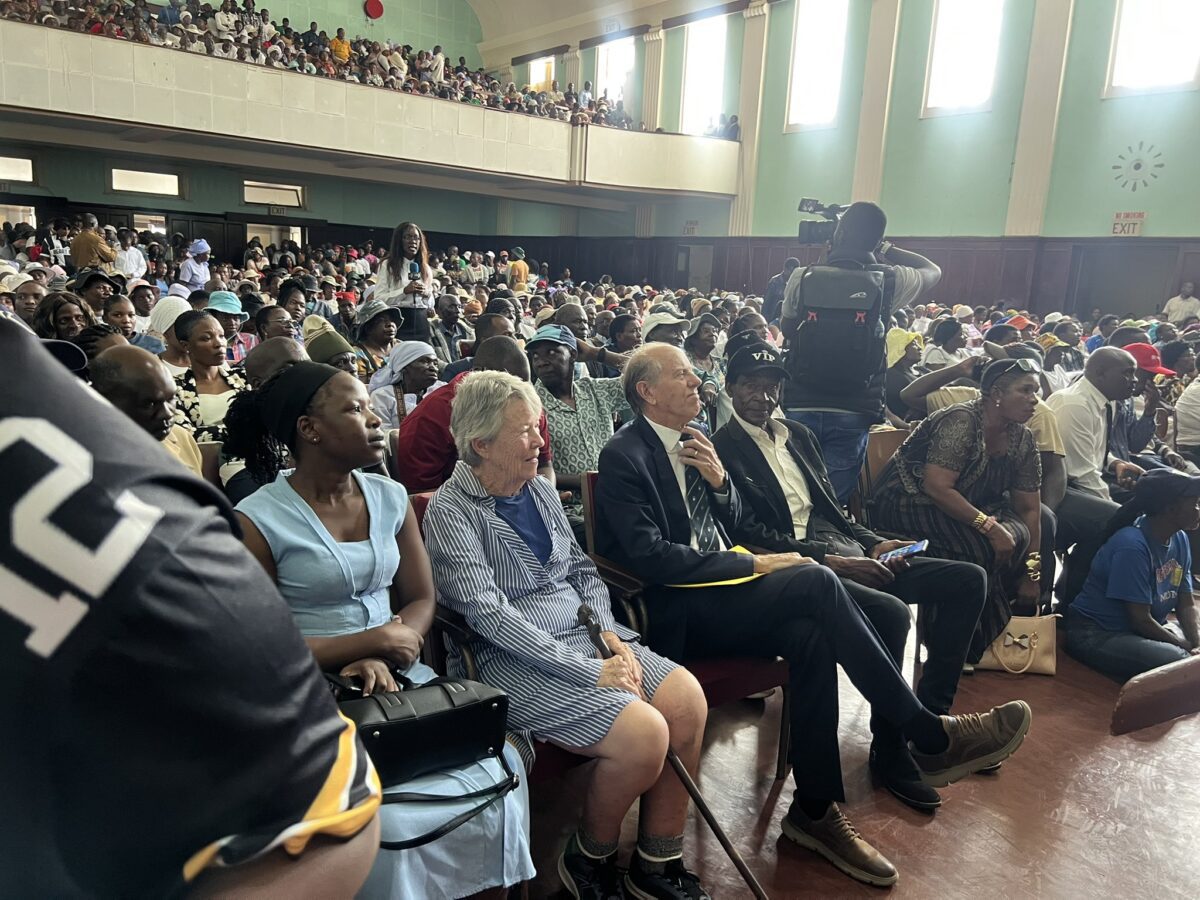
Veteran political activist and liberation struggle figure Judith Todd has likened the government’s proposed Constitutional Amendment Bill No. 3 to actions taken by Ian Smith during Rhodesia’s controversial Unilateral Declaration of Independence (UDI), which led to international isolation and sanctions after it was declared illegal by the United Nations.
Smith, who served as Prime Minister of Rhodesia from 1964 to 1979, declared UDI on November 11, 1965, as an attempt to seize control of the country, declaring independence from Britain.
Rhodesia’s UDI triggered international condemnation and sanctions from the United Nations, effectively turning the country into a pariah state.
Todd (83), spoke to CITE in an interview after a Parliamentary public hearing at the Large City Hall in Bulawayo on Monday, where she was denied an opportunity to speak, noting such developments reflect Zimbabwe’s shrinking democratic space.
Describing the proposed constitutional amendment as “another act of treason,” Todd warned that Zimbabwe risks international isolation if the bill is passed.
“I am old enough to have been through this before,” Todd said.
“The last time was November 11, 1965, when Ian Smith, declared UDI, and that was an attempt by those in power to hijack our country. The same thing is happening today.”
Todd drew parallels between that period and the current political climate, cautioning that Zimbabwe could once again face global isolation.
“Remember what happened to Ian Smith and his UDI, it was not recognised anywhere in the world and they became outcasts,” she said.
“This current regime, which is trying to hijack our country, will also become pariahs. They will not be welcomed in civilised countries or civilised concourses like the UN. It’s simply an act of treason, another act of treason.”
The veteran activist warned that actions perceived to undermine democratic principles could have far-reaching consequences.
“Ian Smith declared a state of emergency to handle us. He locked up many people and killed a whole lot of people, and that led to war,” Todd said.
“I hope that this Bill does not lead to war, but it is already leading to suffering. We must resist it because what is happening is a collective of people in power deciding to hijack our country.”
Todd said the essence of Zimbabwe’s independence, built on the principle of one person, one vote is under threat.
“Smith did it to prevent one mass of people from having one man one vote, and there was war,” she said.
“Zimbabwe was based on that principle, and now the new hijackers are taking away that vote from us. We must say no.”
She added that the proposed changes undermine the sacrifices made by liberation fighters and citizens who endured decades of struggle for democracy.
“There are so many people who sacrificed so much for Zimbabwe, for their brethren and future generations,” Todd said.
“To now see this betrayal is very bitter. It doesn’t matter whether you are Zanu or ZAPU, Muslim or Christian, this is a death blow to what people hoped Zimbabwe would be: a democratic, law-abiding country with hope for the future instead of terror for today.”
Meanwhile, another war veteran, Andrew Ndlovu, also criticised the proposed amendment, describing it as unconstitutional and harmful to national stability.
“It is quite disappointing that we are gathered here because of individuals who have undermined the people of Zimbabwe and decided not to uphold, obey and defend the Constitution,” Ndlovu said.
“This amendment is preposterous and harmful to the nation. It is an intentional move to cause disharmony and instability, a disaster waiting to happen.”
Ndlovu cited Section 2 of the Constitution, which establishes the supremacy of the Constitution over all laws and actions.
“Section 2(1) is crystal clear that the Constitution is the supreme law of the land, and any law inconsistent with it is invalid,” he said.
“Subsection 2 further binds every person and institution, the Executive, Legislative and Judicial, to uphold it.”
While acknowledging that Section 328 allows for constitutional amendments, Ndlovu argued that subsection (7) explicitly prohibits benefiting incumbents.
“Section 328(7) clearly states that such an amendment will not apply to a person who already holds that office,” he said.
“Whoever is in office should not benefit from a term extension. Extending tenure to 2030 is inconsistent with the Constitution.”
The war veteran further accused authorities of abusing their position to entrench power.
“This bill is an abuse of office,” Ndlovu said.
“Changing the Constitution to fulfil selfish political interests undermines democracy and concentrates power in the presidency, reducing accountability to the people.”
Ndlovu also argued the amendment distracts from unresolved national issues.
“We still have pending issues as a nation that the government has failed to address,” he said. “One may conclude that this amendment is not meant to improve anything but to give criminals the upper hand and protect wrongdoing. It must be suspended.”
Support CITE’s fearless, independent journalism. Your donation helps us amplify community voices, fight misinformation, and hold power to account. Help keep the truth alive. Donate today