


Hydrological conditions at the start of 2025 signal a challenging year for water security, with droughts likely to intensify across Southern Africa, northern South America, Central Asia, parts of North America, and Western Australia.
This is according to the recently released Global Water Monitor 2024 Report, which warns of growing threats linked to ongoing climate change.
The report highlights how climate change is driving more frequent and intense extreme weather events, such as flash floods, flash droughts, storms, and heatwaves, projected to disrupt regions globally in 2025.
Southern Africa, a region historically prone to erratic weather, faces an especially severe drought threat. This raises alarm for food and water security in nations like Zimbabwe, which already grapple with water scarcity and agricultural challenges.
In 2024, southern Africa experienced one of its most severe droughts in history. The report estimates that 30 million people were displaced, with economic losses reaching US$5.5 billion.
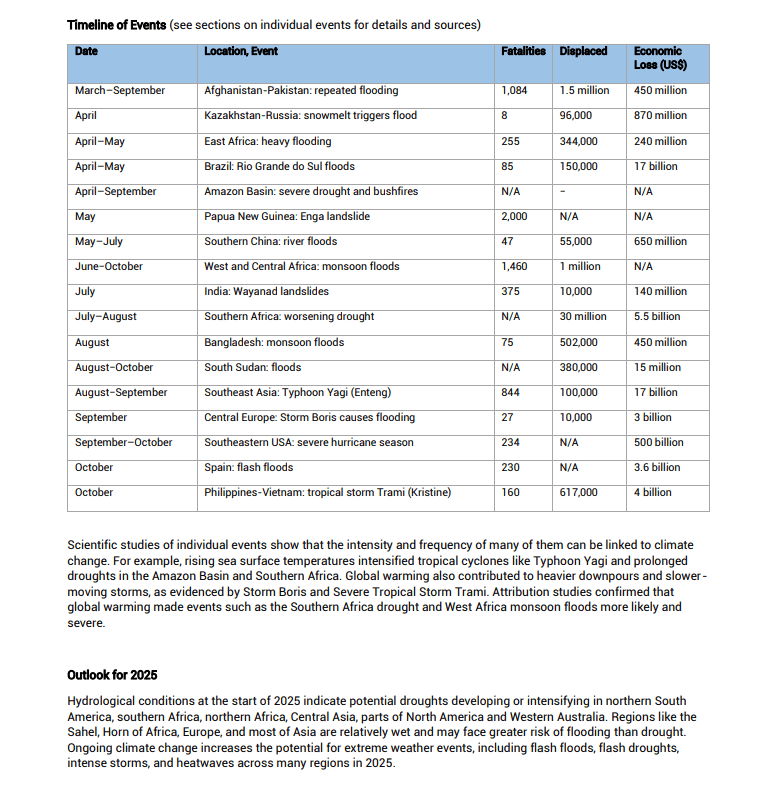
The drought, among the most severe in the region’s history, underscores the growing threat of climate change and its far-reaching consequences.
In its outlook for 2025, Global Water Monitor said studying hydrological conditions at the end of 2024 can help assess the risk of droughts developing in 2025.
“This is less applicable to flood events, as the change from drought to flood conditions can happen rapidly following intense rainfall brought on by storms or cyclones. Soil moisture, vegetation condition, lake volume and total terrestrial water storage at the end of 2024 all remain much below average in northern South America and Southern Africa,” read the report.
“A subset of the same indicators also point at unusually dry conditions in Northern Africa, Central Asia, parts of North America and Western Australia, suggesting the potential for drought to develop in 2024 in those regions.”
Global Water Monitor said as of December 2024, La Niña conditions are predicted to be most likely to emerge before January 2025 (59% chance), with a transition to ENSO-neutral most likely by March to May 2025 (61% chance).
“El Niño conditions are usually associated with above-average precipitation for eastern Africa and most of Asia and below-average precipitation for the western half of South America, the Caribbean, Southern Africa, and northern and western Australia. Therefore, the greatest risk of developing or deepening drought appears to be in the Americas, southern Africa and western Australia,” read the report.
However, regions unlikely to develop drought conditions for at least several months include the Sahel region and the Horn of Africa, Europe except southeastern Europe, and Asia except Central and Western Asia.
“In these regions, the greater risk may be for flooding, landslides and other challenges related to excessive wetness should high rainfall events occur,” said Global Water Monitor.
“Due to ongoing climate change, global temperatures are likely to increase further in 2025, leading to more heatwaves, greater bushfire risk, intense storms, and extreme rainfall events. This includes a greater likelihood of fast developing ‘flash floods’ and ‘flash droughts’ for all regions.”
The report noted that in 2024, parts of Zimbabwe, Botswana, South Africa and Zambia experienced their “driest conditions in decades,” with rainfall less than half of the seasonal average combined with high temperatures.
“The drought severely impacted staple crops. Zambia saw a 54% decline in maize production from the previous year, leading to a deficit of over 1.3 million metric tonnes. Zimbabwe faced similar reductions in cereal production. Livestock industries also suffered as pasturelands dried out, forcing farmers to cull herds,” the report stated.
“Agricultural losses exacerbated food shortages, leaving millions in need of humanitarian assistance. Drought impacts extended beyond agriculture, affecting hydropower as water levels in critical reservoirs like Lake Kariba fell to record lows.”
Intensified load-shedding in Zimbabwe and Zambia disrupted economic activity and public services, added Global water Monitor.
“Urban areas faced water rationing. Including people already affected by earlier droughts, the number of people in need was estimated to reach 61 million, requiring more than US$5.5 billion to meet basic needs. The drought was associated with an El Niño climate pattern but exacerbated by high temperatures intensifying evaporation rates.”
The same report also stated that globally, 2024 was the hottest year on record over land.
“Air temperature across land was 1.2°C above the 1995–2005 average. There has been a statistically significant increase of 0.35°C per decade,” Global Water Monitor said.
“The number of record-high monthly average temperatures in the 4 687 river catchments worldwide was the highest in the 45-year record and 9.3 times the 1995–2005 average. There has been a rapid increase in record-breaking high monthly temperatures of 97% per decade.
“The number of record-low monthly average temperatures was 85% less frequent than the baseline average. There is a significant decreasing trend of −66% fewer record-breaking low monthly average temperatures per decade.”
The Global Water Monitor Consortium is a partnership of several individuals and organisations who share a mission to make global water information more current and available for public interest and debate.
Leave a comment