

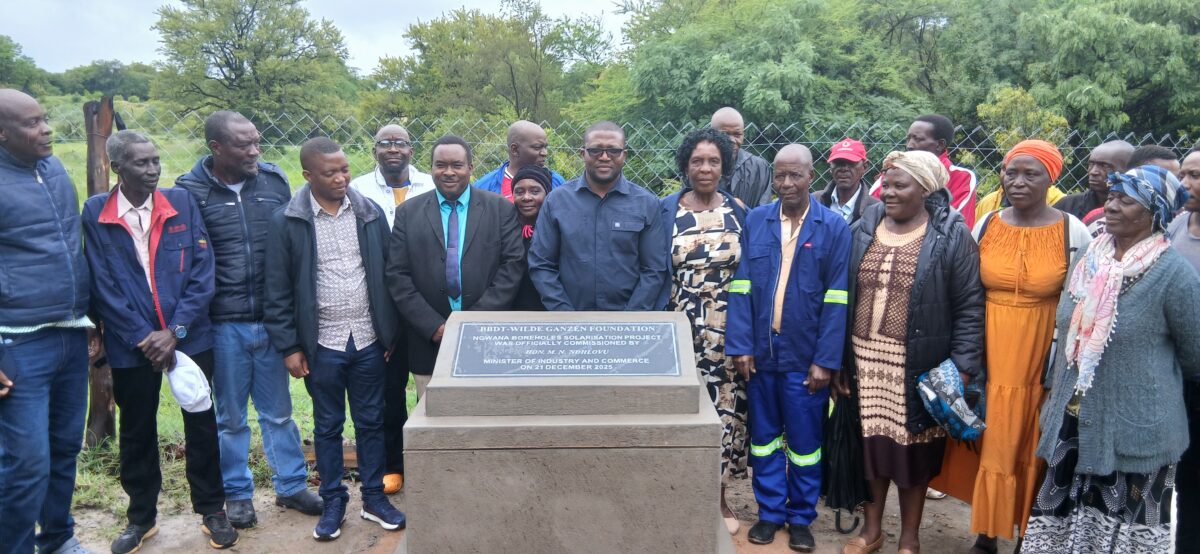
Residents of Ngwana community in Bulilima district, southern Zimbabwe, say access to clean water has significantly improved following the commissioning of four solar-powered boreholes in the area.
The boreholes were officially opened in Ward 21 on Sunday and were implemented by the Banha BeNgwana Development Trust (BBDT), bringing relief to a community in Zimbabwe’s drought-prone Region Five, where water shortages have long disrupted daily life, livestock rearing and small-scale food production.
Speaking at the event, the Minister of Industry and Commerce, Nqobizitha Mangaliso Ndlovu, said the project addressed the realities of climate stress in the area, where rainfall is low and unreliable.
“This place is called Region Five, where there is not much rain. It is a dry area especially between October and March, so our focus must be on water,” he said.
He added that solarised boreholes were particularly important for elderly residents who struggle to use manual bush pumps, describing the initiative as “very good and timely”.
Despite the ward’s proximity to Plumtree town, the minister expressed concern about the lack of a strong local economy and urged residents to harness opportunities created by improved water access.
He pointed to the economic potential of agriculture and the financial support sent home by Bulilima residents living outside the country, saying this could be mobilised to support local development projects.
Ward 21 councillor Dolly Dube said the boreholes had already helped to reduce livestock losses and support community initiatives, including a nutrition garden.
She also said funding had been secured to help complete Ngwana Clinic, which has been under construction since 2013 due to limited resources.
“The long distances people travel to access health facilities pushed us to start this clinic,” she said, adding that the new funding would go towards plumbing and sanitation works ahead of its planned opening in April 2026.
BBDT water department representative Cabangani Moyo said while the solarised boreholes had eased pressure on residents, water access remained a challenge in some parts of the ward.
“In some areas people still have to walk up to three kilometres to fetch water,” he said. “Our aim is to bring water closer, especially for the elderly.”
The project received funding totalling just over US$14,000 from Wilden Gazen Ikon, with installation beginning in early June. Implementation was delayed by logistical challenges linked to the conversion of boreholes originally drilled by government agencies from manual to solar-powered systems.
Community members contributed building materials and fencing to support the project, while the boreholes were fitted with automated systems designed to pump water into storage tanks and shut off once full.
The four boreholes now serve nearly two-thirds of the Ngwana community, including a local primary school, with women identified as the main beneficiaries due to their central role in water collection and household care.
Support CITE’s fearless, independent journalism. Your donation helps us amplify community voices, fight misinformation, and hold power to account. Help keep the truth alive. Donate today