

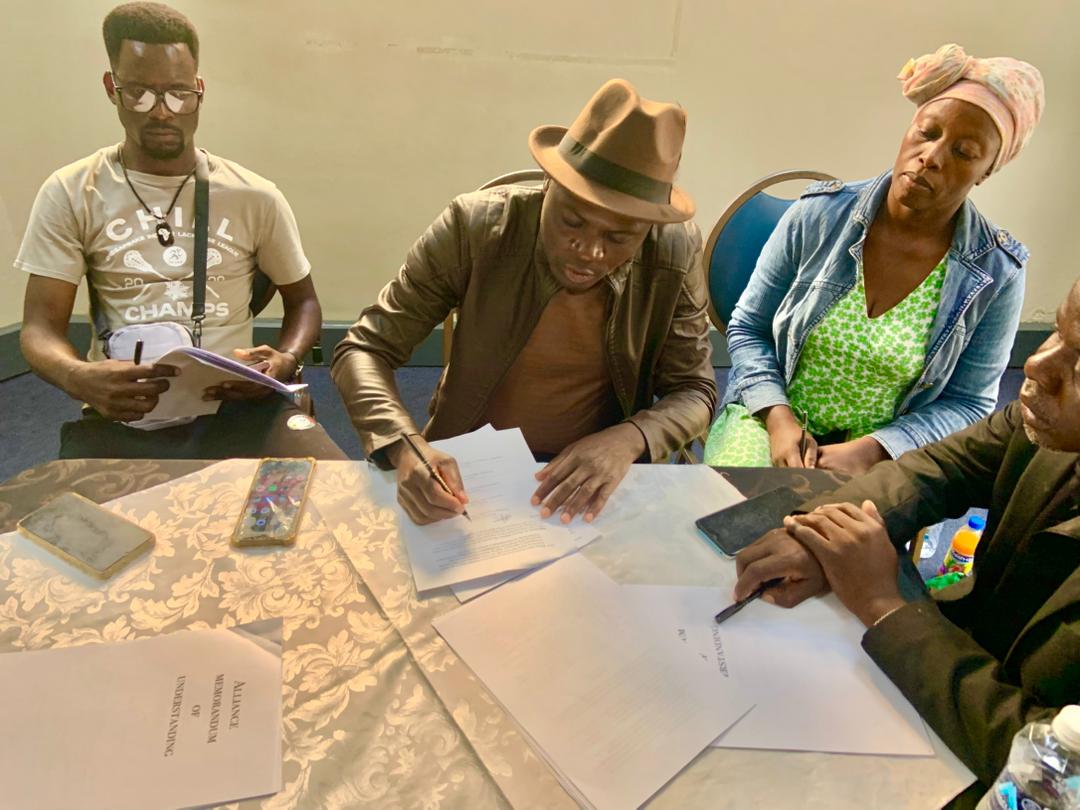
Five political groupings rooted in Matabeleland have signed a Memorandum of Understanding (MoU) in Bulawayo, committing to work together as a collective political response to Zimbabwe’s deepening social, economic and governance crisis, with a particular focus on stopping the ruling party’s proposed “2030 agenda”.
The Progressive Alliance of Mthwakazi Union (PAMU), Assembly of Minorities (AM), Mthwakazi United Party (MUP), Freedom Alliance and the Mayibuye People’s Party (MPP) formalised the pact on Sunday, declaring that time had come for Matabeleland to “stand up” and confront political exclusion, systemic marginalisation and economic decay.
This alliance comes at a time when plans to extend President Emmerson Mnangagwa’s alleged stay in office beyond constitutional limits have intensified, sparking resistance from civil society, opposition groups and sections of the public.
For these Matabeleland groupings, the 2030 agenda is a “nationwide problem” that if left unaddressed, will extend into a longer pattern of political domination that will leave Zimbabweans politically weakened.
Responding to questions from CITE at the signing ceremony, Assembly of Minorities leader, Chilumbo Mudenda, said the unity pact was a strategic and philosophical intervention meant to address long-standing grievances of citizens.
Mudenda acknowledged the grouping had already attracted hostile commentary, including accusations that the alliance was misguided or illegitimate.
“We have only one enemy in Matabeleland. The biggest enemy is not the one we are dealing with at national level. The enemy we have in Matabeleland is sell-outs. The enemy is one, but there are many sell-outs,” he said.
He said some of the negative rhetoric was coming from within the region itself, where individuals deliberately sought to undermine initiatives aimed at building collective political power.
“Our own people deliberately post comments to undermine us. There is a lot of competition in the political arena and the discourse that is there, we are not spared from it,” Mudenda said.
Mudenda argued some political parties in Matabeleland believed they “owned” the narratives and perceptions of the region and were hostile to any new formations attempting to assert leadership.
“They believe no one else must take a lead in liberating this region. It must be only them. That is where the point of argument is,” he said.
Despite this, Mudenda said the alliance would not be distracted by internal rivalries or public attacks.
“We cannot waste time on such people. All that matters is political activism. That’s what people are waiting for,” he said.
“What is going to define us as we go forward is our political activism, the judge is the electorate, not political parties, not civic organisations.”
Mudenda pointed to the recent Nkulumane by-election as evidence that traditional political branding no longer guaranteed electoral support in Matabeleland.
“According to numbers, Nkulumane is a political template for us. ZAPU, MDC, CCC were beaten by independent candidates. Meaning you cannot just say you are a big political formation when you cannot beat an independent candidate,” Mudenda said.
He argued that, in reality, all political actors in Matabeleland were effectively starting from the same point.
“To be frank, in Matabeleland we are all at a starting point. What is needed is for us to come together and move forward with one ideology, one purpose and one case,” he said.
Mudenda said the alliance deliberately excluded groups still embroiled in internal disputes over party names and leadership, arguing that such conflicts would derail what he described as a people-driven movement.
“Our formation is driven by the suffering of our people. We are united in purpose because of those causes,” he said.
He warned against any attempts to postpone elections or extend President Mnangagwa’s stay in office, saying the alliance’s immediate task was grassroots mobilisation.
“Our port of call is getting into the streets through mobilising our people. This is not a ceremonial issue for us leaders. When we go back, we are going to mobilise people,” Mudenda said.
He framed mass action as a constitutional right and criticised what he called excessive legal caution within opposition politics.
“The constitution allows us to be in the streets. The only thing that has enabled the State to do what they do is we have too many lawyers in politics who are too reserved,” he said and drawing historical parallels, invoked Joshua Nkomo’s role in the liberation struggle.
“Zimbabwe needs a political answer, like what Joshua Nkomo did when Ian Smith said Blacks would not rule in a thousand years. In 15 years, Joshua Nkomo was farming in Zvishavane.”
Mudenda said the alliance would exhaust all legal avenues before resorting to mass action.
“We will not fight the police. If they refuse us permission, we go to another level, to the magistrates or the High Court. But after exhausting all legal remedies, we are going to the streets, ngenkani,” he said.
Mayibuye People’s Party leader, Zanele Mguni, said the unity pact was about reclaiming space that Matabeleland had lost culturally, economically and politically.
“If you are not there, who will be there?” she asked.
“Others have given up, others have thrown in the towel, others have run away. If all of us give up, then what happens?”
Mguni said conditions in rural areas were worsening, particularly in education, where “many” children failed to enrol for secondary school.
“It’s painful that people in rural areas are building schools, but after building them the fees are too high. At the end of the year, we record the lowest pass rates,” Mguni said.
She warned division had weakened the region’s ability to resist political and economic exclusion.
“If we are divided, there is nothing we can achieve. Even if you think you are clever, it’s impossible,” she said, calling on all political and civic organisations in Matabeleland to work together, warning that failure to act would entrench long-term authoritarian rule.
“If we don’t demand jobs and defend our space, Zanu PF will stay in power for 100 years. They may even ban elections and say people are happy.”
MUP secretary-general, Andrea Dube, said leadership failures had contributed to public apathy and disengagement.
“It’s important to unite and I started this job a long time ago, mobilising people in Dete but because we pull in different directions and sometimes we don’t know our cause, we leaders are the ones who let people down,” he said.
“People end up losing hope and our parties disappear for no reason.”
Dube cited language exclusion in schools and public institutions as an example of everyday marginalisation that political leaders in Matabeleland have to address .
“ECD children are not taught in their mother languages. Even at police bases, officers will tell you to bring an interpreter in Shona. Where are we going but allow ourselves to be pulled by our noses,” Dube said.
“We may have started small, but the vision is big.”
Freedom Alliance youth leader, Calvin Wiseman Dube, speaking on behalf of party leader Presia Ngulube, framed unity as a tool of resistance.
“Matabeleland is a nation forged in struggle. Unity is not a favour we ask for but a weapon we must consciously wield,” he said.
Support CITE’s fearless, independent journalism. Your donation helps us amplify community voices, fight misinformation, and hold power to account. Help keep the truth alive. Donate today
Leave a comment