

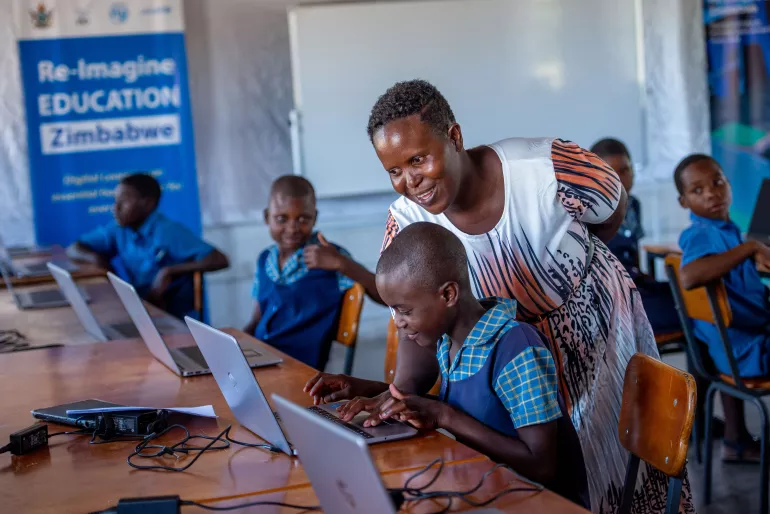
A stark new report on education in Africa has revealed a continent-wide crisis in foundational learning, with data showing only one in ten children complete primary school and achieve minimum proficiency levels.
The report, “Lead for Foundational Learning,” was launched Wednesday at the high-level Association for the Development of Education in Africa (ADEA) Triennale forum in Accra.
The collaborative study by the African Union, United Nations Educational, Scientific and Cultural Organisation (UNESCO)’s Global Education Monitoring Report, and the African Centre for School Leadership uncovers a reality far grimmer than previously estimated.
The findings paint a dire picture of early-grade literacy as an analysis of recent data shows that by Grade 3, a majority of students in the Democratic Republic of Congo, Nigeria and Zambia could not read a single word.
While the out-of-school population has stabilised in recent years, it remains staggeringly high at 44 million children across the continent as of 2023.
The report identifies weak school leadership and a critical lack of learning resources as primary drivers of the crisis.
It notes that school principals in 14 low- and middle-income countries spend 68 percent of their time on administrative duties rather than instructional leadership.
“Pedagogical advisors often spend too much time helping principals with discipline and administration instead of on pedagogy,” states the report
The report also found that school leaders need to deal with poor learning conditions in many schools across Africa.
“Textbooks are scarce, in Cameroon, up to 23 students share one textbook on average, although Côte d’Ivoire has managed to ensure the provision of a textbook for each student. Over half of countries still do not provide textbooks in children’s home language making early literacy acquisition hard.”
The report added that school feeding programmes, though common, still fail to reach every child.
“While 81 percent of countries in Africa provide school meals, they only cover, on average, 43 percent of primary students.”
To address these failures, the report prescribes three urgent actions for governments to improve school leadership and learning quality.
“Ensure school leaders monitor learning with data to help struggling learners improve. Effective school leaders set clear learning goals, focus on teaching and learning, support and motivate teachers, and promote collaboration across the school community,” said the report, which suggested that selecting and supporting the right people for leadership positions is key to progress.
“Select, prepare and support school and system leaders as future instructional leaders. Currently, 35 percent of countries have competency frameworks, which shape selection, training and professional development and only 19 percent require principals to have prior training before taking on their role.”
Another important action is to strengthen the capacity of education officers so they can better support schools.
“Develop education officials’ capacity to understand learning objectives and support schools to achieve them. District education officers should have clear learning objectives linked to their evaluations and receive targeted professional development to strengthen instructional leadership and data-driven quality assurance,” said the report.
The report cited how many countries still do not have clear national learning goals, making it hard to measure progress.
“Beyond leadership, the report also shows that only 20 percent of countries have a national assessment framework, meaning that most countries have no clear learning objectives. It calls for countries to use the new African Union Continental Assessment Framework, which can help them shape their objectives towards generating robust, reliable data on learning,” the report stated.
To help countries share experiences and strengthen education systems, the report also includes a new policy dashboard.
“A new policy dashboard, under the auspices of the African Union’s LEARN peer learning mechanism, accompanies the Spotlight report’s recommendations and outlines member states’ approaches to a range of policy challenges, from curriculum to school leadership, to promote collaboration and policy dialogue on foundational learning.”
In conclusion, the report comes with additional studies on countries that are showing positive practices in education.
“Additional country reports on positive practices driving learning in Africa are also produced in partnership with relevant Ministries of Education alongside the continental Spotlight report: for Kenya, Cameroon, Cote d’Ivoire and Kaduna State, Nigeria. A report for Morocco will follow soon.”
Leave a comment