

By Enos Denhere
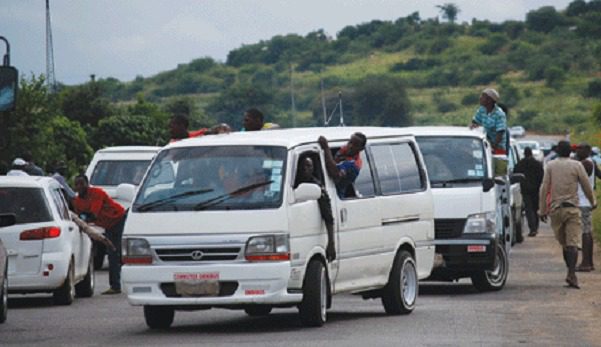
Transport operator Richard Kureva, first kombi, a battered minibus, bought 25 years ago became a family lifeline. The transport business then was simple.
“When I started, operating costs were manageable and profits were predictable,” he said.
Today, Kureva and other public transport operators are facing ruin. Operating in an over taxed economy, transport operators in Zimbabwe have been hit by a new wave of taxes, a financial blow to bring them to a halt.
A new presumptive tax schedule announced in September 2025 by the Zimbabwe Revenue Authority (ZIMRA) is a heavy load for transport operators already announced presumptive taxes for public transport operators. Some of the levies are as high as US$500 per month for public transport operators, haulage companies, and driving schools. For many, the new taxes threaten profits and livelihoods.
The new presumptive tax schedule, outlined in Public Notice No. 51 of 2025 demands that kombis carrying between 8 to 14 passengers will now pay US$50 per month, while buses carrying 37 passengers or more will pay US$100 per month. Taxi operators face a flat US$35 monthly levy and driving schools must pay between US$50 and US$100 per vehicle while haulage trucks will pay even more: US$200 for vehicles over 10 tonnes and US$500 for vehicles exceeding 20 tonnes.
For Kureva, who chairs ZICOTO, a commuter omnibus association based in Harare, running a transport business has become a difficult exercise. Having a fleet of eight vehicles, multiple taxes and levies weight down on his business. He wants government intervention to avoid collapse.
‘’I earn an average of US$ 60 profit/day on a kombi, Monday through Saturday, but now, it costs me US $60/month on each kombi in presumptive tax-only,” he explained.
Then there is a long list of other expenses; Zimbabwe Broadcasting Corporation (ZBC) radio licence fees of US$30 per quarter per vehicle, quarterly insurance payments of US$170, Harare City permits of US $23, Ministry of Transport permits of US$150, Vehicle Inspection Department (VID) permits of US$20, speed governors at US$100, and passenger insurance at US$215. Everyday, Kureva buys US$2.50 parking vouchers from the City of Harare for his vehicles.
The burden doesn’t end there. Drivers are often fined by the police (US$90), when they do not have medical or defensive driving certificates or retest certificates. The City of Harare charges up to US$150 to release vehicles impounded for traffic violations.
Kureva explained that in addition to the horde taxes, he has to pay staff wages and vehicle maintenance on a monthly basis. Transport operators are not opposed to taxation, he said.
“Everyone doing business must pay their dues. We are not against taxes; in fact, we encourage compliance. But we are asking the government to reduce these levies so we can operate without breaking our backs as some of our ZICOTO members are now giving up on transport business,” he added.
Calls for Consultation
The toll of taxes is high on transport operators like Ather Mutaisi, a member of ZICOTO.
“I had three kombis and I ended up selling two because I could no longer sustain them. When I bought this commuter omnibus, the business was good. My intention was to use the proceeds to pay my children’s school fees because my vision was for them to have a better education,” he explained.
“Sometimes my drivers cash in only US$10 in a day and say the rest went to the police. Just imagine, with presumptive tax and other compulsory levies waiting for me on top of that,” he said, calling for a consultative meeting between the government and all transport operators to find a way for a reduction in the taxes and levies to keep transport operators in business.
Economists argue that the presumptive tax was introduced with deep consultation on how it could be made sustainable for operators.
“In other countries, authorities sit down with all stakeholders before implementing policies to hear from all sides. Unfortunately, that is not the case here,” says Godfrey Kanyenze, highlighting the necessity of more inclusive policymaking.
Kanyenze argued that the presumptive tax has become an additional burden in an already heavily taxed environment. “There is a real need for consultative meetings rather than simply imposing measures without engaging those affected. This presumptive tax piles on top of other levies, creating a hostile business environment,” he noted.
He pointed to Rwanda and South Africa as examples Zimbabwe could emulate. Zimbabwe should adopt a formal, structured approach to policy consultations, similar to Rwanda and South Africa, where business players are actively involved. This way, the government can hear directly from stakeholders, understand their concerns, and make more effective, sustainable decisions, Kanyenze added.
A bumpy road
Another kombi operator, who asked to be identified only as Moyo to protect his business, described the operating environment in Harare as “not level and far from fair.”
“There are several kombis plying different routes in Harare without paying any levies,” Moyo said. “They have unauthorised ranks across the city—for example, near Harare Central Police Station, adjacent to the NRZ, there are kombis that serve the Sunningdale route. They don’t pay any levies, so they don’t face the challenges we do. Most of them commit several crimes because they are not registered and flaunt that their kombis are untouchable. Kombis are charged US$2 per trip in these ranks, which goes directly to the rank marshals and their proxies.”
Buses now pay the taxman US$100 per month in presumptive taxes per vehicle. For Nyamweda Bus Services, this means a US$400 monthly payment.
Luckyson Nyamweda, a family member involved in the business, said they are striving to remain in the transport industry but urged the government to ease some of the levies.
“Bus operators do not make consistent profits throughout the month. In our operations, we usually realise better profits at the end of the month, during school and public holidays,” he said.
Nyamweda added, “We have four buses plying the routes in Mhondoro and Chegutu. We have no choice but to adapt to what we are facing in business in terms of extra ordinary levies and business costs as a way of survival, but it’s tough.”
The crisis is not confined to kombis and taxis. The presumptive tax will ground other transport connected sectors.
For trucking operators, the presumptive tax is an additional financial strain that could force many out of business.
Emmanuel Chanyuke, finance administrator at Hub Freight, a trucking company in Budiriro, Harare, says his fleet of 17 trucks, all over 20 tonnes, would be hard to keep on the road with additional taxes. He is set to pay US$8, 500 per month for operating his fleet of trucks. The taxes are in addition to other high costs, the transport operator has to pay for fuel and maintenance.
The company also grapples with additional levies. Toll fees, Zinara road charges of US$450 every four months, operators licenses costing US$160, and other regulatory costs which Chanyuke worries that they eat into the small profits he makes.
“All of our trucks are on the road constantly, but the system is tough. If you charge according to freight prices, you are out of the game,” Chanyuke said.
“We are pleading with the government to enforce bylaws that prioritise local companies for contracts in foreign-owned companies, for example, Chinese mines. Instead of bringing in trucks from outside the country. We work for them.”
The transport industry plays a vital role in the Zimbabwe economy, contributing about 3.3 percent to the national GDP, according to the Zimbabwe National Statistics Agency (ZIMSTAT 2024). The sector employs an estimated 124,000 people, based on ZIMSTAT’s Quarterly Labour Force Survey (Q3 2024), which shows that transport and storage make up around 3.9 percent of the country’s total employed population of 3.2 million.
The majority of public transportation providers, including taxis and kombis, operate in the informal sector and rely on the daily revenue from passengers.
While the presumptive taxes help boost government revenue, many transport operators lament that the taxes are excessive and may compel them to increase fares or cease operations entirely. For regular commuters who already face higher living expenses, this may result in fewer alternatives to public transportation, job losses, and increased travel fares.
Belinda Vermack, an administrator at WheelsofAfrica Truck Company, said the current levies and border charges in Zimbabwe have made the transport business unprofitable.
“We have stopped all operations to Zimbabwe as the rates do not justify the road levies and border costs. Truck drivers are required to pay about USD 203 just to have their passports stamped (one way),” she said.
Vermack added that transporters passing through Zimbabwe must use government-approved trackers, and any deviation from the designated route results in an automatic fine of USD 2,000. “With all these charges and restrictions, it is simply not worth doing any loads to Zimbabwe,” she concluded.
Local operators are facing similar pressures.
“Things are not rosy in the transport industry; we are drowning in the mud instead of surviving. If you look at the issue of presumptive tax, it’s not new but is being implemented in a very restrictive way on top of the many existing levies that demand our attention,” said Ndabazabo Mabunda, an official of the Tshova Mubaiwa Cooperative.
“We have been in the kombi business for decades here in Bulawayo, but we can’t raise our fares to offset the levies because our passengers don’t have money. It’s survival of the fittest, as we hardly make any profit, making it rare to buy new kombis. We need meaningful dialogue with the government,” he added.
The burden is also being felt in the driving school sector. Nyasha Dowa, Chairman of the Zimbabwe National Driving Schools, said the driving school industry is struggling to stay afloat due to high levies and declining client numbers.
“Many driving schools are closing, which means we are losing experienced instructors and registered operators who have been compliant with taxes. They simply can’t bear the burden anymore as the levies are too high,” he said.
Dowa explained that driving schools are required to pay several fees, including US$620 for a council licence, as their training vehicles fall under the shop licence category. Additional charges include US$280 for a fire extinguisher licence, US$120 for the Traffic Safety Council of Zimbabwe licence, US$50 for vehicle logos, plus insurance and Vehicle Inspection Department (VID) costs, among others.
“When we pay all these levies, we expect to see some improvements. For example, many VID premises have potholes, yet the money collected should be used to rehabilitate those facilities. Councils should also provide land for training our clients because most schools are renting those open spaces,” he added.
Commenting on the presumptive tax, Dowa said that non-compliant driving schools are particularly affected when they fail to update their quarterly payment dates (QPDs). “Two-thirds of our revenue goes to levies and other expenses, leaving us with little profit. This is different from South Africa, where driving schools are a lucrative business and the levies are more conducive to a healthy business environment,” he said.
The challenges extend to the taxi industry, where operators say the playing field is no longer level. “The load is now too much as the ground for business is no longer fair. We can’t compete with e-hailing operators because most people prefer them since they are cheaper, they don’t pay levies, yet we now have presumptive tax,” said Tendai Jonga, Secretary of the Bulawayo Metered Taxi Operators Association. He explained that for a single taxi to be fully compliant, operators need to pay about USD 600 per year, in addition to daily parking fees, monthly, and quarterly levies.
“E-hailing operators should also pay tax because they are running businesses. POTRAZ should be engaged to help identify and regulate these online taxi platforms so that everyone operates under the same rules,” he said.
Jonga added that most traditional taxi operators have joined e-hailing platforms and removed branding and yellow plates to avoid the compliance burden and mounting costs. “Right now, my profit margin is only 10 to 15 percent per month,” he said.
Former Finance Minister Tendai Biti has warned that Zimbabwe’s economy is “bleeding” under the weight of “high toxic taxes, an artificially tight monetary policy and a mismanaged exchange rate.”
Writing on his X account, Biti argued that presumptive taxes such as the IMMT should be scrapped, saying the development of a broad, inclusive formal economy is the real solution to informality.
Presumptive taxes, like other excessively high taxes, merely fuel non-compliance through avoidance and evasion, Biti cautioned.
ZIMRA’s spokesperson, Francis Chimhanda, did not respond to emailed questions for comment.
Support CITE’s fearless, independent journalism. Your donation helps us amplify community voices, fight misinformation, and hold power to account. Help keep the truth alive. Donate today
Leave a comment