

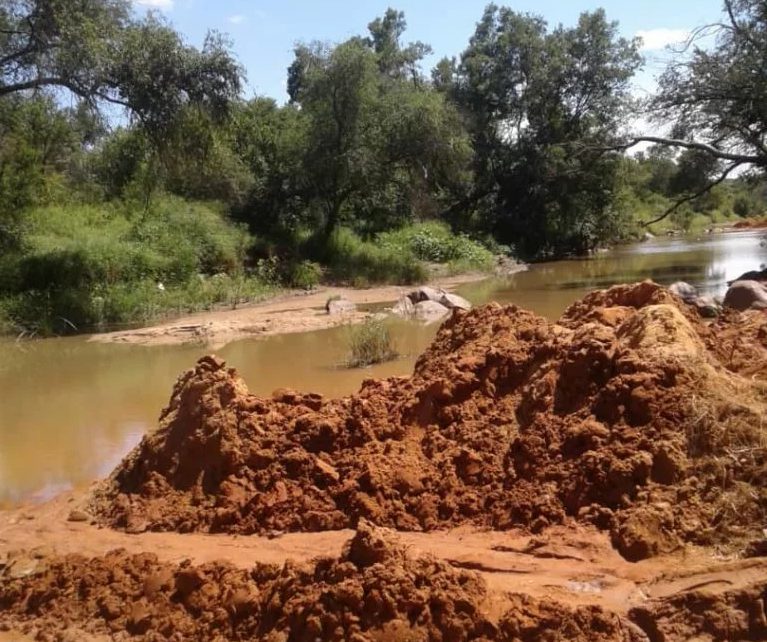
The government has reiterated that all alluvial mining in rivers and streams remains strictly prohibited under Statutory Instrument (SI) 188 of 2024, amid growing concerns from communities about environmental degradation, polluted water sources, and livestock deaths.
During a parliamentary question-and-answer session, lawmakers pressed the Ministry of Mines and Mining Development to explain why destructive mining activities continue in many rural areas despite the law.
“We see that there are many people, including companies, rushing to carry out mining activities, especially gold mining in streams. This is affecting water availability and causing significant environmental damage. Does the government allow alluvial mining in rivers and streams?” asked MP S. Ziyambi.
Deputy Minister of Mines and Mining Development Caleb Makwiranzou responded, emphasising that mining along riverbeds and stream banks is illegal.
“Statutory Instrument 188 of 2024 prohibits alluvial mining. Mining in rivers and streams is not allowed. Currently, no companies are permitted to conduct alluvial mining. However, the government is developing a programme to rehabilitate rivers affected by stream bank cultivation, stream bank mining, and alluvial mining,” he said.
He added that the ministry is working closely with the Ministry of Environment, Climate and Wildlife, the Environmental Management Authority (EMA), and the Ministry of Lands, Agriculture, Fisheries, Water and Rural Resettlement, noting that a further statutory instrument is expected soon.
Lawmakers also raised concerns about the impact on rural households, many of which rely on livestock for food and income.
MP Lynette Karenyi cited cases where miners allegedly use chemicals that contaminate rivers, causing livestock deaths.
“We know that rural communities depend on livestock for sustenance and children’s education. Mining companies engage in alluvial mining using chemicals, which are then discharged into rivers. Livestock are being destroyed after drinking polluted water. What plans does the government have to compensate those who have lost livestock due to contaminated water?” she asked.
Deputy Minister Makwiranzou said only responsible miners operating within the law are permitted to work and stressed that mining involving harmful chemicals is illegal.
“Responsible mining is carried out by those who comply with the law. Those using chemicals in ways that harm livestock are clearly operating illegally,” he said.
MPs also questioned whether holders of special mining grants are exempt from the ban. MP Noah Mangondo noted that some miners claim to operate legally under special grants issued by provincial offices.
Makwiranzou clarified that while special grants still exist, they are subject to strict conditions and cannot override river protection laws.
“Special grants still exist, but each grant must be scrutinised to ensure it applies to the correct area and that the area is not reserved. Special grants do not exempt holders from compliance with the law,” he said.
Meanwhile, Joseph Bonda raised concerns from communities in mining zones, saying some prospectors are entering graveyards, homesteads, and private yards while claiming to hold valid licences.
“Does a prospecting licence specify the exact areas miners are allowed to operate? Currently, we are witnessing prospecting on graveyards and rivers, even within our own yards. This creates panic and insecurity among residents,” he said.
Deputy Minister Makwiranzou deferred part of the question to the Minister of Lands, Agriculture, Fisheries, Water and Rural Resettlement, Dr Anxious Masuka, who chairs the inter-ministerial taskforce on alluvial mining.
Dr Masuka confirmed that SI 188 of 2024 prohibits all alluvial mining, including for those who previously held special grants, and that enforcement has now been handed over to the security sector.
“Cabinet established an inter-ministerial taskforce in August 2024 to address the menace of alluvial mining. SI 188 of 2024 stopped all alluvial mining, irrespective of type, including for holders of special grants. The security sector is enforcing this statutory instrument. If members of the public are aware of ongoing alluvial mining, they can report it to the provincial committees or the national committee, which I chair, so that security can intervene,” he said.
Dr Masuka added that the statutory instrument also provides for the rehabilitation of degraded rivers to restore ecosystem integrity.
“At a meeting earlier this morning, we developed a framework for site-specific rehabilitation of degraded river ecosystems. These plans are approved in consultation with the Minister responsible for the environment, the Minister of Mines, and the Ministry of Water. We have also established mechanisms for compliance, monitoring, review, and learning,” he said.
Support CITE’s fearless, independent journalism. Your donation helps us amplify community voices, fight misinformation, and hold power to account. Help keep the truth alive. Donate today