

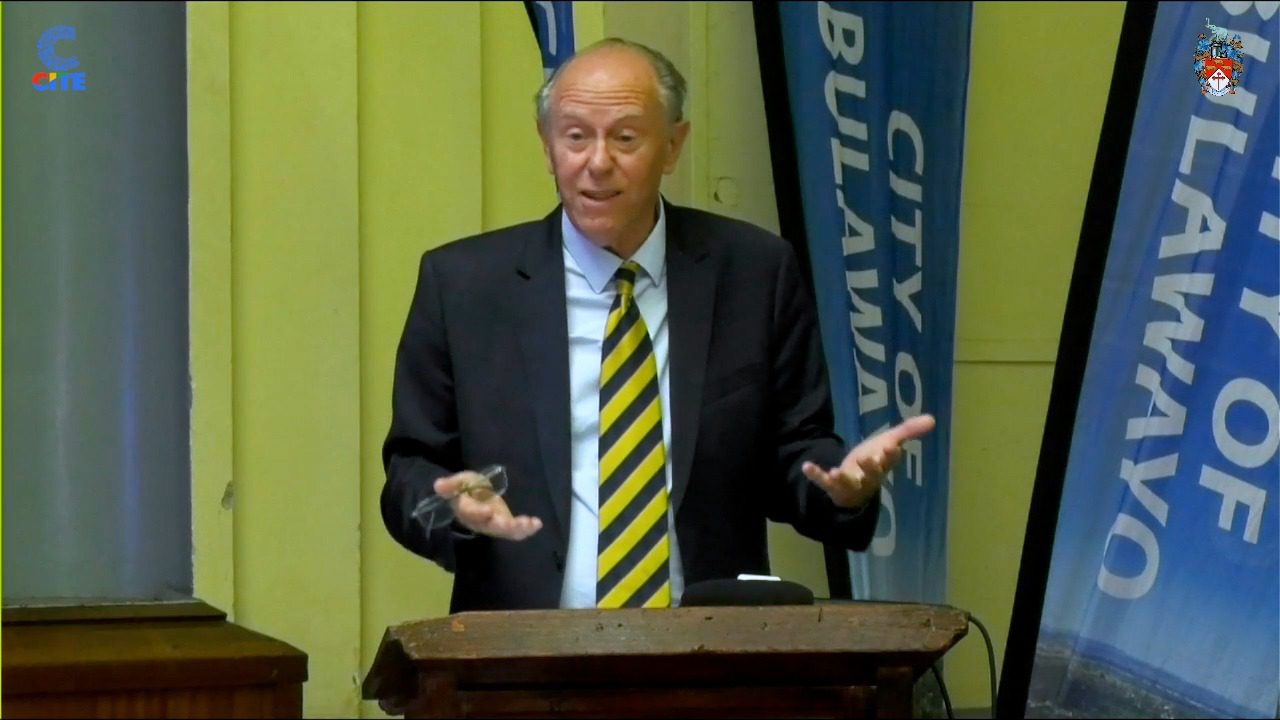
Bulawayo Mayor, David Coltart, says the city’s persistent water shedding, despite significant dam inflows, is not due to water shortages but longstanding infrastructure deficiencies.
Speaking during a recent full council meeting, Coltart acknowledged improved water levels across Bulawayo’s supply dams, describing them as the highest recorded since 2017.
However, he said the gains have not translated into reliable water supply for residents.
The Bulawayo City Council (BCC) reduced its weekly water-shedding schedule from 130 hours to 96 hours in January following improved inflows.
Despite this, residents in some suburbs continue to endure longer outages than officially scheduled.
Coltart said the continued rains throughout March had heightened expectations among residents.
“Since we last met, we had a wonderful continuation of rains through March. We have seen our dams fill dramatically in the last four weeks and I believe they are at the highest level since 2017. Whilst we are grateful to God for that, it raises expectations amongst residents, and I know as councillors you are already feeling that pressure,” said the mayor.
He added that residents were increasingly questioning why water shedding persists despite the improved dam levels.
“Residents are asking, ‘why is it with all this rain that we still have water shedding?’ It is a major challenge for us as councillors, the Town Clerk, and management to explain why, despite the fact that Mtshabezi is full, Insiza is very high, and even Inyankuni, which was so low, is now around 30 percent, we are unable to deliver sufficient quantities of water,” Coltart said.
Coltart pointed to findings from a Water Technical Committee established in early 2024 by the Minister of Lands and Water, Anxious Masuka.
The committee, comprising government officials, engineers, academics from the National University of Science and Technology (NUST), and city representatives, identified critical weaknesses in Bulawayo’s water delivery system.
Among the major challenges is the Mtshabezi pipeline, which is operating far below its design capacity despite the dam overflowing since January.
“Mtshabezi has been spilling since the end of January, it is still spilling, in fact it is pouring over. The pipeline has a design capacity of 17 megalitres per day, but at best we are getting nine megalitres,” Coltart said.
He added that frequent power outages affecting the dedicated electricity lines have further disrupted pumping operations.
“The dedicated ZESA power line frequently goes down, which causes disruption in power supply and consequently water supply,” he said.
Coltart also highlighted structural flaws in the pipeline system connecting Mtshabezi to the Mzingwane network, saying its current design prevents efficient water transfer.
“At present, it has been designed to go below the pump station at Mzingwane. It needs to be diverted above the pump station so that the water can be pumped effectively. Because of gravity and pressure differences, water from higher altitude dams like Insiza and Inyankuni does not flow efficiently into the system,” he explained.
The mayor further noted that aging infrastructure continues to hamper water delivery.
The Insiza pipeline, built in 1975, has never been upgraded, while the Ncema-to-Thuli pipeline is also in urgent need of rehabilitation.
“The Insiza pipeline has not been rehabilitated since 1975, and the Water Technical Committee identified that as a priority. We have similar problems with the Ncema to Thuli pipeline, the pumps are decades old and need replacement, and the pipeline itself requires upgrading,” he said.
He added that the Thuli reservoir, which currently has a capacity of 45 megalitres, needs to be expanded to 90 megalitres to meet growing demand.
“All of these issues were identified and agreed upon nearly two years ago, but no progress has been made,” Coltart said.
According to the mayor, approximately US$15 million is required to address the infrastructure challenges, an amount he said the government had committed to providing.
“We agreed with the government that about US$15 million is needed to fix these issues. While that may seem like a lot to individuals, it is not a significant amount for the government. However, that funding has not been provided and the work has not been done,” Coltart said.
Coltart warned that without urgent investment in infrastructure, Bulawayo’s water crisis will persist regardless of dam levels.
“We can have dams that are 100 percent full at the end of this season and still fail to deliver adequate water to residents. That is the physical engineering reality. Until these remedial works are done, we will not be able to meet demand,” he said.