

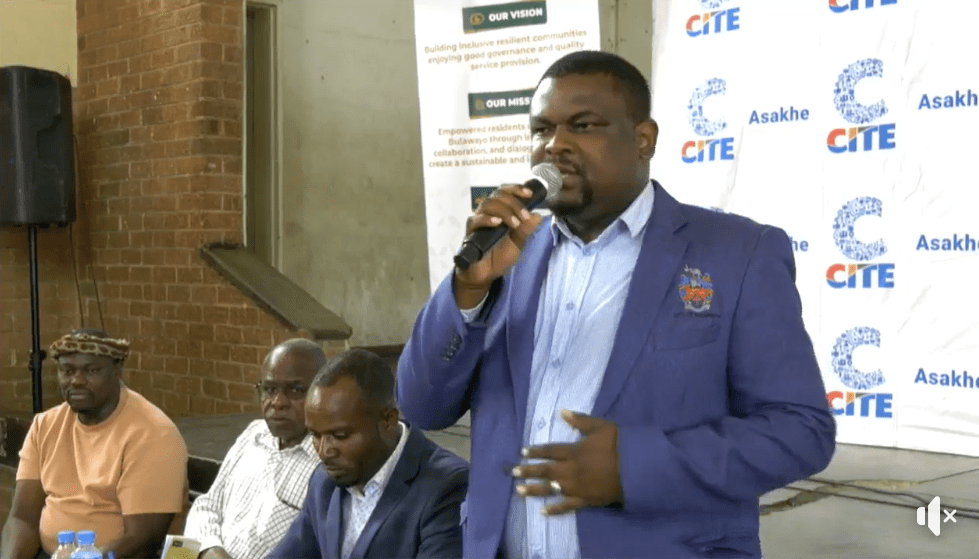
Candidates vying for the Nkulumane parliamentary seat laid bare the fundamental fault in Zimbabwe’s urban politics after the Zanu PF candidate argued he is best positioned to deliver development, insisting only someone aligned to the ruling party can unlock progress, which independent contenders swiftly dismissed as a flawed narrative that overlooks the systemic centralisation designed to weaken opposition-led councils.
The exchanges emerged during a Meet Your Candidates debate community meeting in Nkulumane where aspiring legislators were asked to say out what they had done and what they could realistically do for Nkulumane.
The debate was held Wednesdy at Nkulumane Hall and organised by the Centre for Innovation and Technology (CITE) in collaboration with the Bulawayo Progressive Residents Association (BPRA), Election Resource Centre (ERC) and the Nkulumane Constituency Development Committee.
Zanu PF’s candidate, Freedom Murechu, championed a model of development-through-access and leveraging connection to the ruling party to extract resources while the independent candidates such as Rodney Jele advocated for a model of devolved governance, where development is planned and executed locally, free from partisan manipulation from Harare.
The Zanu PF candidate argued opposition-led urban councils had failed Bulawayo and were responsible for the city’s deterioration over the past two decades.
He said aligning Nkulumane with the ruling Zanu PF would facilitate development because the national government, including President Emmerson Mnangagwa, is controlled by Zanu PF.
“Zanu is in opposition in Bulawayo province. The opposition has been in power for two decades now. The city was run by Zanu before the opposition took over. In 2000 when the opposition came over that’s when we started seeing the city deteriorating,” he said.
Murechu claimed Zanu PF had long-term development plans that were discarded after the opposition took control of the city’s governance.
“Zanu council had a vision of growing the population and said short-term let’s drill boreholes, long-term, do Gwayi-Shangani, but Zanu was voted out,” he said, noting the government has been accused of neglect when water shortages worsened.
Murechu also questioned the need to build new dams, saying residents will shoulder that burden after Mbuso Fuzwayo, one of the independent candidates, had proposed that.
The Zanu PF hopeful cited developments in Pelandaba–Tshabalala and Cowdray Park, attributing them to by-elections that returned the constituencies to Zanu PF.
“We took control in Pelandaba–Tshabalala and Cowdray Park after by-elections and a lot is happening now there, but the development is seen as a drop in the ocean because our cities and towns have deteriorated a lot. Look at what Mthuli Ncube (finance minister who ran for the seat but was beaten in the 2023 election) did in Cowdray Park, look at the roads, he has continued.”
Murechu said he had personally financed some community initiatives.
“I have drilled a borehole using my own money after speaking to the local councillor Mmeli Dube regardless of the fact that I am a Zanu member. We do a lot but people don’t notice. You only see it during a campaign but the challenge is you people don’t rise up. You say ‘yizinto zeZanu asizingeni’ but that’s money to develop our communities.”
He added that his close ties to the government would provide steady support for Nkulumane.
“I have good relations with the government of the day. Now we have fixed four transformers and over 7 000 food hampers have arrived. The US$100,000 revolving fund is here but I was already capacitating others with my own money,” Murechu said.
Positioning himself as the only candidate who can work seamlessly with the national administration, he said: “I am clearly someone who can work with the current government, already Zanu is in the government and the president is a Zanu candidate. Vote for someone who can work with the Zanu government and the Zanu leader,” said the candidate
However Murechu’s assertions were swiftly challenged.
Former councillor, Jele, now an independent candidate, dismissed the idea that aligning with the ruling party guarantees development.
He argued the deterioration of Bulawayo began when the central government stripped councils of autonomy.
“I don’t have money to bring development. You would be thieving if you do that from your own pocket but as a public official you work with the state that releases funds. The government centralised everything when the opposition took over power. The local authority is as poor as its residents,” Jele said.
“The government removed local power and centralised everything. That’s when the local authority failed to deliver. To an extent that if you want to hire personnel, you must go to Harare. That’s why we are pushing devolution.”
Another independent candidate, Mbuso Fuzwayo, said development in Nkulumane should not be reduced to political allegiance or personal wealth.
“I cannot develop Nkulumane on my own. Development doesn’t need me alone as Fuzwayo but everyone. All of us must set our priorities well, but our priorities are misplaced, let’s meet together halfway.”
MDC–T candidate, Ethel Sibanda, highlighted her past work with community organisations focusing on children’s welfare.
“I worked with NGOs which were paying fees for children. Some who are here can testify but when the government made the law tough for NGOs, we ended this last year. I have worked with children, improving relations with parents so they can become good models,” she said.
Support CITE’s fearless, independent journalism. Your donation helps us amplify community voices, fight misinformation, and hold power to account. Help keep the truth alive. Donate today
Leave a comment