

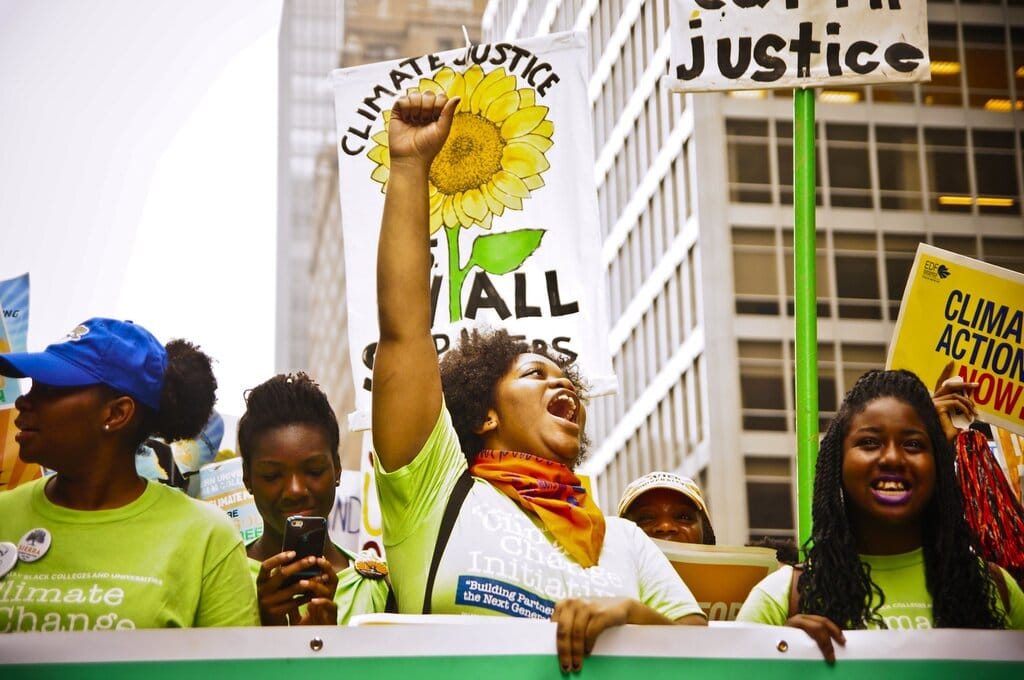
Less than three percent of global climate money supports “just transition” efforts, which make sure vulnerable communities, women, and workers are not left behind in the transition to a green economy, according to a recent research by ActionAid International.
According to the report, Climate Finance for Just Transition and How the Finance Flows, this shockingly low funding level shows how communities most affected by the climate crisis are being neglected, leading to harmful practices that deepen inequality.
The findings come just days before COP30, the United Nations Climate Change Conference, in Brazil, where ActionAid is calling for urgent global coordination on just transition efforts.
ActionAid, an organisation that supports communities impacted by the climate crisis, analysed data from two major global climate funds – the Green Climate Fund and the Climate Investment Funds.
It found that only 1.96 percent (one in 50 projects) adequately support people through just transition, while just one US dollar in every 35 goes toward such efforts.
The organisation said there is an urgent need to move away from fossil fuels and industrial agriculture toward renewable energy and agroecology – but in a way that protects jobs, rights, and livelihoods. Just transition efforts, it said, should involve communities in planning, provide retraining, and offer income support when polluting industries close.
ActionAid International Secretary General Arthur Larok said climate action must not come at the expense of the poor and working class.
“Our new report shows just transition approaches are jaw-droppingly underfunded, and people’s needs are at the bottom of the priority list. Something’s got to give. If just transition continues to be overlooked, then there’s a real risk that inequalities will deepen,” said Larok.
Report author and ActionAid’s Global Lead on Climate Justice, Teresa Anderson, said climate action must go hand in hand with social justice.
“No one should have to choose between a secure job and a safe planet. Just transition approaches make sure that climate action prioritises people’s daily needs and doesn’t accidentally push people deeper into poverty. Without them, climate action risks unintended harm, backlash, and evermore delay,” said Anderson.
The report also highlights the consequences of neglecting local communities, including stories of exploitation by industrial agriculture and fossil fuel companies in the Global South.
In Brazil’s legal Amazon region, for instance, a community near Timbiras has faced years of intimidation as deforestation expands.
“They want to push us out to grow corn, soya, or cattle. They just want to grab this land,” said a babassu coconut breaker, who depends on the forest for her livelihood.
ActionAid reported that farmers in the region have used aerial pesticide attacks from planes and drones, causing serious health issues for residents. While pesticide spraying has since been banned, enforcement remains weak and deforestation continues.
Jessica Siviero, Climate Justice Specialist at ActionAid Brazil, said industrial agriculture remains one of the biggest threats to the Amazon and Cerrado ecosystems.
“The Amazon forest acts as the lungs of planet earth, while the Cerrado serves as its veins, carrying life and connecting vital ecosystems. COP30 coming to Belem puts the spotlight on industrial agriculture’s role in driving Amazon and Cerrado destruction,” said Siviero.
“It’s time for the world to move away from harmful industrial agriculture and towards agroecological approaches that feed people and cool the planet. Just transition approaches need to be applied to agriculture as well.”
With one week to go before COP30 begins in Belem, Brazil ActionAid is urging world leaders to establish a global mechanism to coordinate just transition efforts.
The organisation and its allies are proposing the creation of a “Belem Action Mechanism” to provide shared learning, coordination, and implementation of fair transition plans.
“This is a critical opportunity for global climate action to evolve for the better,” said Anderson.
“COP30 needs to deliver on a global plan for just transition to support and reassure those on the frontlines, and to unleash the action our planet so urgently needs.”
COP30, the United Nations Climate Change Conference, will take place in Belem, Brazil, from 10 to 21 November 2025, bringing together global leaders to chart the next steps in tackling the climate crisis.
Leave a comment