

Zimbabwe’s veterinary authorities have confirmed a serious outbreak of Foot and Mouth Disease (FMD) in Mangwe District, near the Botswana border, threatening local livelihoods and triggering immediate trade restrictions from a key regional neighbour.
FMD is a highly contagious viral disease that does not affect humans but leads to severe loss of productivity in livestock.
For small-scale farmers in Mangwe, already facing climatic and economic pressures, this FMD outbreak represents an existential threat to their primary assets.
In an official communication, also shared to the Southern African Development Community (SADC) Directors of Veterinary Services, Chief Director of Zimbabwe’s Directorate of Veterinary Services, Dr Pious Makaya, said the outbreak first broke out on January 5, 2026, at the Maholi and Hannavale dip tanks in Mangwe.
“Investigations suggest that the source of the infection may have been buffaloes which were sighted in the communal areas two months before the outbreak,” Dr Makaya said.
Laboratory tests confirmed the presence of the FMD SAT 1 serotype.
According to the chief veterinarian, clinical signs were observed in cattle across various age groups, with 54 confirmed cases out of a census of 2 403 cattle in the affected area.
“Further analysis is underway with epithelial tissues sent to the (World Organisation for Animal Health) OIE FMD reference laboratory in Botswana for typing and vaccine matching,” Dr Makaya said.
The outbreak comes at a critical time for farmers who had begun the year with optimism following good seasonal rains.
“Just as we were celebrating good rains, reports of a foot-and-mouth disease outbreak have emerged in my area,” said a distressed communal farmer from Mangwe who requested anonymity.
“While adult cattle often survive, calves are highly vulnerable. I hope the authorities act swiftly to contain this. Livestock farming is becoming increasingly risky, one season you battle drought, the next it’s January disease, now foot-and-mouth. For farmers, it feels like you’re always one crisis away from losing everything.”
To control the spread of the disease, Dr Makaya said the urgent control measures currently underway include, “strict quarantine enforcement, movement control, vaccinations within a 20 kilometre radius, surveillance in and around the affected areas and awareness campaigns.”
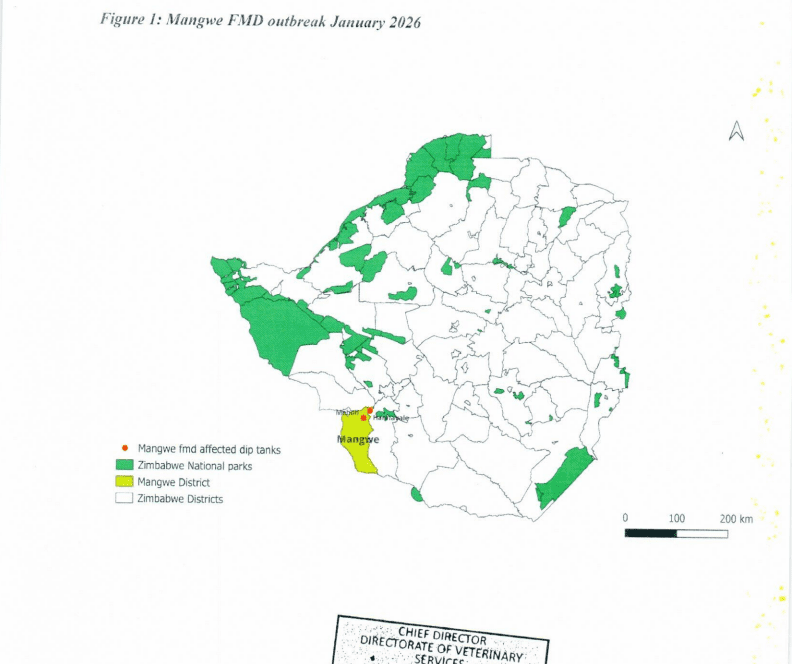
A map attached to the notification delineates the outbreak location in the western part of Mangwe District, highlighting its proximity to the international boundary.
This outbreak has also affected Zimbabwe’s neighbours, who have put their livestock industry on high alert.
In South Africa, reports said farmers who were still grappling with previous FMD challenges, had heightened anxiety.
Lloyd Hadebe of the African Farmers Association of South Africa was reported saying that over 600 of their members in Limpopo and other northern provinces are deeply worried about vaccine availability and cross-border transmission.
Most decisively, Botswana reacted by announcing an immediate ban on the importation of cloven-hoofed livestock and related products from Zimbabwe.
Reports stated that acting director of Veterinary Services for Botswana, Kobedi Segale, said to prevent FMD from spreading into Botswana’s national herd, farmers in border districts had to become more vigilant and strictly follow FMD prevention protocols,
Segale imposed stringent movement controls, stating that movement of cloven-hoofed animals out of, into and within zones 3b, 3c (Maitengwe), 6b and 7 is not allowed except for direct slaughter.
“The livestock from these zones are not eligible for export or slaughter for export.”
Segale urged farmers to report any suspected FMD symptoms, such as lameness, drooling, or mouth and hoof ulcers, as well as any sightings of Zimbabwean livestock straying across the border or attempts at illegal importation of animals, raw meat, or milk.
Support CITE’s fearless, independent journalism. Your donation helps us amplify community voices, fight misinformation, and hold power to account. Help keep the truth alive. Donate today