

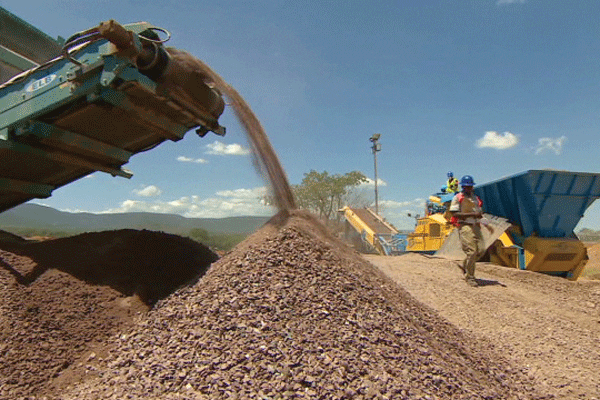
Legislators have urged Government to enforce laws that compel mining companies to reinvest in local development in different mining communities.
This came out during Parliament session yesterday where Members of Parliament where weighing on the State of the Nation Address that was delivered by President Emmerson Mnangagwa to open the third session of the 10th Parliament.
Contributing to debate on the State of the Nation Address, MP Judith Tobaiwa said mining communities continue to suffer from crumbling roads, collapsing infrastructure, and poor access to health services while both local and foreign miners extract millions in minerals.
“What really touched me from the State of the Nation Address, when we look at the different areas where we come from, we have a lot of minerals. I desire that these minerals should benefit the people of Zimbabwe because this is a resource that can build our nation because when we look at where we are coming from, looking at the roads, they are deteriorating. We do not have funds for road rehabilitation,” she said.
“We know ZINARA is rehabilitating the roads but it does not have enough resources, so we need to have good roads that will be able to link up Zimbabwe and other countries. You would find haulage trucks coming to Zimbabwe, crossing into other countries. These countries bring money through the haulage trucks.”
Tobaiwa said a lot of miners are failing to build schools and clinics in communities where they are mining.
“When we also look at the areas that we come from, a lot of miners cannot build schools and clinics, which are meant to help the communities but they are making a lot of money from the communities. We have miners who are coming from other countries. They just come to mine and take the profits to their countries.”
She said Zimbabweans need to be empowered so that they can do mining locally instead of empowering foreigners.
“They cannot develop our nation more than our local people, so those who are into mining can develop local schools. In the past few years, we had a situation where Globe and Phoenix where I come from, the school collapsed because of artisanal mining, which was being done under the school. However, I want to thank Latter-day Saints for intervening and rebuilding the school.”
“However, I request that for those who will be mining, they should be able to build schools because they are making money through mining. Yes, churches are there, but those who are mining should pay and rebuild schools and clinics so that our children will benefit from their mining.”
“You would find that students who are learning at a particular school are disadvantaged when a school collapses because those who are mining would not play any part in rebuilding the school. We have many minerals in Zimbabwe. It is important that mining companies build hospitals,” she said.
Tobaiwa told Parliament that a lot of people in mining communities contract a lot of diseases and they need health care, yet nearby hospitals remain under-equipped.
“When you look at the area that I am coming from, there is a prevalent disease. A lot of our young people are dying. They go to hospitals and cannot find any assistance but a lot of money is being extracted by the miners who are extracting minerals from these areas,” she said.
“The President spoke about minerals that are found in Zimbabwe and their utility in terms of developing Zimbabwe. I would like to say that those who are into mining should inject funds back into the community so that local communities can benefit from their mining activities,” said Tobaiwa.
In addition, MP Joseph Mapiki said the country needs to adopt sustainable mining.
“For gold, there should be laws that govern mining so that the mining process becomes safe for everyone. Then those different players who are in the mining sector should do their jobs properly, following the law and also preserving our environment,” he said.
Mapiki added, “Then the issue of pollution of our environment, for example, mining in mountains results in a lot of heat being radiated, which affects even precipitation and affects the rainfall patterns.”
Support CITE’s fearless, independent journalism. Your donation helps us amplify community voices, fight misinformation, and hold power to account. Help keep the truth alive. Donate today
Leave a comment